
Euler's Eyes
2024-07-10
Point Power
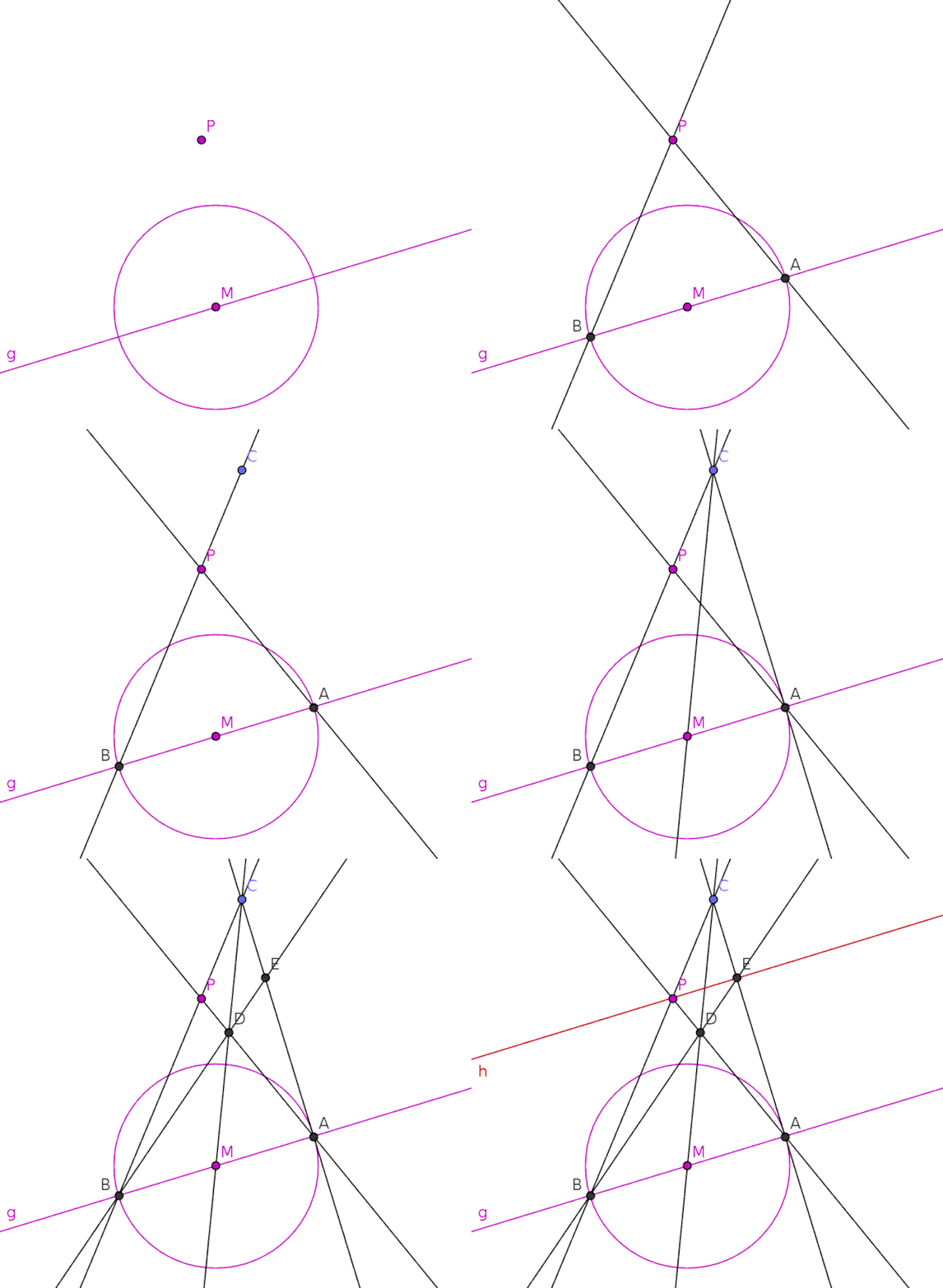
In previous posts we talked about inscribed angle. The power of a point is a real number that reflects the relative distance of a given point to a given circle. To understand this better, imagine you have a point A outside a circle. Draw two secants of A that intersect the circle at two points each. The power of point A is then defined as the product of the distances from A to one point of intersection with the product of the distances from A to the other point of intersection on the other secant.
This concept becomes even more interesting when the point is inside the circle. In this case, the power is negative and is equal to the product of the distances from the point to the intersections of a chord passing through it. The beauty of the power of a point lies in its simplicity and the elegance of the relationships it establishes between the various parts of a circle.

The power of a point has several applications, from solving complex geometric problems to understanding fundamental properties of geometric figures. For example, it can be used to prove theorems related to tangency and secance, and to explore the properties of triangles and polygons inscribed in circles.
History
The history of Point Power dates back to Ancient Greece, with mathematicians such as Euclid and Archimedes, who laid the foundations of Euclidean geometry and contributed to the development of potentiation. Although there are no specific records of a single “discoverer” of the Point Power, it is certain that these ancient mathematicians and many others throughout history contributed to the development of this concept.

Power of Point teaching is an essential part of the high school mathematics curriculum, preparing students for more advanced concepts such as the Pythagorean Theorem and Trigonometry. Furthermore, understanding this topic strengthens logical and critical thinking, creating a link between theory, abstract notions and real applications, reinforcing the relevance of mathematics in everyday life.
Point power
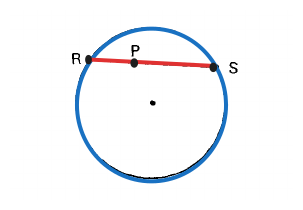
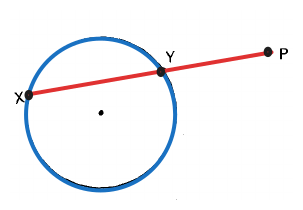
Let a point $P$ be positioned somewhere in the plane, in relation to a circle $\lambda$, the possible cases are:
| $P$ is interior to $\lambda$ | $P$ is exterior to $\lambda$ |
|---|---|
|
|
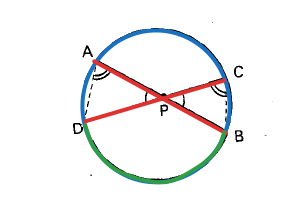
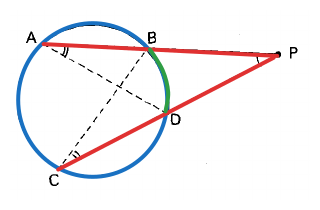
Note that through $P$ pass two competing lines that intersect the circle at $A$, $B$, $C$ and $D$. Therefore, the power of the point is divided into the following cases:
| $P$ is interior to $\lambda$ | $P$ is exterior to $\lambda$ |
|---|---|
|
|
| If two chords of the same circle intersect, then the product of the measurements of the two parts of one is equal to the product of the measurements of the two parts of the other. | If through a point $P$ rcterior to a circle we conduct two secant segments $PA$ and $PC$, then the product of the measurement of the first $\overline{PA}$ by the outer part $\overline{PB}$ is equal to product |
In both cases, the triangles $PAD$ and $PCB$ and with a common angle $\hat{P}$ we have:
$$\hat{A} = \hat{C} = \frac{\stackrel{\frown}{BD}}{2}$$From triangles $PAD$ and $PCB$, we use triangle similarity:
$$\frac{PA}{PC} = \frac{PD}{PB}$$Consequently:
$$PA ~.~ PB = PC ~.~ PD$$Generalization
Case 1: $P$ is interior to $\lambda$
Let the strings be $\overline{AB}$, $\overline{CD}$, $\overline{EF},\dots$, $\overline{MN}$, We fix the string $\overline{AB}$ for comparison and we get:
$$PA ~.~ PB = PC ~.~ PD$$$$PA ~.~ PB = PE ~.~ PF$$
$$PA ~.~ PB = PG ~.~ PH$$
$$ \vdots \qquad \vdots$$
$$PA ~.~ PB = PM ~.~ PN$$
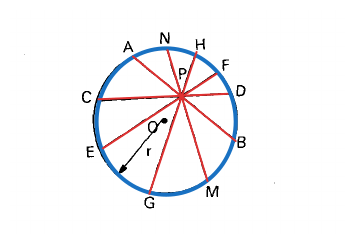
Note that once the point and the circle are fixed, we have that $PA ~.~ PB$ is constant, whatever the string $\overline{AB}$ passing through $P$. With this, we define:
Definition: the product $PA ~.~ PB$ is called the power of the point $P$ with respect to the circle.
$$PA ~.~ PB = PC ~.~ PD = PE ~.~ PF = PG ~.~ PH = \dots = PM ~.~ PN = \text{ Power of P in relation to the circumference } \lambda( O,r)$$
Case 2: $P$ is exterior to $\lambda$
Let the secant segment $\overline{PA}$ be its outer part $\overline{PB}$ and be a segment $\overline{PT}$ tangent to $\lambda$.
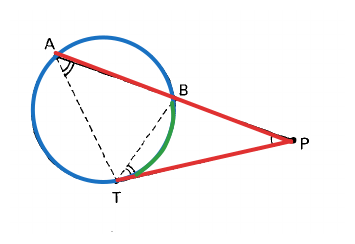
Let the triangles be $PAT$ and $PTB$, we have:
$$\hat{A} = \hat{T} = \frac{\stackrel{\frown}{TB}}{2}$$From triangles $PAT$ and $PTB$, we use the similarity of triangles:
$$\frac{PA}{PT} = \frac{PT}{PB}$$Consequently:
$$PA ~.~ PB = PT^2$$which is a particular case, for the case of one of the straight lines secant to the circle.
Analogously to case 1, with the previous result, we have:
Definition: the product $PA ~.~ PB$ is called the power of the point $P$ with respect to the circle.
$$PA ~.~ PB = PC ~.~ PD = PE ~.~ PF = PG ~.~ PH = \dots = PM ~.~ PN = PT^2= \text{ Power of P in relation to the circumference } \lambda(O,r)$$
Solved exercises
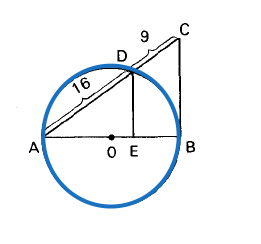
- Determine the measurement of the segment $\overline{DE}$, knowing that $\overline{AB}$ is the diameter of the circle, $B$ is the point of tangency of the segment $\overline{BC}$ to the circle and $\overline{DE}$ is parallel to $\overline{BC}$
Resolution:
When using the power of the point we have:
$$BC^2 = 9~.~25$$$$BC = \sqrt{9~.~25} = 3~.~5 = 15$$
Now from the similarity of triangles $ABC$ and $ADE$:
$$\frac{BC}{DE}=\frac{AC}{AD}$$$$\frac{15}{DE}=\frac{25}{16}$$
$$DE=\frac{15~.~16}{25} = \frac{3 ~.~\cancel{5}^1~.~16}{5~.~\cancel{5}}$$
$$DE=\frac{48}{5}$$
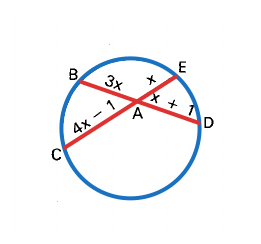
- From the figure, calculate the measurements of the strings $\overline{BD}$ and $\overline{CE}$.
Resolution:
From the power of the point we have:
$$AB ~.~ AD = AC ~.~ AE$$$$3x (x+1) = (4x-1) x$$
Since $x=0$ is absurd, since $A$ does not belong to the points of the circle. In this case:
$$3\cancel{x} (x+1) = (4x-1) \cancel{x}$$$$3 (x+1) = 4x-1$$
$$3x+3 = 4x-1$$
$$x = 4$$
From this we get
$$BD = 3x+x+1=17$$$$CE = 4x-1+x=19$$
Considerations
The power of a point is a wonderful example of how mathematics can be both simple and profoundly complex. She invites us to explore the world of plane geometry with a new look, appreciating the harmony and beauty that mathematical relationships can reveal. Whether you are a student, an educator or simply someone passionate about mathematics, the journey of studying the power of a point will certainly be enriching and inspiring. Here a small contribution was made to Potência do Ponto, wait for the next posts.