
Euler's Eyes
2024-07-01
Position relative to the Circumference
In previous posts we talked about Introduction to Circumference. Mathematics is a fascinating science that allows us to understand and describe the world around us with precision and beauty. One of the most interesting topics within geometry is the study of the relative positions between straight lines and circles. This field of study has a rich history, marked by significant discoveries made by mathematicians over the centuries.

The relative positions of a straight line in relation to a circle can be classified into three main categories:
- exterior,
- drying and
- tangent.

A straight line is considered exterior to a circle when there are no points in common between them. A straight line is secant when it cuts the circle at two distinct points, and tangent when it touches the circle at just one point.

History
The mathematicians who contributed to the development of these concepts come from different eras and cultures. From the ancient Greeks such as Euclid, who laid the foundations of plane geometry, to modern mathematicians who continue to expand our understanding of geometric properties and relationships.
Euclid of Alexandria, often referred to as the “Father of Geometry”, is a central figure in the history of mathematics. His influence is so profound that his work, “The Elements”, remains one of the most important and widely studied texts in mathematics to this day.

A classic example of the contribution of mathematicians to this field is the secant property, which states that if a secant line and a circle intersect at two distinct points, then the line that passes through the center of the circle and the midpoint of the chord formed by the intersection points is perpendicular to the secant. This property has been explored and proven by mathematicians throughout history, and is an example of the beauty and simplicity found in geometry.
Another important contribution is the study of tangent properties. The tangent to a circle is always perpendicular to the radius at the point of tangency, a discovery that has practical implications in many areas, from engineering to art.
Secant
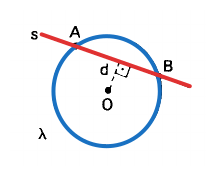
The straight line is secant when it intersects the circle at two different points. In this case, the distance from the center of the circle to the straight line is smaller than the radius of the circle. The secant divides the circle into two arcs and the part of the straight line that is inside the circle is called the chord.
Definition: A straight line secant to a circle is a straight line that intersects the circle at two distinct points.
$$s\cap \lambda = \\{A,B\\}$$
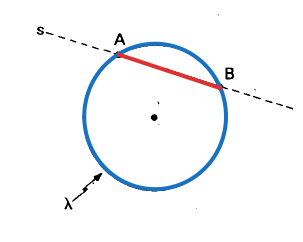
Secant properties
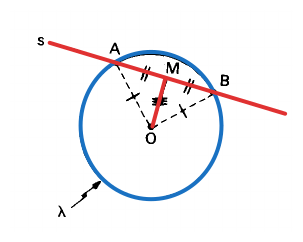
a) If a straight line $s$, secant to a circle $\lambda(O,r)$ does not pass through the center $O$, it intersects $\lambda$ at the different points $A$ and $B$ if $M$ is the midpoint of the chord $\overline{AB}$ then the straight line $\overleftrightarrow{OM}$ is perpendicular to the secant $s$ or to the chord $\overline{AB}$.
In symbols:
$M$ is the midpoint of the chord $\overline{AB}$ with $M\neq O$, so $\overline{OM}\perp \overline{AB}$.
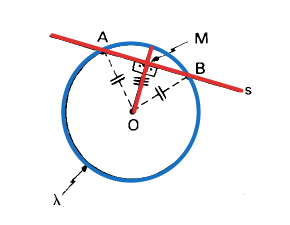
b) If a straight line $s$, secant to a circle $\lambda(O,r)$ does not pass through the center $O$, it intersects $\lambda$ at the different points $A$ and $B$ , then the perpendicular to $s$ led by the center passes through the midpoint of the chord $\overline{AB}$.
In symbols:
$OM$ perpendicular to the string $\overline{AB}$, then $\overline{AM}\equiv \overline{MB}$
Tangent
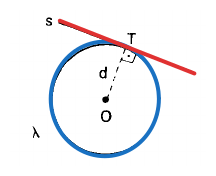
A straight line is tangent to the circle if it touches the circle exactly at one point. The distinguishing feature of a tangent is that it is perpendicular to the radius of the circle at the point of tangency. The distance from the center of the circle to the tangent line is exactly equal to the radius of the circle.
A tangent line to a circle is a straight line that intersects the circle at a single point.
The tangent line to a circle has a common point with the circle and the other points on the line are external to the circle.
The common point is the point of tangency.
$$t \cap \lambda = \\{T\\}$$
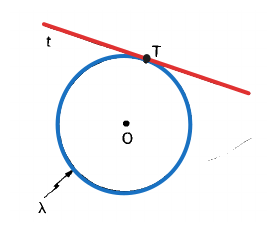
This is a topic widely used in higher education, more specifically, in differential calculus (derivatives). Widely used in engineering and other exact areas, such as physics.

Tangent properties
a) Every straight line perpendicular to a radius at its end of the circle is tangent to the circle
If the circle $\lambda (O,r)$ and $T$ is one of its points.
If $t\perp \overline{OT}$ in $T$, then $t$ is tangent to $\lambda$.
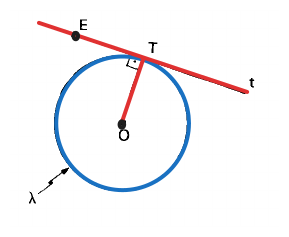
b) Every tangent to a circle is perpendicular to the radius at the point of tangency.
If the circle $\lambda (O,r)$ and $T$ is one of its points.
If $t$ tangent to $\lambda$ in $T$, then $t \perp \overline{OT}$ in $T$.
Exterior
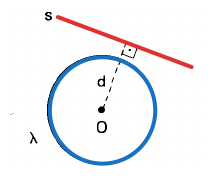
A straight line is considered exterior to the circle when there are no points in common between them, that is, the straight line does not touch or cross the circle at any point. This occurs when the distance from the center of the circle to the straight line is greater than the radius of the circle.
A straight line outside a circle is a straight line that does not intersect the circle.
$$e \cap \lambda = \varnothing$$
Relative positions of the straight line to a circle
These relationships are important for solving problems involving the intersection of lines and circles, such as finding points of tangency or calculating the area of figures that include segments of circles. Furthermore, they are applied in different areas, such as engineering, architecture and even navigation.
Let there be a straight line $s$, a circle $\lambda(O,r)$ and with $d$ being the distance from the center $O$ to the straight line $s$, we define $d=d_{O,s}$ we have three possibilities for $s$ and $\lambda$:
| $s$ and $\lambda$ secants | $s$ and $\lambda$ tangents | external $s$ and $\lambda$ |
|---|---|---|
|
|
|
| $s\cap \lambda = \\{A,B\\}$ | $s\cap \lambda = \\{T\\}$ | $s\cap \lambda = \varnothing$ |
| $d < r$ | $d=r$ | $d>r$ |
Relative positions of two circles
The relative positions of two circles are a fundamental concept in analytical geometry, offering a rich understanding of the spatial relationships between circular shapes in a plane. This concept not only has practical applications in various areas, such as engineering and design, but also challenges the mind to visualize and solve complex geometric problems.
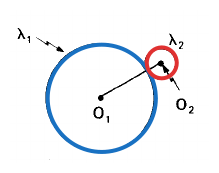
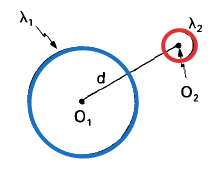
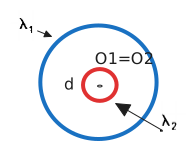
There are five main relative positions that two circles can assume:

-
Tangent Circles: Occurs when circles share exactly one point in common. They can be internal tangents, with one circle inside the other, or external tangents, where they are side by side.
-
Secant Circles: They are characterized by having two points in common. This happens when the distance between the centers of the circles is less than the sum of the radii and greater than the difference between them.
-
External Circumferences: These are those that do not have any points in common and the distance between their centers is greater than the sum of the radii.
-
Internal Circumferences: One circle is completely contained within the other without sharing any points.
-
Concentric Circumferences: Both share the same center, but do not have common points on the edge, as they have different radii.
Analyzing these relative positions is crucial to understanding how circles interact with each other, which is essential for solving problems involving properties such as tangency and intersection. For example, in designing mechanical parts that fit together, understanding relative positions can ensure that parts move smoothly without colliding.
For students and professionals who deal with geometry, mastering this topic opens doors to better interpreting diagrams and improving the ability to solve complex spatial problems. The beauty of mathematics lies in its ability to describe the world around us with precision and elegance, and the relative positions of circles are a perfect example of this.
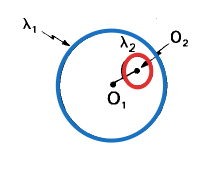
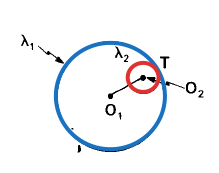
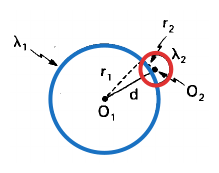
Let two circles be $\lambda_1 (O_1,r_1)$ and $\lambda_2 (O_2,r_2)$ with $r_1> r_2$ and $d$ the distance between the centers.
| $\lambda_2$ internal to $\lambda_1$ | $\lambda_2$ internal tangent to $\lambda_1$ | $\lambda_2$ and $\lambda_1$ secants |
|---|---|---|
|
|
|
| $d < r_1 - r_2$ | $d=r_1 - r_2$ | $r_1 - r_2 < d < r_1 + r_2$ |
| Internal Circumferences | Tangent Circles | Secant Circumferences |
| $\lambda_2$ external tangent to $\lambda_1$ | $\lambda_2$ external to $\lambda_1$ | $\lambda_2$ internal to $\lambda_1$ |
|---|---|---|
|
|
|
| $d = r_1 + r_2$ | $d>r_1 + r_2$ | $d=0$ |
| Tangent Circles | External Circumferences | Concentric Circumferences |
Here a small contribution was made to positions relative to the circumference, wait for the next posts.