
Euler's Eyes
2022-12-03
Introduction to Angles
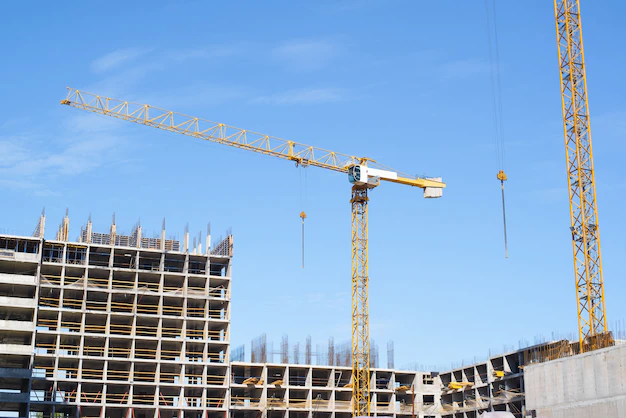
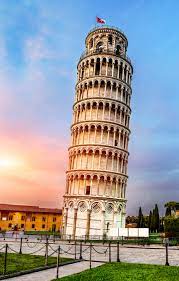
Angles are key parts for the development of geometry. It is present in our daily life as stairs, building cranes, constructions like the tower of Pisa, among others. In the book Elements of Euclid, this concept was well worked, even in decades before Christ.
Examples of angle applications
Next, we present some applications of angles.
| Building Crane | Leaning Tower of Pisa | Ladder |
|---|---|---|
|
|

|
A very used example is the clock, with movement of the hour and minute hands, the angles are formed and the time is defined.

Introduction to angles
Definition (Angles): is defined as the union of two half-lines with the same origin, not contained in the same line, that is, not collinear.
$$AÔB = \overrightarrow{OA}\cup \overrightarrow{OB}$$

- the angle $AÔB$ is equal to the union between the half-lines $\overrightarrow{OA}$ and $\overrightarrow{OB}$
- the point $O$ is the vertex (intersection between the half-lines) of the angle.
- the rays $\overrightarrow{OA}$ and $\overrightarrow{OB}$ are sides of the angle.
Consecutive angles
Definition (Consecutive Angles): two angles are consecutive if and only if one side of one of them is also the side of the other.

- $AÔB$ and $AÔC$ are consecutive angles
- $\overrightarrow{OA}$ is the common side
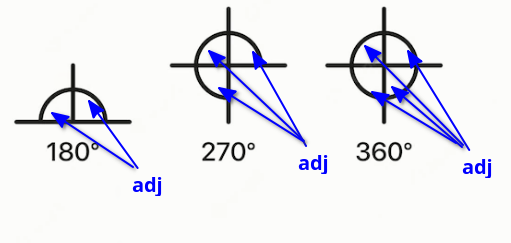
Adjacent Angle
Definition: Two angles are said to be adjacent, when they have a common side and these angles are side by side (neighbors).
- $AÔB$ and $BÔC$ are adjacent angles
- $\overrightarrow{OB}$ is the common side
Opposite angles by vertex
Definition: two angles are said to be vertex-opposite if the rays are concurrent.
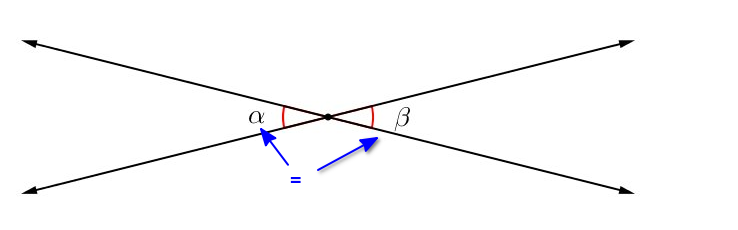
From the figure, we notice that
- $\alpha \equiv \beta$
- the angles $\alpha$ and $\beta$ are equal.
Are the angles equal?
In fact,
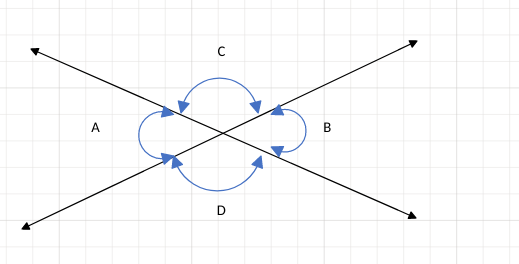
From the post angles in planes we have:
- the angles $C$ and $B$ are supplementary $C + B = 180^\circ$
- likewise $C$ and $A$ are supplementary $C + A = 180^\circ$
- With that, we have $C + B = C + A$
- Logo $B=A$
- Therefore, the apex-opposite angle property holds.
From the figure we get:
$$A=B \qquad \text{e} \qquad C=D$$Wait for the next posts with consequences of this subject.