
Euler's Eyes
2022-12-15
Angle Comparison
Angle comparisons are important for properties that will be used in later posts.
Congruence
Congruence in angles is a concept that is similar to equality of numbers. Here congruence is used with the symbol ($\equiv$) and this primitive notion satisfies the postulates:
- Reflective
- every angle is congruent to itself.
- $\widehat{ab} \equiv \widehat{ab}$
- Symmetric
- If $\widehat{ab} \equiv \widehat{cd}$ then $\widehat{cd} \equiv \widehat{ab}$
- Transitive
- If $\widehat{ab} \equiv \widehat{cd}$ and $\widehat{cd} \equiv \widehat{ef}$ then $\widehat{ab} \equiv \widehat{ef}$

Angle Transport
Angle transport postulate: given an angle $a\hat{o}b$ and a half-line $\overrightarrow{oe}$ of a plane, exists on this plane and one of the half-planes that $\ overrightarrow{oe}$ allows to determine a single straight line $\overrightarrow{of}$ that forms with $\overrightarrow{oe}$ an angle that is congruent to the angle $a\hat{o}b$

Comparison of angles
In comparing angles, we will use the angle transport postulate;
- Angle $\widehat{ab}$ greater than $\widehat{cd}$

- Angle $\widehat{ab}$ congruent to $\widehat{cd}$

- Angle $\widehat{ab}$ less than $\widehat{cd}$

Add angles
If the ray $ob $ is internal to the angle $a\hat{o}c$, the angle $a\hat{o}c$ is the sum of the angles $a\hat{o}b$ and $b \hat{o}c$.


Angle Bisector
Definition: the bisector of an angle is a ray, which starts from the vertex of the angle and divides it into two congruent angles ($\cong$).
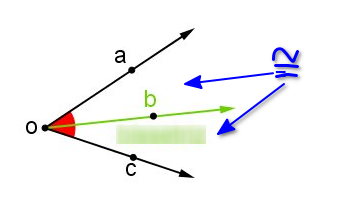
From the figure, we notice that
- $\angle \widehat{aob} \cong \angle\widehat{boc}$
- Angle $\widehat{aob}$ is congruent to angle $\widehat{boc}$.
- The ray b is the bisector of this angle.
These are concepts of comparing angles. Wait for the next posts with consequences of this matter.