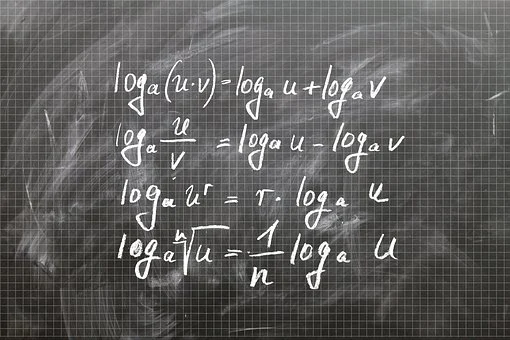
From the semiotically active logarithm notation (abbreviated Mirabilis) we obtain the properties that are used in current times. Next, we present the properties. Law of Multiplication (Multiplicatio Canon) $$ \begin{aligned} \displaystyle \log_{2^6} 64 &= \\ &= \log_{2^6} 4~.~16 = \log_{2^2} 4 + \log_{2^4} 16 \\ &= \log_{2^6} 8~.~8 = \log_{2^3} 4 + \log_{2^3} 16 \\ &= \log_{2^6} 2~.~32 = \log_{2^1} 2 + \log_{2^5} 32 \\ \end{aligned} $$ $$\log_{C} A~.~B = \log_{C} A + \log_{C} B$$ Law of division (Tangentiplus Canon) $$ \begin{aligned} \log_{2^4} \frac{64}{4} &= \log_{2^6} 64 - \log_{2^2} 4 \\ \log_{5^1} \frac{125}{25} &= \log_{5^3} 125 - \log_{5^2} 25 \end{aligned} $$ $$\log_{C} \frac{A}{B} = \log_{C} A - \log_{C} B$$ Law of Power (Potestati Canon) $$ \begin{aligned} \log_{2^6} 4^3 &= \log_{2^6} 64\\ &= \log_{2^6} 4 ~.~ 4 ~.~ 4\\ &\overset{\text{Multiplicatio Canon}}{=} \log_{2^2} 4 + \log_{2^2} 4 + \log_{2^2} 4\\ &= 3~.~\log_{2^2} 4\\ \end{aligned} $$ $$\log_{C} A^B = B~.~\log_{C} A$$ Application for Planck constant To understand the power of this notation, let’s calculate Planck’s constant.