Logo Euler's Eyes
  • Dark Theme
    Light Theme Dark Theme System Theme
Logo Inverted Logo
  • Tags
  • 1 Phase
  • 1st Phase
  • 2 Phase
  • 2 Phase,
  • 2nd Phase
  • 2° Degree Equation
  • Alan Turing
  • Algebra
  • Algebraic Expressions
  • Analysis
  • Analytic Geometry
  • Analytical Geometry
  • Angle Bisector
  • Angle Measurements
  • Angles
  • Apothem
  • Arc Capable
  • Arc Properties
  • Archimedes
  • Area
  • Arithmetic Progression
  • Artificial Intelligence
  • Axioms and Postulates
  • Basic Concepts of Statistics
  • Bernoulli
  • Bhaskara
  • Binary Numbers
  • Binomial
  • Biography
  • Calculating Machine
  • Calculation
  • Calculus
  • Calculus of Variations
  • Cartesian Plane
  • Cartesian Product of Sets
  • Cauchy
  • Central Angle
  • Centroid
  • Children
  • Circle
  • Circle Area
  • Circumcenter
  • Circumference
  • Circumference Ratio
  • Circumferences
  • Circumscript Segments
  • Classification in Mathematics
  • Combinatorial Analysis
  • Combinatorics
  • Comparison of Angles
  • Complement
  • Complex Numbers
  • Compound Interest
  • Computing
  • Concave Region
  • Congruence
  • Congruence of Triangles
  • Convex Region
  • Correspondence Law
  • Cosine Theorem
  • Count
  • Cryptography
  • Decision Theory
  • Demo
  • Derivative
  • Descartes
  • Diagonals
  • Diamond
  • Differential Equations
  • Dispersion Measures
  • Distance
  • Division
  • Domain and Image
  • Einstein
  • Elasticity
  • Electromagnetism
  • Elementary Descriptive Statistics
  • Elementary School I
  • Elementary School II
  • ENEM 2021
  • ENEM 2022
  • ENEM 2023
  • ENEM 2024
  • ENEM 2025
  • Entrance Exam
  • Equality
  • Equations
  • Equiprobable Events
  • Equivalence Between Sets
  • Equivalence Relations
  • Euclid
  • Euclid's Postulate
  • Euler
  • Euler Project
  • Even Numbers
  • Exercises for Adding Natural Numbers
  • Exponential Function
  • External Angles
  • Fees
  • Fermat
  • Fermat's Last Theorem
  • Financial Mathematics
  • First Degree Equations
  • First Degree Functions
  • Flat
  • Flat Figures
  • Flat Geometry
  • Fractions
  • Function Concept
  • Function Discovery
  • Functions
  • FUVEST 2021
  • FUVEST 2022
  • FUVEST 2023
  • FUVEST 2024
  • FUVEST 2025
  • FUVEST 2026
  • Galois
  • Game Theory
  • Gauss
  • Geometric Constructions
  • Geometric Shapes
  • Geometry
  • Geometry With Natural Numbers
  • Geometry With Sequences of Numbers
  • Golden Segment
  • Graph Reading
  • Graphics
  • Graphs for Integers
  • Gravitation
  • Greatest Common Divisor
  • Group Theory
  • Groups
  • Hamilton
  • Height
  • History of Mathematics
  • Incenter
  • Increases and Discounts
  • Inequalities
  • Inscribable Quadrilateral
  • Inscribed Angle
  • Integral
  • Internal Angles
  • Interval Operations
  • Intervals
  • Introduction
  • Introduction to Angles
  • Introduction to Circumference
  • Introduction to Function Theory
  • Introduction to Geometry
  • Introduction to Integers
  • Introduction to Logarithm Table
  • Introduction to Polygons
  • Introduction to Probability
  • Introduction to Quadrilaterals
  • Introduction to Radiciation
  • Introduction to Rational Numbers
  • Introduction to Real Numbers
  • Introduction to Sets
  • Introduction to Statistics
  • Introduction to Triangles
  • Johann Bernoulli
  • John Napier
  • John Nash
  • Kids
  • Lagrange
  • Language
  • Law of Cosines
  • Law of Sines
  • Least Common Multiple
  • Leibniz
  • Level 1
  • Level 2
  • Level 3
  • Limit
  • Linear Systems
  • Logarithm
  • Logarithm Properties
  • Logarithms
  • Logic
  • Magnification
  • Math Elements
  • Mathematical Biology
  • Mathematical Logic
  • Mathematical Notation
  • Mathematical Programming
  • Mathematics Education
  • Mathematics Elements
  • Mathematics for Children
  • Mathematics for Kids
  • Matrices
  • Maxwell
  • Measure
  • Mechanics
  • Medium Base
  • Metric Relationships
  • Midpoint
  • Modular Function
  • Multiplication
  • Napier
  • Natural Number Subtraction Exercises
  • Newton
  • Niels Henrik Abel
  • Notable Points of the Triangle
  • Notation
  • Notion of Infinity
  • Notions of Probability
  • Nth Root
  • Number And
  • Number Theory
  • Number Π
  • Numbering Systems
  • Numerical Calculation
  • Numerical Methods
  • OBMEP
  • OBMEP 2023
  • Obmep,
  • Odd Numbers
  • Operations With Rational Numbers
  • Operations With Sets
  • Operations With Venn-Euler Diagrams
  • Optics
  • Optimization
  • Orthocenter
  • Parallelism
  • Parallelogram
  • Parallels
  • Partial Derivatives
  • Pascal
  • Pascal's Triangle
  • Peano Axioms
  • Peirce
  • Percentage
  • Percentage Basics
  • Perimeter
  • Perpendicular Bisector
  • Perpendicularity
  • Perpendiculars
  • Philosophy
  • Physical
  • Physics
  • Pi Number
  • Pi Numbers
  • Pitot
  • Plane Geometry
  • Point
  • Point Power
  • Polygons
  • Polynomials
  • Position Measurements
  • Position Relative to the Circumference
  • Postulates
  • Potentiation of Integers
  • Power With Negative Exponent
  • Prime Numbers
  • Primitive Notions
  • Principia
  • Probability
  • Progressions
  • Proof
  • Properties
  • Properties of Polygons
  • Proportion
  • Proportionality
  • Proportions
  • Proportions and Geometry
  • Pure Mathematics
  • Pythagoras Theorem
  • Pythagorean Suits
  • Quadratic Function
  • Quadrilateral
  • Quadrilaterals
  • Quantifier
  • Quantity Analysis
  • Quaternions
  • R Programming
  • Real Numbers
  • Rectangle
  • Rectangle Triangles
  • Reduction
  • Reflection
  • Regions in Planes
  • Regular Polygons
  • Relations
  • Relationship Properties
  • Relativity
  • Rhombus
  • Right Angle
  • Right Triangle
  • Right Triangle Relationships
  • Rule of 3
  • Rule of Three
  • Saussure
  • Segment Angle
  • Semi-Inscribed Angle
  • Semi-Straight
  • Semiotics
  • Sequences
  • Series
  • Set Family
  • Set Partition
  • Set Theory
  • Signal Rule
  • Similarity
  • Similarity of Triangles
  • Simple Interest
  • Sines Theorem
  • Sophie Germain
  • Spatial Geometry
  • Square
  • Square Root
  • Statistic
  • Stewart Ratio
  • Straight
  • Straight Lines
  • Straight Segment
  • Sum of Angles
  • Supplement
  • Symmetry
  • Tangent
  • Thales' Theorem
  • The Number Zero
  • Theorems
  • Trapezium
  • Trapezius
  • Triangle
  • Triangles
  • Triangular Inequality
  • Trigonometry
  • Truth Table
  • Understanding Relationships
  • Vectors
  • Venn-Euler Diagrams
  • Whole Numbers
  • Wiles
  • Women in Mathematics
  • Year 2018
  • Year 2019
  • Year 2021
  • Year 2022
  • Évariste Galois
Hero Image
Interest that never ends and the number e

Imagine a generous bank that pays 100% interest a year. You deposit 1 dollar in January and, in December, you have 2 dollars. Now the bank offers something else: instead of 100% at the end of the year, it pays 50% every six months, and the interest from the first half also earns interest in the second. Is it worth it? And if it paid every month, every day, every second? Could you become infinitely rich?

October 14, 2026 Read
Hero Image
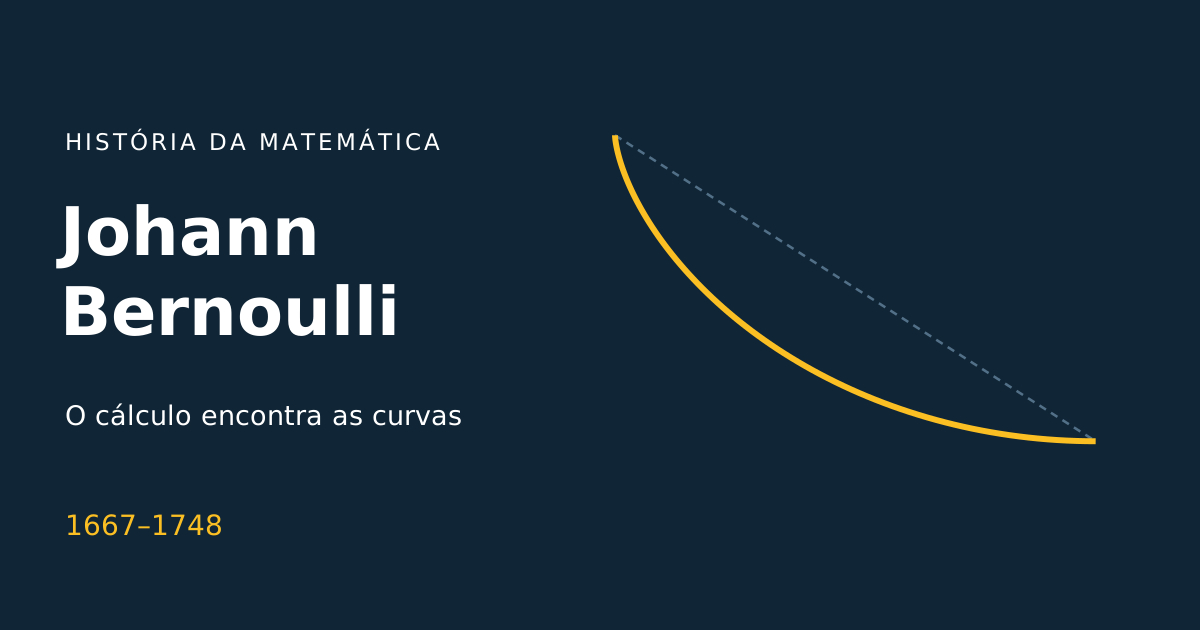
The calculus of variations: a letter from a 19-year-old

The calculus of Newton and Leibniz can find the highest point of a curve: it is where the derivative vanishes. But there are questions of another kind. What is the shortest path between two points? What shape should a slide have so that a ball runs down it fastest? What curve does a hanging chain make? In these questions the answer is not a number but a whole curve, chosen from infinitely many possible curves.

October 14, 2026 Read
Hero Image
The catenary: the hanging chain

Ut pendet continuum flexile, sic stabit contiguum rigidum inversum. (As hangs the flexible line, so but inverted will stand the rigid arch.) — Robert Hooke, anagram deciphered in 1705 Take a thin chain by its two ends and let it hang. It forms a beautiful curve that looks like a parabola. Galileo, in 1638, thought it really was a parabola, at least approximately. The Dutchman Christiaan Huygens, at 17, showed that it could not be. But what curve it was, nobody knew.

October 14, 2026 Read
Hero Image
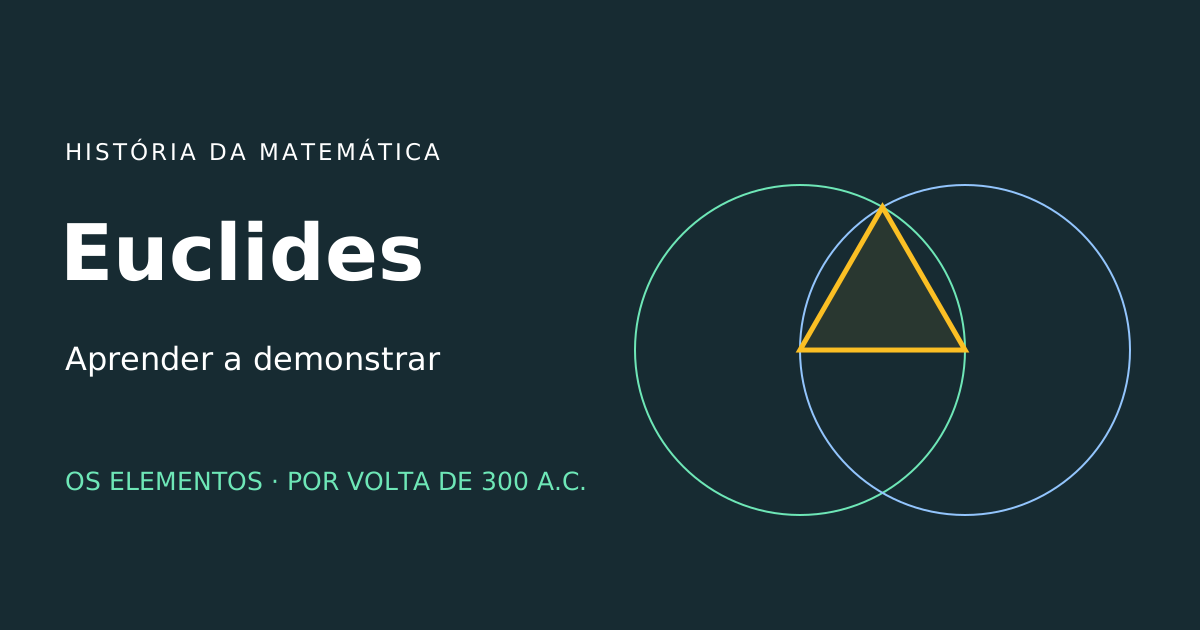
The Elements: definitions, postulates and common notions

A point is that which has no part. A line is breadthless length. — Euclid, Elements, Book I, Definitions 1 and 2 Imagine you want to convince someone, beyond any possible doubt, that the angles of a triangle always add up to 180°. Measuring is not enough: the protractor makes errors, and you can only measure a few triangles. You need an argument. But every argument starts from something. Where should you start? If every claim must be justified by another, and that one by another, the chain never ends.

October 14, 2026 Read
Hero Image
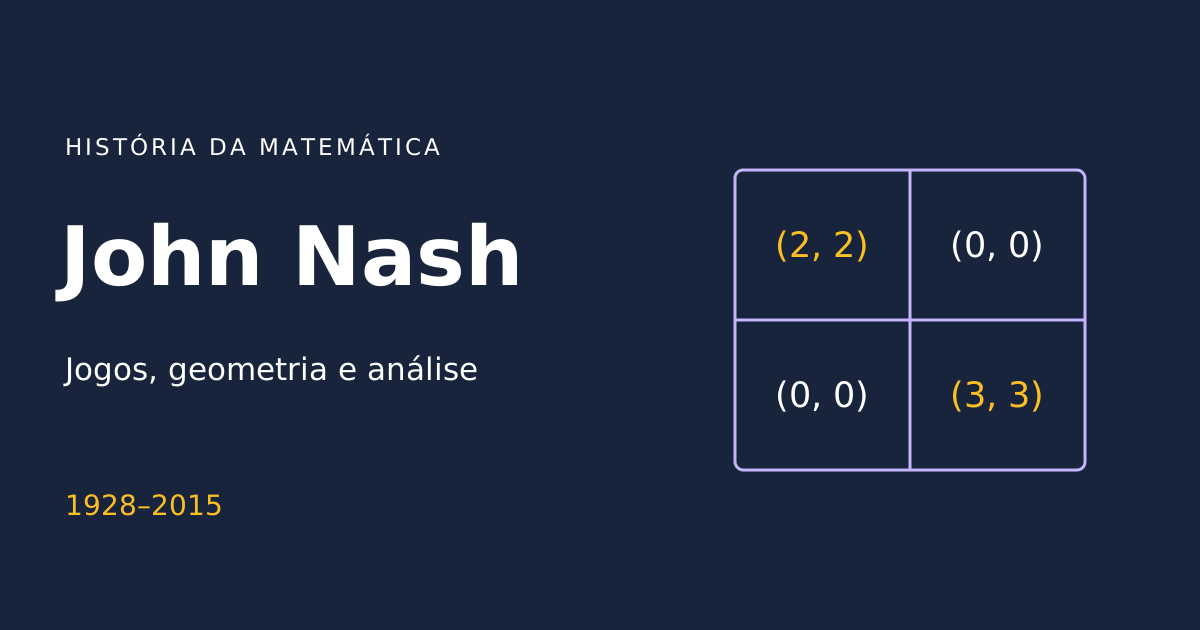
The game of Hex: why the first player wins

In 1948, in the common room of the Princeton mathematics building, where professors and students played chess and Go in the afternoons, John Nash presented a new game. The board is a rhombus covered with hexagonal cells, like a honeycomb. Two players, red and blue, take turns placing pieces, one at a time, on empty cells. The pieces never move. Red wants to form a chain of red pieces joining the top edge to the bottom one; blue, a blue chain joining the left edge to the right one.

October 14, 2026 Read
Hero Image
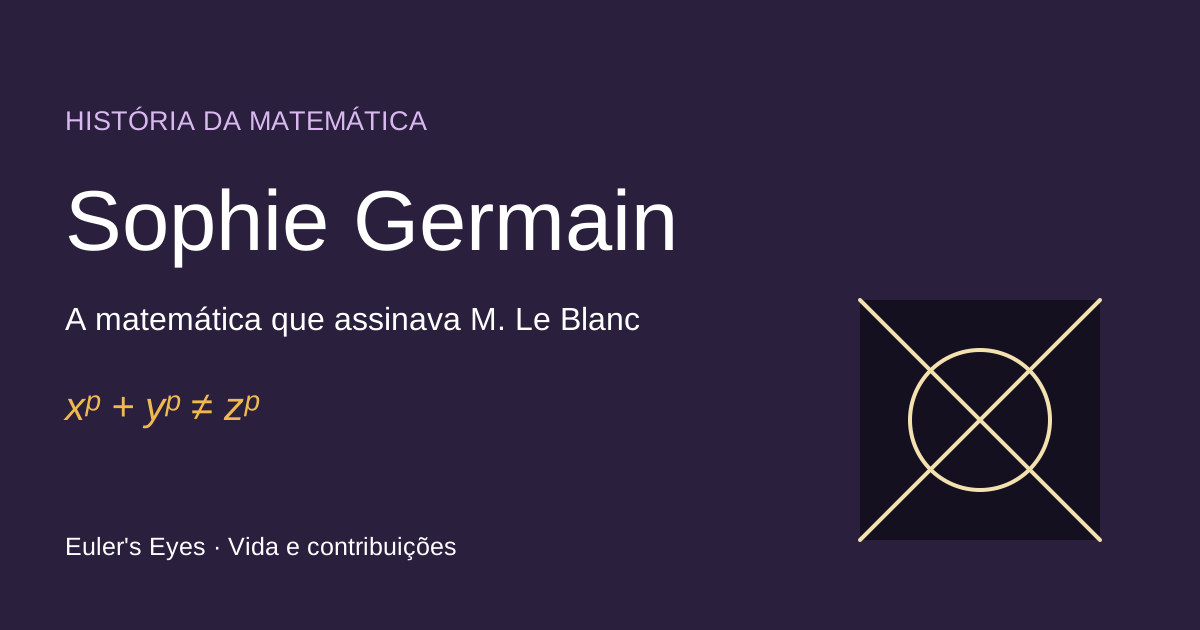
The letters of Monsieur Le Blanc: the arithmetic of remainders

When Sophie Germain wrote to Gauss in 1804, the two spoke a language that had just been born. Three years earlier, in the Disquisitiones Arithmeticae, Gauss had introduced a new sign, $\equiv$, and a new way of thinking about whole numbers: not by what they are, but by the remainder they leave on division. Everything Sophie later did on Fermat was written in that language. It is worth learning. Clock arithmetic If it is 9 o’clock now, what time will it be in 5 hours? Nobody answers 14 on a clock with hands: they answer 2. The clock keeps only the remainder on division by 12. Gauss wrote this as

October 14, 2026 Read
Hero Image
The photoelectric effect: light comes in packets

It deals with radiation and the energy properties of light and is very revolutionary. — Albert Einstein, letter to Conrad Habicht (May 1905) In May 1905 Einstein wrote to his friend Conrad Habicht announcing four papers. Of the four, he called only one revolutionary, and it was not relativity: it was the paper on light, sent to the Annalen der Physik in March. It was for this paper that Einstein won the Nobel Prize.

October 14, 2026 Read
Hero Image
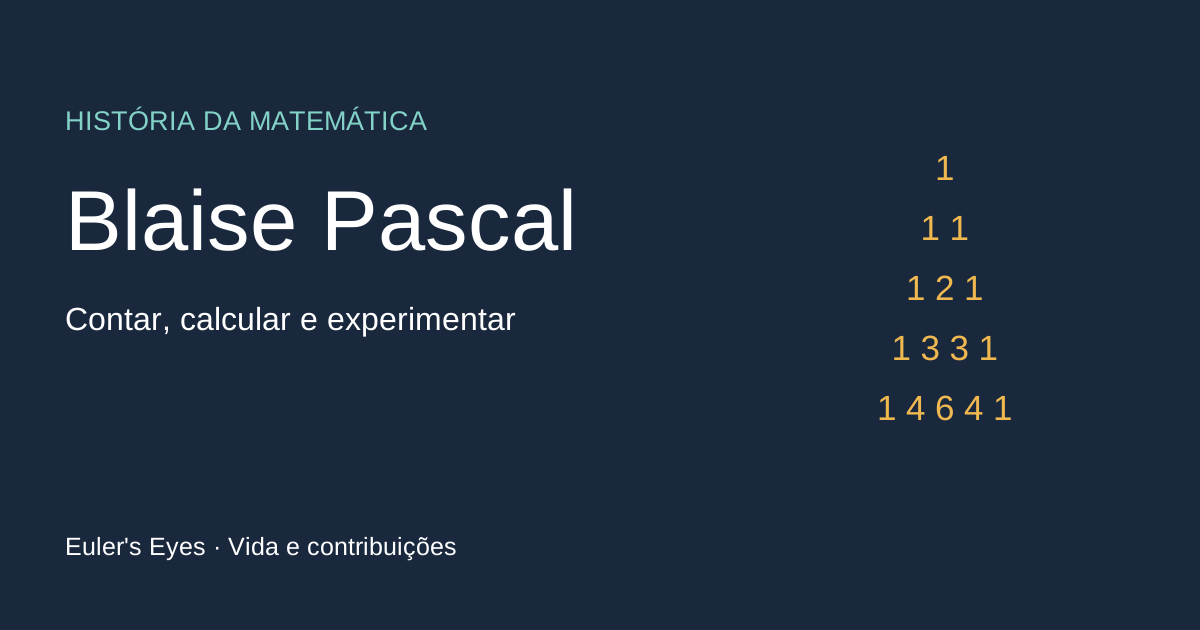
Pascal's triangle: build it by adding

Write a $1$. Below it, two $1$s. From then on, each row starts and ends with $1$, and each number in between is the sum of the two numbers just above it: $$\begin{array}{ccccccccccc} &&&&&1&&&&&\\ &&&&1&&1&&&&\\ &&&1&&2&&1&&&\\ &&1&&3&&3&&1&&\\ &1&&4&&6&&4&&1&\\ 1&&5&&10&&10&&5&&1 \end{array}$$That is all. A rule a child learns in a minute produces one of the richest tables in mathematics. Today it is called Pascal’s triangle, but Pascal was one of the last to find it.

October 11, 2026 Read
Hero Image
Fermat and analytic geometry: a curve in an equation

For almost two thousand years, geometry and algebra lived apart. Greek geometry worked with ruler, compass and figures. Algebra, which reached Europe through the Arabs, worked with equations. At the start of the 17th century, two people had, at the same time and without consulting each other, the idea of joining them: René Descartes and Pierre de Fermat. A sentence that created a field Around 1636 Fermat wrote a short Latin text, Introduction to plane and solid loci. “Locus” was the Greek name for a set of points satisfying a condition, like the circle, the locus of points at a fixed distance from the centre. Right at the start, Fermat wrote:
October 11, 2026 Read
Hero Image
Leibniz's notation: a language for change

In signs one observes an advantage in discovery which is greatest when they express the exact nature of a thing briefly and, as it were, picture it; then indeed the labour of thought is wonderfully diminished. — Leibniz, letter to Tschirnhaus (1678) Newton reached calculus first, but it was Leibniz who decided how it would be written. And the writing made all the difference. The letter d On 11 November 1675, in a manuscript written in Paris, Leibniz began using the letter $d$ for an infinitely small difference. The $d$ comes from the Latin differentia, from the verb differre, “to carry apart”. So:

October 11, 2026 Read
Hero Image
The generalized binomial: beyond whole-number powers

At school we learn to expand $(1+x)^2=1+2x+x^2$ and $(1+x)^3=1+3x+3x^2+x^3$. The coefficients come from the arithmetic triangle, which Pascal studied and which was known long before him. For positive whole-number exponents, the expansion always stops. In the winter of 1664–1665, still a student, Newton asked a question nobody had asked so boldly: what if the exponent were $\frac12$? Or $-1$? What would $(1+x)^{1/2}$, that is $\sqrt{1+x}$, look like as a sum of powers of $x$?

October 11, 2026 Read
Hero Image
The sum of 1 to 100

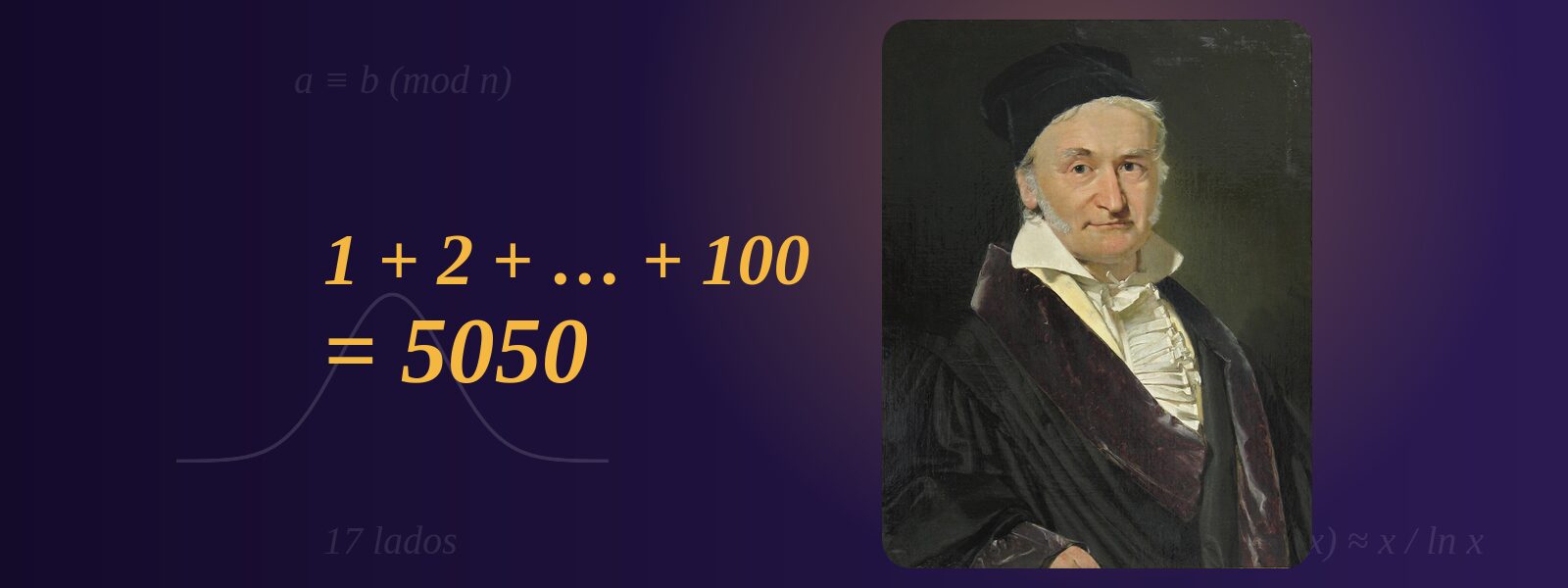
Gauss’s most famous story is from when he was about 9 years old. To keep the class busy, the Professor Büttner told the students to add up all the numbers from 1 to 100. In a few seconds, Gauss placed the blackboard on the table with the correct answer: 5050. (The story was told by the first biographer of Gauss, and the exact numbers in the account may have been different, but the idea is the same.)

October 10, 2026 Read
  • ««
  • «
  • 1
  • 2
  • 3
  • 4
  • 5
  • »
  • »»
Navigation
  • Start here
  • Recent posts
  • About Euler
  • App
  • Privacy
Contact me:
  • hirowat2@gmail.com

Euler's Eyes
© 2021 Euler Eyes.
Powered by Hugo Logo