Logo Euler's Eyes
  • Dark Theme
    Light Theme Dark Theme System Theme
Logo Inverted Logo
  • Tags
  • 1 Phase
  • 1st Phase
  • 2 Phase
  • 2 Phase,
  • 2nd Phase
  • 2° Degree Equation
  • Alan Turing
  • Algebra
  • Algebraic Expressions
  • Analysis
  • Analytic Geometry
  • Analytical Geometry
  • Angle Bisector
  • Angle Measurements
  • Angles
  • Apothem
  • Arc Capable
  • Arc Properties
  • Archimedes
  • Area
  • Arithmetic Progression
  • Artificial Intelligence
  • Axioms and Postulates
  • Basic Concepts of Statistics
  • Bernoulli
  • Bhaskara
  • Binary Numbers
  • Binomial
  • Biography
  • Calculating Machine
  • Calculation
  • Calculus
  • Calculus of Variations
  • Cartesian Plane
  • Cartesian Product of Sets
  • Cauchy
  • Central Angle
  • Centroid
  • Children
  • Circle
  • Circle Area
  • Circumcenter
  • Circumference
  • Circumference Ratio
  • Circumferences
  • Circumscript Segments
  • Classification in Mathematics
  • Combinatorial Analysis
  • Combinatorics
  • Comparison of Angles
  • Complement
  • Complex Numbers
  • Compound Interest
  • Computing
  • Concave Region
  • Congruence
  • Congruence of Triangles
  • Convex Region
  • Correspondence Law
  • Cosine Theorem
  • Count
  • Cryptography
  • Decision Theory
  • Demo
  • Derivative
  • Descartes
  • Diagonals
  • Diamond
  • Differential Equations
  • Dispersion Measures
  • Distance
  • Division
  • Domain and Image
  • Einstein
  • Elasticity
  • Electromagnetism
  • Elementary Descriptive Statistics
  • Elementary School I
  • Elementary School II
  • ENEM 2021
  • ENEM 2022
  • ENEM 2023
  • ENEM 2024
  • ENEM 2025
  • Entrance Exam
  • Equality
  • Equations
  • Equiprobable Events
  • Equivalence Between Sets
  • Equivalence Relations
  • Euclid
  • Euclid's Postulate
  • Euler
  • Euler Project
  • Even Numbers
  • Exercises for Adding Natural Numbers
  • Exponential Function
  • External Angles
  • Fees
  • Fermat
  • Fermat's Last Theorem
  • Financial Mathematics
  • First Degree Equations
  • First Degree Functions
  • Flat
  • Flat Figures
  • Flat Geometry
  • Fractions
  • Function Concept
  • Function Discovery
  • Functions
  • FUVEST 2021
  • FUVEST 2022
  • FUVEST 2023
  • FUVEST 2024
  • FUVEST 2025
  • FUVEST 2026
  • Galois
  • Game Theory
  • Gauss
  • Geometric Constructions
  • Geometric Shapes
  • Geometry
  • Geometry With Natural Numbers
  • Geometry With Sequences of Numbers
  • Golden Segment
  • Graph Reading
  • Graphics
  • Graphs for Integers
  • Gravitation
  • Greatest Common Divisor
  • Group Theory
  • Groups
  • Hamilton
  • Height
  • History of Mathematics
  • Incenter
  • Increases and Discounts
  • Inequalities
  • Inscribable Quadrilateral
  • Inscribed Angle
  • Integral
  • Internal Angles
  • Interval Operations
  • Intervals
  • Introduction
  • Introduction to Angles
  • Introduction to Circumference
  • Introduction to Function Theory
  • Introduction to Geometry
  • Introduction to Integers
  • Introduction to Logarithm Table
  • Introduction to Polygons
  • Introduction to Probability
  • Introduction to Quadrilaterals
  • Introduction to Radiciation
  • Introduction to Rational Numbers
  • Introduction to Real Numbers
  • Introduction to Sets
  • Introduction to Statistics
  • Introduction to Triangles
  • Johann Bernoulli
  • John Napier
  • John Nash
  • Kids
  • Lagrange
  • Language
  • Law of Cosines
  • Law of Sines
  • Least Common Multiple
  • Leibniz
  • Level 1
  • Level 2
  • Level 3
  • Limit
  • Linear Systems
  • Logarithm
  • Logarithm Properties
  • Logarithms
  • Logic
  • Magnification
  • Math Elements
  • Mathematical Biology
  • Mathematical Logic
  • Mathematical Notation
  • Mathematical Programming
  • Mathematics Education
  • Mathematics Elements
  • Mathematics for Children
  • Mathematics for Kids
  • Matrices
  • Maxwell
  • Measure
  • Mechanics
  • Medium Base
  • Metric Relationships
  • Midpoint
  • Modular Function
  • Multiplication
  • Napier
  • Natural Number Subtraction Exercises
  • Newton
  • Niels Henrik Abel
  • Notable Points of the Triangle
  • Notation
  • Notion of Infinity
  • Notions of Probability
  • Nth Root
  • Number And
  • Number Theory
  • Number Π
  • Numbering Systems
  • Numerical Calculation
  • Numerical Methods
  • OBMEP
  • OBMEP 2023
  • Obmep,
  • Odd Numbers
  • Operations With Rational Numbers
  • Operations With Sets
  • Operations With Venn-Euler Diagrams
  • Optics
  • Optimization
  • Orthocenter
  • Parallelism
  • Parallelogram
  • Parallels
  • Partial Derivatives
  • Pascal
  • Pascal's Triangle
  • Peano Axioms
  • Peirce
  • Percentage
  • Percentage Basics
  • Perimeter
  • Perpendicular Bisector
  • Perpendicularity
  • Perpendiculars
  • Philosophy
  • Physical
  • Physics
  • Pi Number
  • Pi Numbers
  • Pitot
  • Plane Geometry
  • Point
  • Point Power
  • Polygons
  • Polynomials
  • Position Measurements
  • Position Relative to the Circumference
  • Postulates
  • Potentiation of Integers
  • Power With Negative Exponent
  • Prime Numbers
  • Primitive Notions
  • Principia
  • Probability
  • Progressions
  • Proof
  • Properties
  • Properties of Polygons
  • Proportion
  • Proportionality
  • Proportions
  • Proportions and Geometry
  • Pure Mathematics
  • Pythagoras Theorem
  • Pythagorean Suits
  • Quadratic Function
  • Quadrilateral
  • Quadrilaterals
  • Quantifier
  • Quantity Analysis
  • Quaternions
  • R Programming
  • Real Numbers
  • Rectangle
  • Rectangle Triangles
  • Reduction
  • Reflection
  • Regions in Planes
  • Regular Polygons
  • Relations
  • Relationship Properties
  • Relativity
  • Rhombus
  • Right Angle
  • Right Triangle
  • Right Triangle Relationships
  • Rule of 3
  • Rule of Three
  • Saussure
  • Segment Angle
  • Semi-Inscribed Angle
  • Semi-Straight
  • Semiotics
  • Sequences
  • Series
  • Set Family
  • Set Partition
  • Set Theory
  • Signal Rule
  • Similarity
  • Similarity of Triangles
  • Simple Interest
  • Sines Theorem
  • Sophie Germain
  • Spatial Geometry
  • Square
  • Square Root
  • Statistic
  • Stewart Ratio
  • Straight
  • Straight Lines
  • Straight Segment
  • Sum of Angles
  • Supplement
  • Symmetry
  • Tangent
  • Thales' Theorem
  • The Number Zero
  • Theorems
  • Trapezium
  • Trapezius
  • Triangle
  • Triangles
  • Triangular Inequality
  • Trigonometry
  • Truth Table
  • Understanding Relationships
  • Vectors
  • Venn-Euler Diagrams
  • Whole Numbers
  • Wiles
  • Women in Mathematics
  • Year 2018
  • Year 2019
  • Year 2021
  • Year 2022
  • Évariste Galois
Hero Image
The harmonic series and the call for help

Even as the infinite series is contained by the finite sum, and in the unbounded a bound is discerned, so the soul of immensity dwells in the minute, and in the narrowest limits there are no limits. — Jakob Bernoulli, Tractatus de seriebus infinitis (1689) Between 1689 and 1704, Jakob Bernoulli published in Basel five dissertations on infinite series, sums with infinitely many terms. It was a new and dangerous subject. Some of these sums give a number, like

October 14, 2026 Read
Hero Image
The Nash equilibrium: nobody does better alone

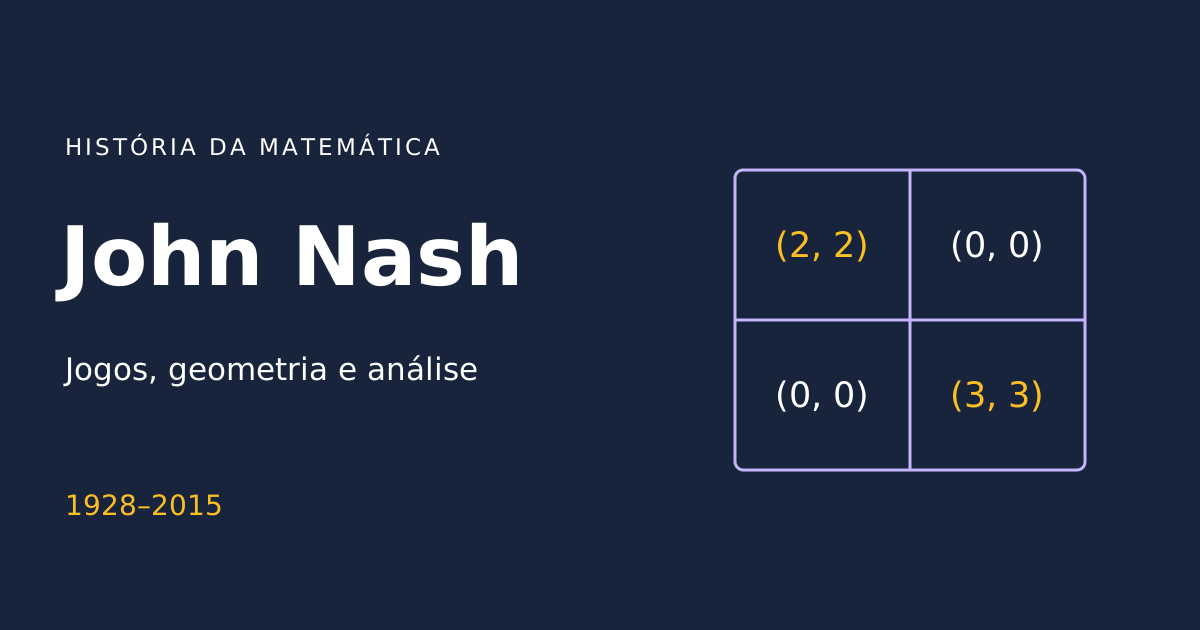
An equilibrium point is an n-tuple such that each player’s mixed strategy maximizes his payoff if the strategies of the others are held fixed. — John Nash, Proceedings of the National Academy of Sciences (1950) In 1944 John von Neumann and the economist Oskar Morgenstern published Theory of Games and Economic Behavior, a huge book that turned strategic decisions into mathematics: card games, wars, markets. Von Neumann’s great result applied to two-player zero-sum games, in which what one wins the other loses, like chess or poker. But most of life is not like that: in a trade deal, a negotiation or traffic, both sides can win together, or lose together.

October 14, 2026 Read
Hero Image
Combinations: counting without listing

In Brazil’s Mega-Sena lottery you choose 6 numbers out of 60. How many different tickets are there? Listing them all would take a lifetime: there are more than fifty million. But you can count without listing, and Pascal showed how. Choosing without order Start with a small case: in how many ways can you choose 2 people out of a group of 5 to form a committee? If order mattered, there would be $5$ options for the first person and $4$ for the second: $5\cdot4=20$. But on a committee “Ana and Bruno” is the same as “Bruno and Ana”, and every pair has been counted twice. There are $20/2=10$ committees.

October 11, 2026 Read
Hero Image
Maxima and minima: the rectangle with the largest area

You have 24 metres of fencing and want to enclose a rectangular plot with the largest possible area. Which dimensions should you choose? A long thin rectangle wastes fencing; a square seems better. But how do you prove it? Fermat invented a method for questions like this around 1636, more than thirty years before Newton and almost fifty before Leibniz published calculus. Fermat’s problem Fermat’s first example was exactly this: divide a segment of length $b$ into two parts, $x$ and $b-x$, so that the product $x(b-x)$ is as large as possible. That is our plot: with 24 m of fencing, two adjacent sides add up to $12$, and the area is

October 11, 2026 Read
Hero Image
The product rule: two changes in one calculation

If you know how $u$ changes and how $v$ changes, how does the product $uv$ change? The natural guess is to multiply the changes: $d(uv)=du\cdot dv$. It looks so symmetrical, so elegant… Leibniz made the same guess. Leibniz tests and fails In the same manuscript of 11 November 1675 in which he began using the letter $d$, Leibniz asked himself whether $d(xy)$ would equal $dx\,dy$, and whether $d\!\left(\frac xy\right)$ would equal $\dfrac{dx}{dy}$. Instead of trusting elegance, he tested it with an example and found it did not. A few days later he found the right rule.

October 11, 2026 Read
Hero Image
Fluxions: how to measure an instantaneous change

A car leaves one city and reaches another, 90 km away, in one hour. Its average speed was 90 km/h. But at every instant the speedometer showed a different number. What exactly does it measure? Speed is distance divided by time, but in an instant no distance is covered and no time passes. Dividing zero by zero gives no answer. That was the question Newton wanted to answer in 1665. His answer was the method of fluxions.

October 11, 2026 Read
Hero Image
The 17 sided polygon

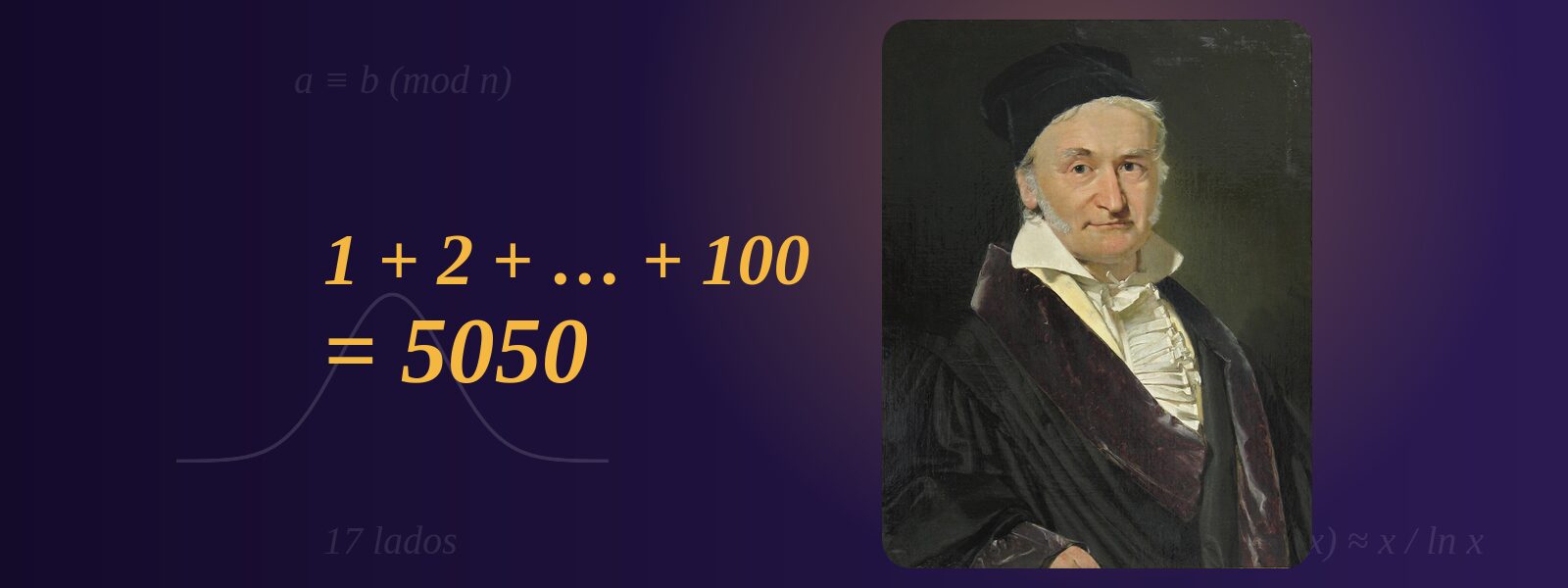
Since the Greeks, it was known how to construct regular polygons with 3, 4, 5 and 15 sides with a ruler and compass, and all that come out of them doubling the number of sides (6, 8, 10, 12…). For 2000 years, no one found another. Gauss showed that constructing the $n$ sided polygon is the same as calculating $\cos\frac{2\pi}{n}$ using only integers, the four operations and square roots. And ruler and compass know how to take root square: it is exactly the construction that we saw in the chapter on Descartes. For 17 sides, he reached
October 10, 2026 Read
Hero Image
Square root with ruler and compass

Geometry begins by showing that arithmetic operations can be done with segments. The most beautiful is the square root. To find $\sqrt{a}$: Draw on a straight line a segment $AB$ of length 1 and then a segment $BC$ of length $a$. Draw a semicircle with diameter $AC$. Lift a perpendicular through $B$ until you find the semicircle at point $D$. Then $BD = \sqrt{a}$. Change the value of a: the height BD is always √a. For a = 4, 9 or 2,25 the root is exact. Ative o JavaScript para ver esta figura interativa.

October 10, 2026 Read
Hero Image
The Basel problem

In 1650, Pietro Mengoli asked how much the sum of the inverse squares is worth: $$1 + \frac{1}{4} + \frac{1}{9} + \frac{1}{16} + \frac{1}{25} + \cdots = \sum_{n=1}^{\infty} \frac{1}{n^2} = \ ?$$ The Bernoullis tried and failed. The sum grows slowly: with 10 terms it gives $1{,}5498$, with 100 terms gives $1{,}6350$, with 1000 terms gives $1{,}6439$. No one recognized the number to which she walked. See the figure: each bar is the sum up to $N$ terms.

October 10, 2026 Read
Hero Image
Computable numbers: almost every number is impossible to calculate

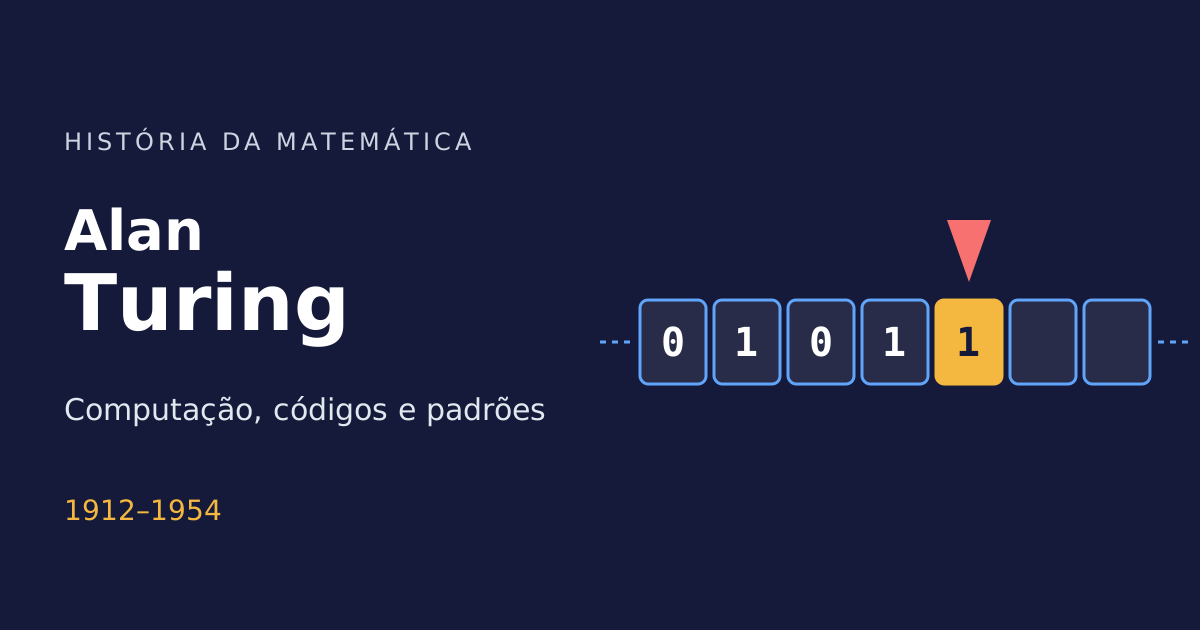
The title of the 1936 paper does not talk about machines. It talks about numbers: “On computable numbers”. Turing defined them like this: a real number is computable when there is a machine that writes out, one after another, all of its digits, without ever getting any wrong. Who is computable Almost all the numbers that appear at school are computable. Fractions: $\frac17=0.142857142857\ldots$ The machine does the long division and repeats the cycle forever. Roots: $\sqrt2=1.41421356\ldots$ To find the next digit, the machine tests from 0 to 9 which is the largest that, when appended, still gives a number whose square does not exceed 2. $\pi$ and $e$: there are series that approximate them as closely as we like, such as $e=1+\frac1{1!}+\frac1{2!}+\frac1{3!}+\cdots$, and with them a machine produces any digit, sooner or later. It looks as if every “real” number is computable. And here comes the surprise: almost none is.

October 16, 2026 Read
Hero Image
Briggs and base-10 logarithms

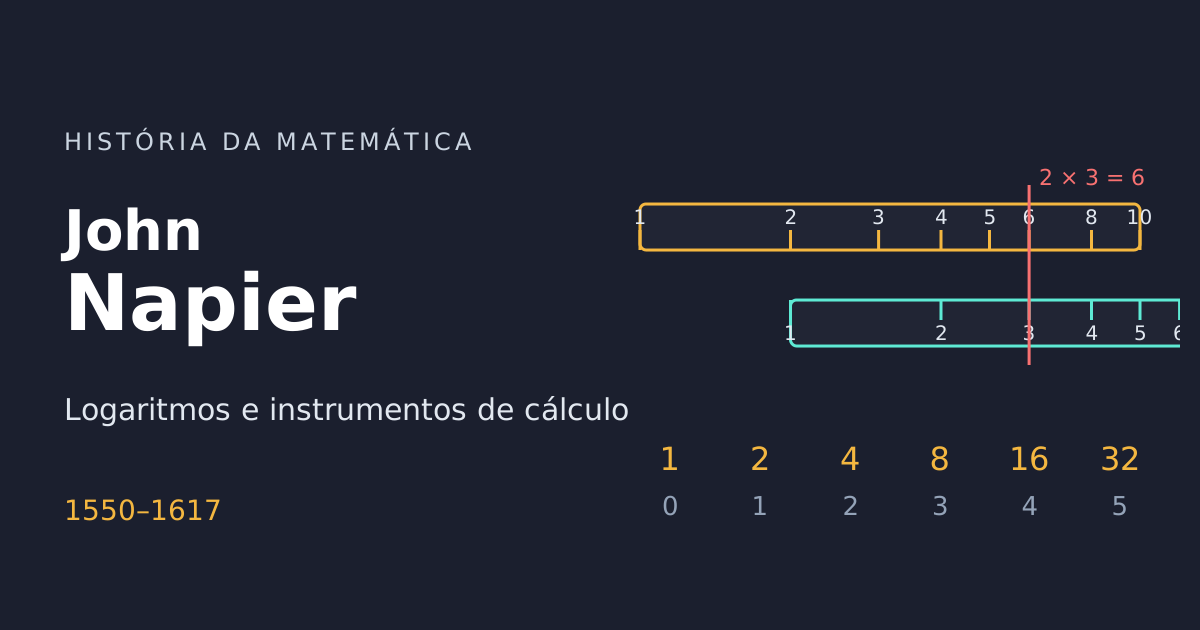
These numbers were first invented by the most illustrious John Napier, Baron of Merchiston; they were then changed, following his own opinion, by Henry Briggs. — Title page of Henry Briggs's Arithmetica logarithmica (1624) Henry Briggs was professor of geometry at Gresham College in London and one of the greatest calculators in England. In March 1615 he wrote to a friend that Napier had set his “head and hands a work” with his new logarithms, and that he hoped to meet him that summer. He did. In the conversation at Merchiston the two agreed that the tables would be far more practical with two changes: the logarithm of 1 would be 0, and that of 10 would be 1.

October 15, 2026 Read
Hero Image
Inverting the integral: elliptic functions

Start with a familiar function, seen in an odd way. The integral $$\arcsin x=\int_0^x\frac{dt}{\sqrt{1-t^2}}$$gives the length of an arc of a circle of radius 1, measured from the lowest point, as a function of the height $x$. It is a complicated function. But its inverse, which gives the height as a function of the arc, is the sine, the simplest function in trigonometry. And the sine has a property the integral hides: it is periodic. Since a quarter turn measures

October 15, 2026 Read
  • ««
  • «
  • 3
  • 4
  • 5
  • 6
  • 7
  • »
  • »»
Navigation
  • Start here
  • Recent posts
  • About Euler
  • App
  • Privacy
Contact me:
  • hirowat2@gmail.com

Euler's Eyes
© 2021 Euler Eyes.
Powered by Hugo Logo