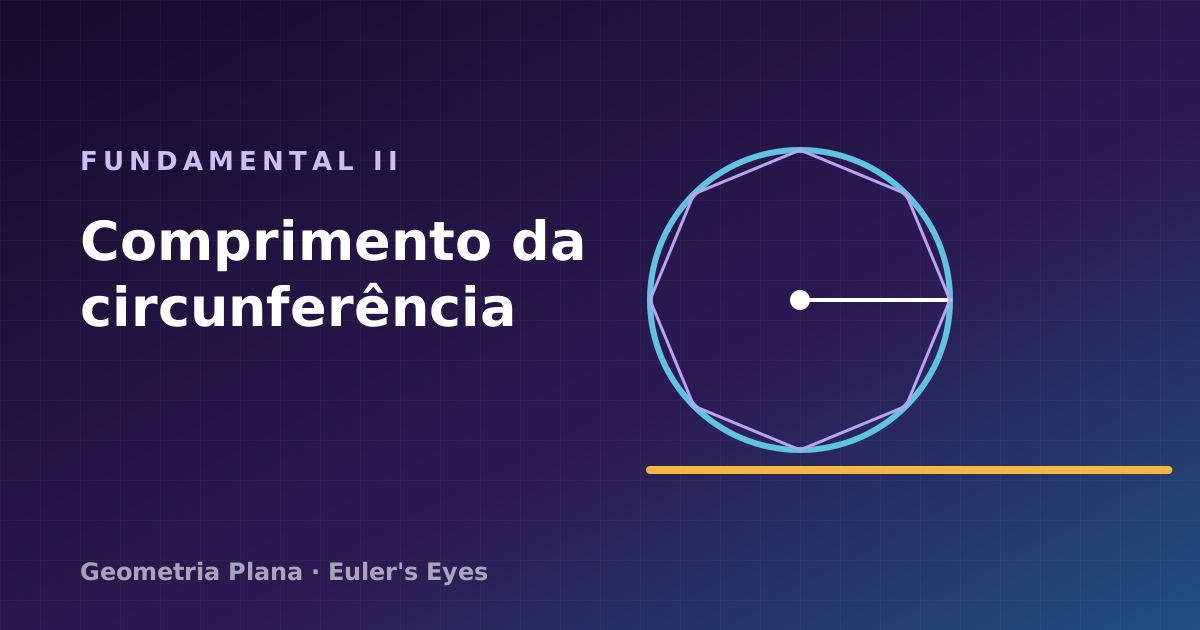
Wrap a string around a can and then stretch it over the diameter: it fits just over three times. This goes for any can, wheel or coin. This “just over three” is the number π. Who discovered That the outline of a circle is a little larger than three diameters was already known by the Babylonians and Egyptians almost 4 000 years ago; they used values like 3, $3\tfrac{1}{8}$ and 3,16. The first calculated π with certainty was Archimedes of Syracuse (3rd century BC): using polygons with 96 sides, he proved that π is between $3\tfrac{10}{71}$ and $3\tfrac{1}{7}$. The symbol π was used by the Welshman William Jones in 1706 and popularized by Leonhard Euler.
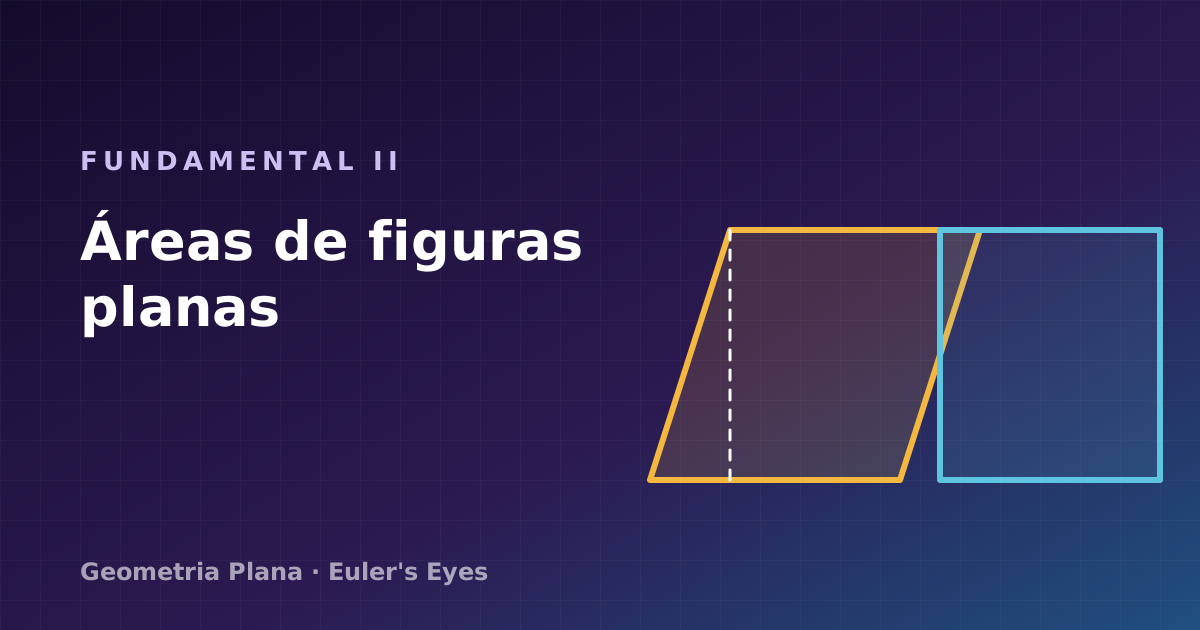
How many square meters are there on land, how much paint goes on a wall, how much fabric goes on a flag? All these questions are about area — and almost all the formulas come from just one: the rectangle. Who discovered The first area calculations that we have records of are from scribes from Egypt and Mesopotamia: the Rhind papyrus (c. 1650 BC) calculates areas of rectangular, triangular and even circular fields, and Babylonian tablets show areas of trapezoids. The Greeks gave these rules a justification: in The Elements, Euclid (c. 300 BC) proves that parallelograms with the same base and the same height have the same area (proposition I.35) and that the triangle is half of the parallelogram (I.41). The circle formula was demonstrated by Archimedes (3rd century BC).
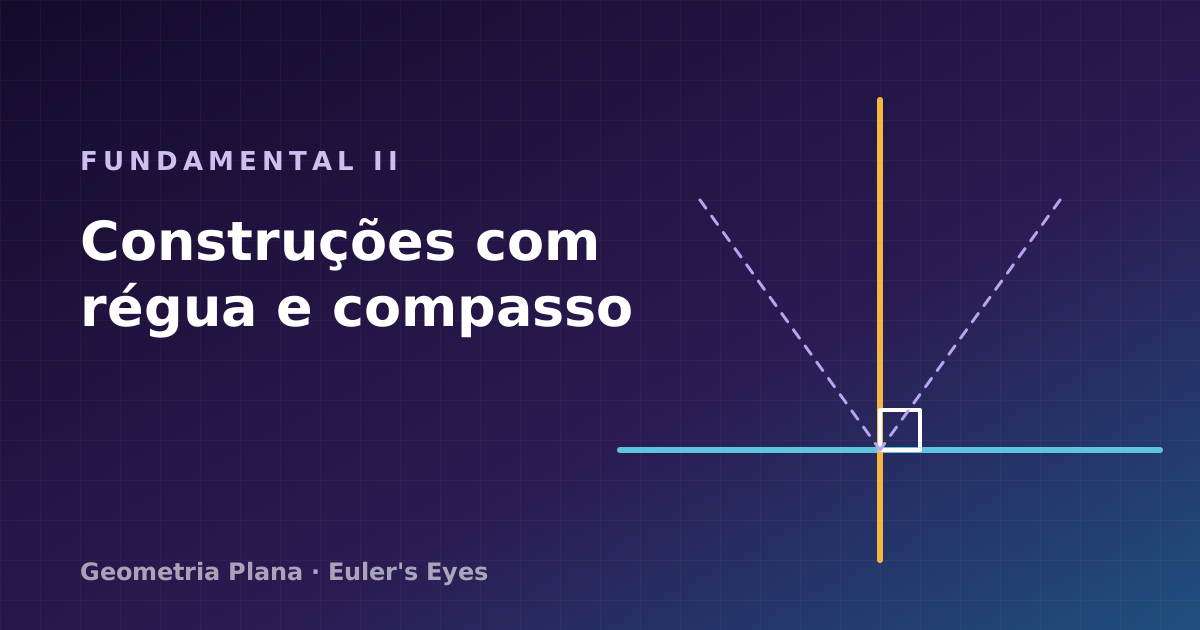
A ruler without marks and a compass: with just these two tools, the Greeks constructed midpoints, perpendiculars and parallels with total precision. Who discovered The classical constructions are in The Elements of Euclid (c. 300 BC): the perpendicular bisector and the midpoint (proposition I.10), the angle bisector (I.9), the perpendicular by one point (I.11 and I.12) and the parallel by one point (I.31). The rule of using only a ruler without marks and a compass comes from Euclid’s first three postulates: draw a straight line through two points, extend it and draw a circle with any center and radius.