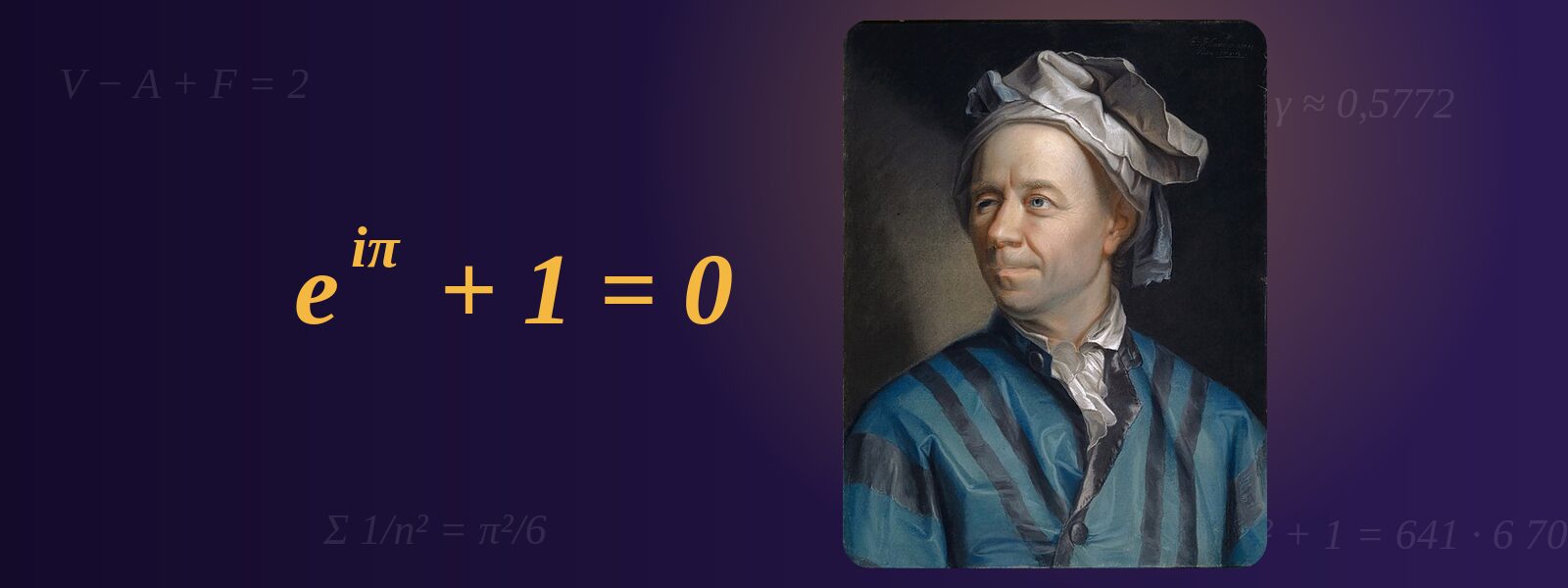
The language that Euler left us
Part of Euler’s influence is in things that seem to have always existed. He created or popularized:
$f(x)$ to indicate a function of $x$; the letter $e$ for the base of natural logarithms, $e \approx 2{,}71828$; the letter $\pi$ for the ratio between the length of the circumference and the diameter (the symbol already existed, but it was Euler who spread it); $i$ for the imaginary unit, with $i^2 = -1$; $\Sigma$ to indicate a sum. The equals sign and the letter π
Symbols have birthdays. The sign $=$ was invented by the Welshman Robert Recorde in 1557, in the book The Whetstone of Witte, so as not to have to write “is equal to” all the time. He chose two parallel strokes of the same length because, as he explained, no two things can be more equal. The letter $\pi$, the initial of the Greek word periphéreia, the circumference, was first used in today’s sense by another Welshman, William Jones, in 1706. Euler began using it in the 1730s, and his books made it standard.