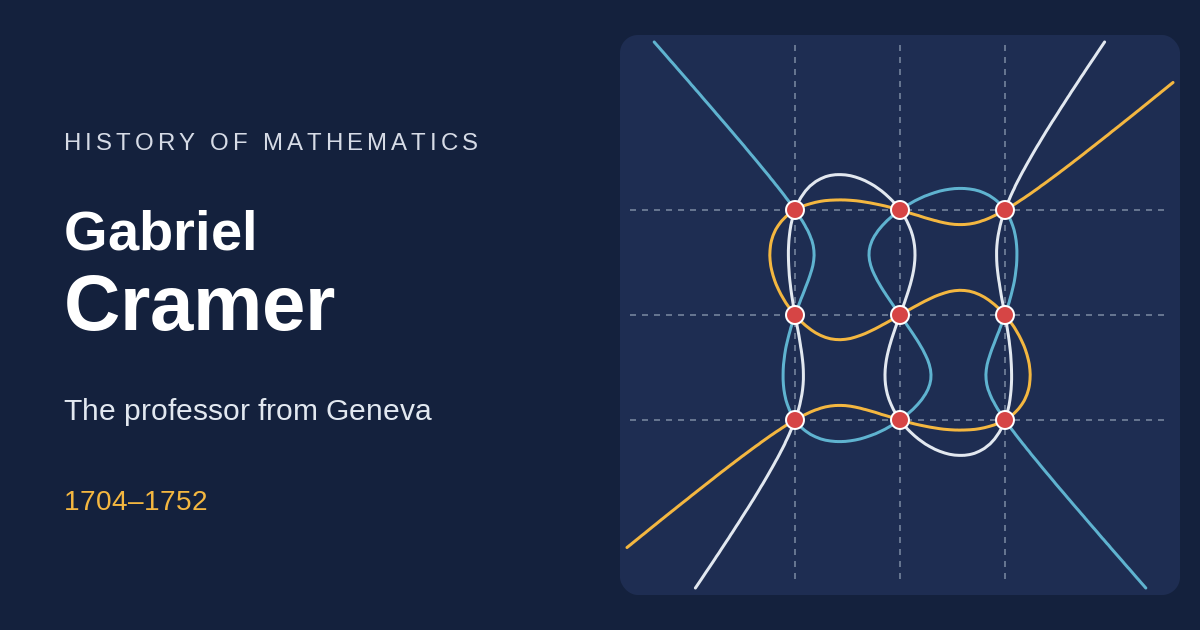
Cramer himself did not claim to have invented the rule: he presented it in an appendix, as a tool, without asserting priority. And indeed the idea of combining the coefficients of a system into a sum of products with alternating signs had appeared before, at least three times, in three places that had no contact with one another. Seki Takakazu, 1683 In Edo-period Japan, the mathematician Seki Takakazu wrote in 1683 a manuscript entitled Kaifukudai no hō, “method for solving concealed problems”. The problem was to eliminate unknowns from a system of polynomial equations so as to arrive at a single equation. To do so, Seki arranged the coefficients in a table and formed sums of products taken one from each row and each column, with signs fixed by a rule of his own. This is what we now call a determinant, and Seki computed it for tables of order 2, 3, 4 and 5.