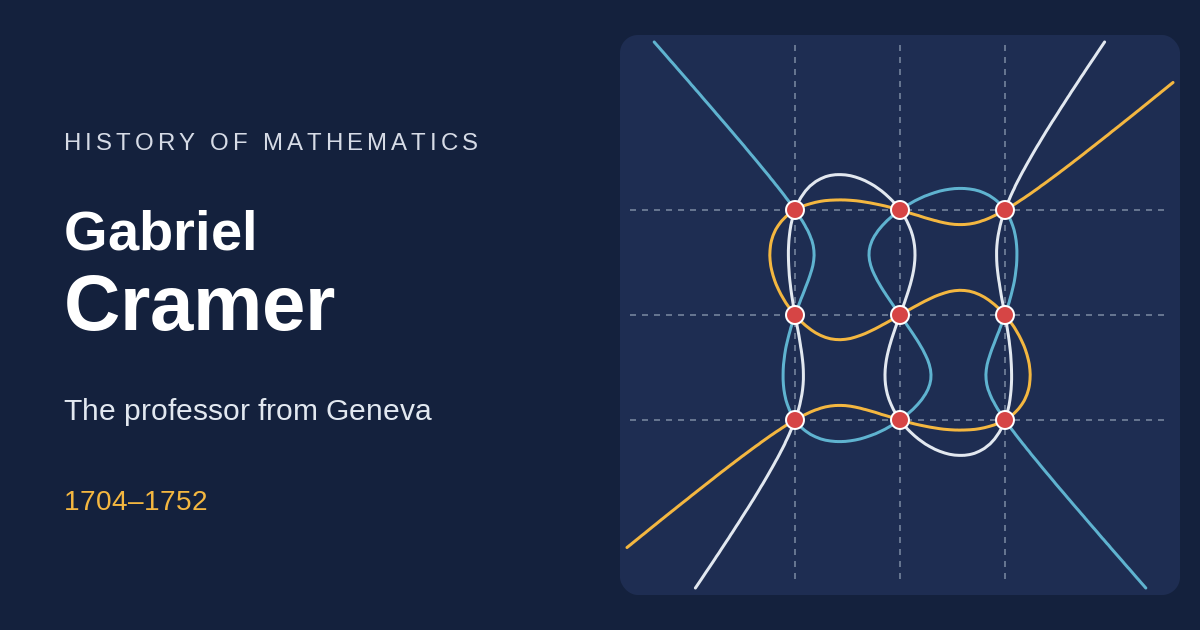
Through two distinct points passes a single line. Through three points not on a line passes a single circle. Through five points, as the Greeks already knew, passes a single conic. Is there a general rule behind these numbers? In the third chapter of the Introduction, Cramer shows that there is, and that it is obtained simply by counting. Counting the coefficients The most general equation of degree $n$ in $x$ and $y$ has one term $x^i y^j$ for each pair with $i + j \le n$. For degree $2$, for example,
By counting coefficients, Cramer concluded that a curve of degree $n$ is determined by $\frac{n(n + 3)}{2}$ of its points. For cubics that is $9$ points. But there was another known result, stated by Newton and by Maclaurin, though not yet fully proved: two curves of degrees $m$ and $n$ meet, in general, in $m \cdot n$ points. So two cubics meet in $3 \cdot 3 = 9$ points. Put the two statements together and a contradiction appears. Take two different cubics and their nine crossing points. By Cramer’s count, only one cubic passes through those nine points. Yet at least two do: the ones we started with.
One of the central questions of the Introduction is: given the equation of a curve, how does it behave near a point, and how does it run off to infinity? Near most points a curve looks like a straight line. But there are special points, singular points, where two or more branches cross, or where the curve forms a spike. To study them Cramer used a tool invented by Newton, which Newton called the parallelogram and which is now called the Newton polygon.
Cramer was not a genius on the scale of Euler or the Bernoullis, whom he knew and whose works he edited. He was an excellent teacher, a clear writer and a tireless organiser, and much of what he left bears the mark of those qualities: he took ideas that were scattered, or hidden, and put them in a form everyone could use. What bears his name Cramer’s rule, for solving linear systems with determinants, taught all over the world. Cramer’s paradox, about the crossing points of two curves, which led to the Cayley–Bacharach theorem. The Cramer–Castillon problem, in geometry, described below. The rule in the textbooks Cramer’s rule quickly entered the algebra textbooks. Bézout used it in 1764 and in 1779, in his great treatise on elimination; Laplace and Vandermonde studied Cramer’s expressions for their own sake; and at the beginning of the 19th century, with Cauchy, they became determinants, one of the central objects of linear algebra. In numerical practice the rule was replaced by the method of elimination, which is much faster. But it remains the most direct way to write the solution of a system as a formula, and it is with it that one proves, for instance, the formula for the inverse matrix and the fact that a system has a unique solution exactly when the determinant is not zero.