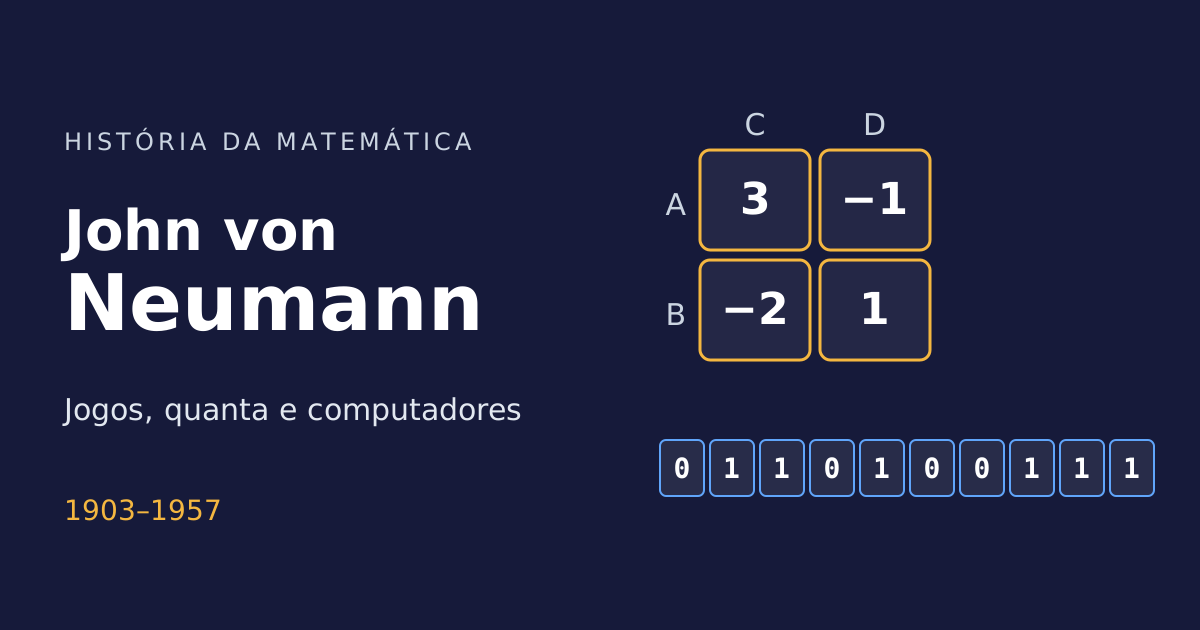
The life of John von Neumann
Timeline 1903Born on 28 December in Budapest, the son of a banker. 1913His father receives a title of nobility; the son becomes “von Neumann”. 1921Finishes the Lutheran gymnasium in Budapest, where he studied alongside Eugene Wigner. 1923Publishes, at 19, his definition of ordinal numbers. 1926Diploma in chemical engineering in Zurich and doctorate in mathematics in Budapest. 1927Becomes the youngest Privatdozent at the University of Berlin. 1928Publishes the minimax theorem, the basis of game theory. 1930Moves to Princeton. In 1933 he is one of the first professors of the Institute for Advanced Study. 1932Publishes the Mathematical Foundations of Quantum Mechanics. 1943Begins working at Los Alamos, on the atomic bomb project. 1944Publishes, with Oskar Morgenstern, the Theory of Games and Economic Behavior. 1945Writes the EDVAC report, which describes the stored-program computer. 1946With Stanisław Ulam, develops the Monte Carlo method. 1952The IAS computer comes into operation. 1955Appointed to the Atomic Energy Commission. Discovers he has cancer. 1957Dies on 8 February, in Washington, aged 53. ◀ Previous Follow the journey Next ▶ 1903–1921 BudapestHe is born on 28 December, the son of a banker. He studies at the Lutheran gymnasium, where Eugene Wigner is a schoolmate. 1921–1923 BerlinHe studies chemistry, at his father’s insistence, while enrolled for a doctorate in mathematics in Budapest. 1923–1926 ZurichHe graduates in chemical engineering at the Polytechnic. He attends classes by George Pólya, who would say he was the only student he was ever afraid of. 1926–1927 GöttingenHe works with David Hilbert on the foundations of mathematics and of the new quantum mechanics. 1927–1930 BerlinThe university’s youngest Privatdozent. In 1928 he publishes the minimax theorem. 1930–1957 PrincetonProfessor at the university and, from 1933, at the Institute for Advanced Study, alongside Einstein and Gödel. There he builds the IAS computer. 1943–1955 Los AlamosConsultant to the atomic bomb project. With Ulam, he creates the Monte Carlo method. 1955–1957 WashingtonMember of the Atomic Energy Commission. He dies of cancer on 8 February 1957, at Walter Reed Hospital. Enable JavaScript to see the map. The stages are listed below.
From Budapest to Washington, by way of Zurich, Göttingen, Berlin, Princeton and Los Alamos. Map: © OpenStreetMap contributors