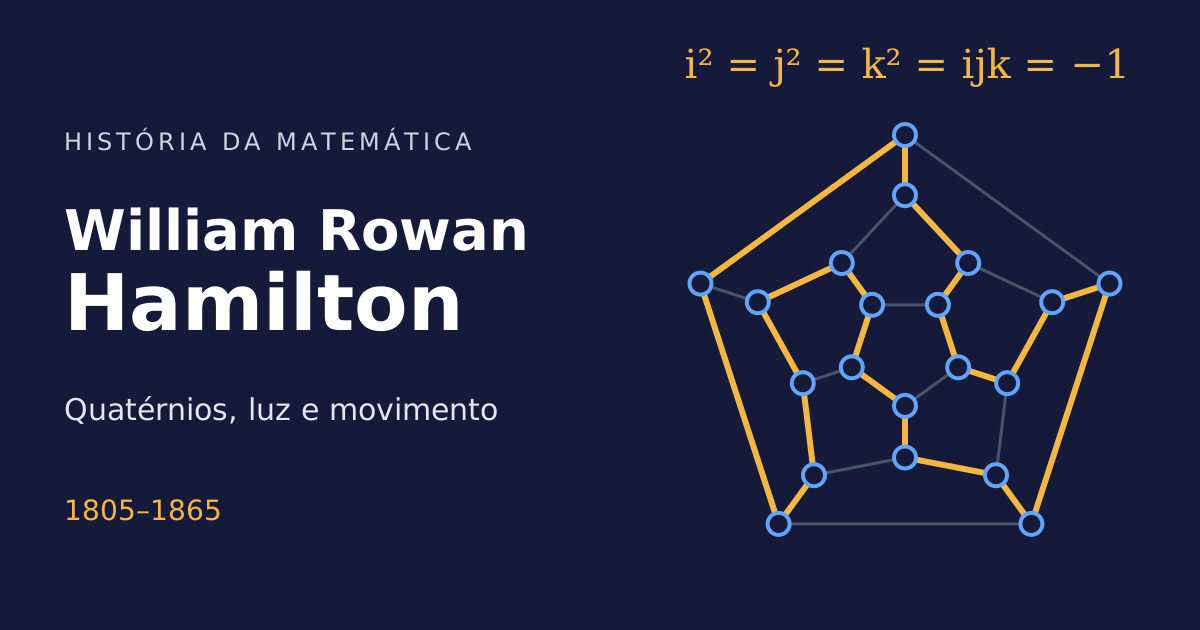
In 1856, still busy with non-commutative algebras, Hamilton invented the icosian calculus: three symbols $\iota$, $\kappa$ and $\lambda$ obeying the rules $$\iota^2 = 1, \qquad \kappa^3 = 1, \qquad \lambda^5 = 1, \qquad \lambda = \iota\kappa.$$Today we would say they generate the group of rotations of the icosahedron, the solid with twenty triangular faces. Hamilton presented the calculus at a meeting of the British Association in Dublin in 1857, and noticed that it described paths along the edges of the dodecahedron, the solid with twelve pentagonal faces and twenty vertices.