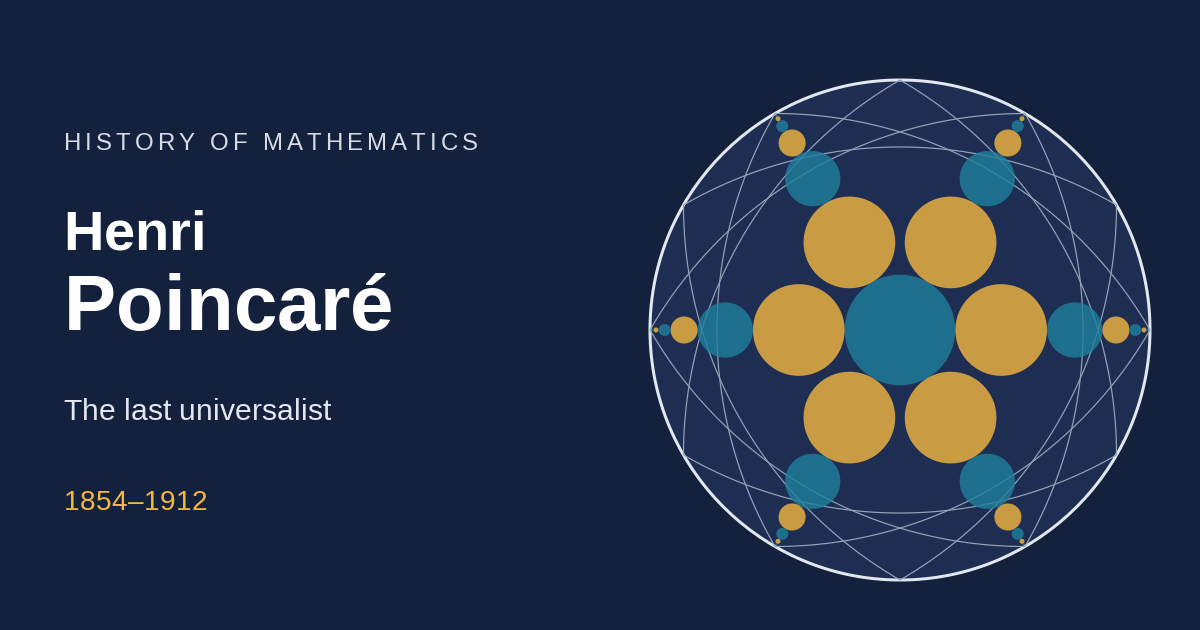
Trigonometric functions repeat: $\sin(x + 2\pi) = \sin x$. Elliptic functions, studied by Abel and Jacobi, repeat in two directions of the complex plane, like wallpaper. In 1880, at 26, Poincaré was looking for even more symmetric functions that would let him solve the linear differential equations studied by the German Lazarus Fuchs. He called them Fuchsian functions. The bus at Coutances For fifteen days Poincaré tried to prove that such functions could not exist. Then, on a sleepless night, he saw that they did and constructed a family of them. What remained was to understand the structure of the transformations under which they repeated. The answer came on a geological excursion organised by the École des Mines:
Projective geometry was born from the perspective of painters. When a figure is projected from one plane onto another, from a point, straight lines stay straight, but lengths and angles change: a square becomes a trapezium, a circle becomes an ellipse. In the nineteenth century Poncelet, Steiner and von Staudt built a whole geometry out of the properties that survive these projections, such as lying on a line or being tangent to a conic. It seemed a poorer geometry than Euclid’s, because it had no measurements.