Logo Euler's Eyes
  • Dark Theme
    Light Theme Dark Theme System Theme
Logo Inverted Logo
  • Tags
  • 1 Phase
  • 1st Phase
  • 2 Phase
  • 2 Phase,
  • 2nd Phase
  • 2° Degree Equation
  • Alan Turing
  • Algebra
  • Algebraic Expressions
  • Analysis
  • Analytic Geometry
  • Analytical Geometry
  • Angle Bisector
  • Angle Measurements
  • Angles
  • Apothem
  • Arc Capable
  • Arc Properties
  • Archimedes
  • Area
  • Arithmetic Progression
  • Artificial Intelligence
  • Axioms and Postulates
  • Basic Concepts of Statistics
  • Bernoulli
  • Bhaskara
  • Binary Numbers
  • Binomial
  • Biography
  • Calculating Machine
  • Calculation
  • Calculus
  • Calculus of Variations
  • Cartesian Plane
  • Cartesian Product of Sets
  • Cauchy
  • Central Angle
  • Centroid
  • Children
  • Circle
  • Circle Area
  • Circumcenter
  • Circumference
  • Circumference Ratio
  • Circumferences
  • Circumscript Segments
  • Classification in Mathematics
  • Combinatorial Analysis
  • Combinatorics
  • Comparison of Angles
  • Complement
  • Complex Numbers
  • Compound Interest
  • Computing
  • Concave Region
  • Congruence
  • Congruence of Triangles
  • Convex Region
  • Correspondence Law
  • Cosine Theorem
  • Count
  • Cryptography
  • Decision Theory
  • Demo
  • Derivative
  • Descartes
  • Diagonals
  • Diamond
  • Differential Equations
  • Dispersion Measures
  • Distance
  • Division
  • Domain and Image
  • Einstein
  • Elasticity
  • Electromagnetism
  • Elementary Descriptive Statistics
  • Elementary School I
  • Elementary School II
  • ENEM 2021
  • ENEM 2022
  • ENEM 2023
  • ENEM 2024
  • ENEM 2025
  • Entrance Exam
  • Equality
  • Equations
  • Equiprobable Events
  • Equivalence Between Sets
  • Equivalence Relations
  • Euclid
  • Euclid's Postulate
  • Euler
  • Euler Project
  • Even Numbers
  • Exercises for Adding Natural Numbers
  • Exponential Function
  • External Angles
  • Fees
  • Fermat
  • Fermat's Last Theorem
  • Financial Mathematics
  • First Degree Equations
  • First Degree Functions
  • Flat
  • Flat Figures
  • Flat Geometry
  • Fractions
  • Function Concept
  • Function Discovery
  • Functions
  • FUVEST 2021
  • FUVEST 2022
  • FUVEST 2023
  • FUVEST 2024
  • FUVEST 2025
  • FUVEST 2026
  • Galois
  • Game Theory
  • Gauss
  • Geometric Constructions
  • Geometric Shapes
  • Geometry
  • Geometry With Natural Numbers
  • Geometry With Sequences of Numbers
  • Golden Segment
  • Graph Reading
  • Graphics
  • Graphs for Integers
  • Gravitation
  • Greatest Common Divisor
  • Group Theory
  • Groups
  • Hamilton
  • Height
  • History of Mathematics
  • Incenter
  • Increases and Discounts
  • Inequalities
  • Inscribable Quadrilateral
  • Inscribed Angle
  • Integral
  • Internal Angles
  • Interval Operations
  • Intervals
  • Introduction
  • Introduction to Angles
  • Introduction to Circumference
  • Introduction to Function Theory
  • Introduction to Geometry
  • Introduction to Integers
  • Introduction to Logarithm Table
  • Introduction to Polygons
  • Introduction to Probability
  • Introduction to Quadrilaterals
  • Introduction to Radiciation
  • Introduction to Rational Numbers
  • Introduction to Real Numbers
  • Introduction to Sets
  • Introduction to Statistics
  • Introduction to Triangles
  • Johann Bernoulli
  • John Napier
  • John Nash
  • Kids
  • Lagrange
  • Language
  • Law of Cosines
  • Law of Sines
  • Least Common Multiple
  • Leibniz
  • Level 1
  • Level 2
  • Level 3
  • Limit
  • Linear Systems
  • Logarithm
  • Logarithm Properties
  • Logarithms
  • Logic
  • Magnification
  • Math Elements
  • Mathematical Biology
  • Mathematical Logic
  • Mathematical Notation
  • Mathematical Programming
  • Mathematics Education
  • Mathematics Elements
  • Mathematics for Children
  • Mathematics for Kids
  • Matrices
  • Maxwell
  • Measure
  • Mechanics
  • Medium Base
  • Metric Relationships
  • Midpoint
  • Modular Function
  • Multiplication
  • Napier
  • Natural Number Subtraction Exercises
  • Newton
  • Niels Henrik Abel
  • Notable Points of the Triangle
  • Notation
  • Notion of Infinity
  • Notions of Probability
  • Nth Root
  • Number And
  • Number Theory
  • Number Π
  • Numbering Systems
  • Numerical Calculation
  • Numerical Methods
  • OBMEP
  • OBMEP 2023
  • Obmep,
  • Odd Numbers
  • Operations With Rational Numbers
  • Operations With Sets
  • Operations With Venn-Euler Diagrams
  • Optics
  • Optimization
  • Orthocenter
  • Parallelism
  • Parallelogram
  • Parallels
  • Partial Derivatives
  • Pascal
  • Pascal's Triangle
  • Peano Axioms
  • Peirce
  • Percentage
  • Percentage Basics
  • Perimeter
  • Perpendicular Bisector
  • Perpendicularity
  • Perpendiculars
  • Philosophy
  • Physical
  • Physics
  • Pi Number
  • Pi Numbers
  • Pitot
  • Plane Geometry
  • Point
  • Point Power
  • Polygons
  • Polynomials
  • Position Measurements
  • Position Relative to the Circumference
  • Postulates
  • Potentiation of Integers
  • Power With Negative Exponent
  • Prime Numbers
  • Primitive Notions
  • Principia
  • Probability
  • Progressions
  • Proof
  • Properties
  • Properties of Polygons
  • Proportion
  • Proportionality
  • Proportions
  • Proportions and Geometry
  • Pure Mathematics
  • Pythagoras Theorem
  • Pythagorean Suits
  • Quadratic Function
  • Quadrilateral
  • Quadrilaterals
  • Quantifier
  • Quantity Analysis
  • Quaternions
  • R Programming
  • Real Numbers
  • Rectangle
  • Rectangle Triangles
  • Reduction
  • Reflection
  • Regions in Planes
  • Regular Polygons
  • Relations
  • Relationship Properties
  • Relativity
  • Rhombus
  • Right Angle
  • Right Triangle
  • Right Triangle Relationships
  • Rule of 3
  • Rule of Three
  • Saussure
  • Segment Angle
  • Semi-Inscribed Angle
  • Semi-Straight
  • Semiotics
  • Sequences
  • Series
  • Set Family
  • Set Partition
  • Set Theory
  • Signal Rule
  • Similarity
  • Similarity of Triangles
  • Simple Interest
  • Sines Theorem
  • Sophie Germain
  • Spatial Geometry
  • Square
  • Square Root
  • Statistic
  • Stewart Ratio
  • Straight
  • Straight Lines
  • Straight Segment
  • Sum of Angles
  • Supplement
  • Symmetry
  • Tangent
  • Thales' Theorem
  • The Number Zero
  • Theorems
  • Trapezium
  • Trapezius
  • Triangle
  • Triangles
  • Triangular Inequality
  • Trigonometry
  • Truth Table
  • Understanding Relationships
  • Vectors
  • Venn-Euler Diagrams
  • Whole Numbers
  • Wiles
  • Women in Mathematics
  • Year 2018
  • Year 2019
  • Year 2021
  • Year 2022
  • Évariste Galois
Hero Image
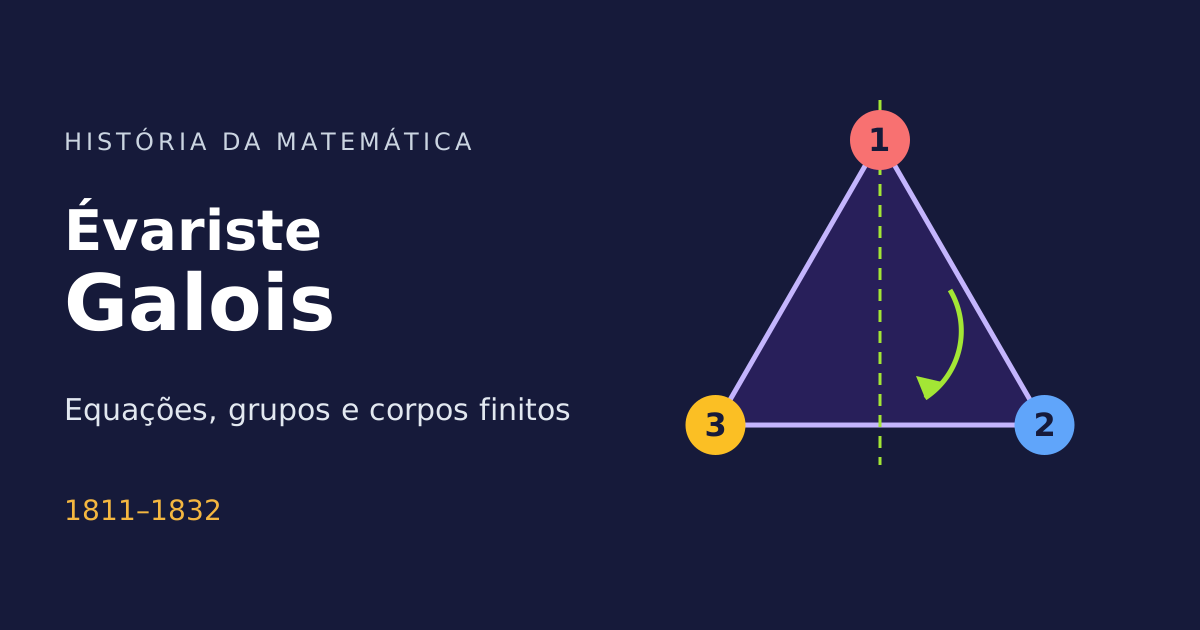
When an equation can be solved by radicals

With the idea of the group of an equation, Galois answered the question left open after Abel: which equations can be solved by radicals? The answer does not depend on any trick. It depends only on the shape of the group. Each root cuts the group Solving an equation by radicals means adding roots, one at a time, to the numbers already known. At the start we know only the rational numbers, and the group of the equation is whole. Each time we add a root, such as $\sqrt3$ or $\sqrt[3]{5}$, new true relations appear, and fewer permutations respect them. The group shrinks. When the group becomes just the identity, all the roots of the equation are written with known numbers: the equation is solved.

October 15, 2026 Read
Hero Image
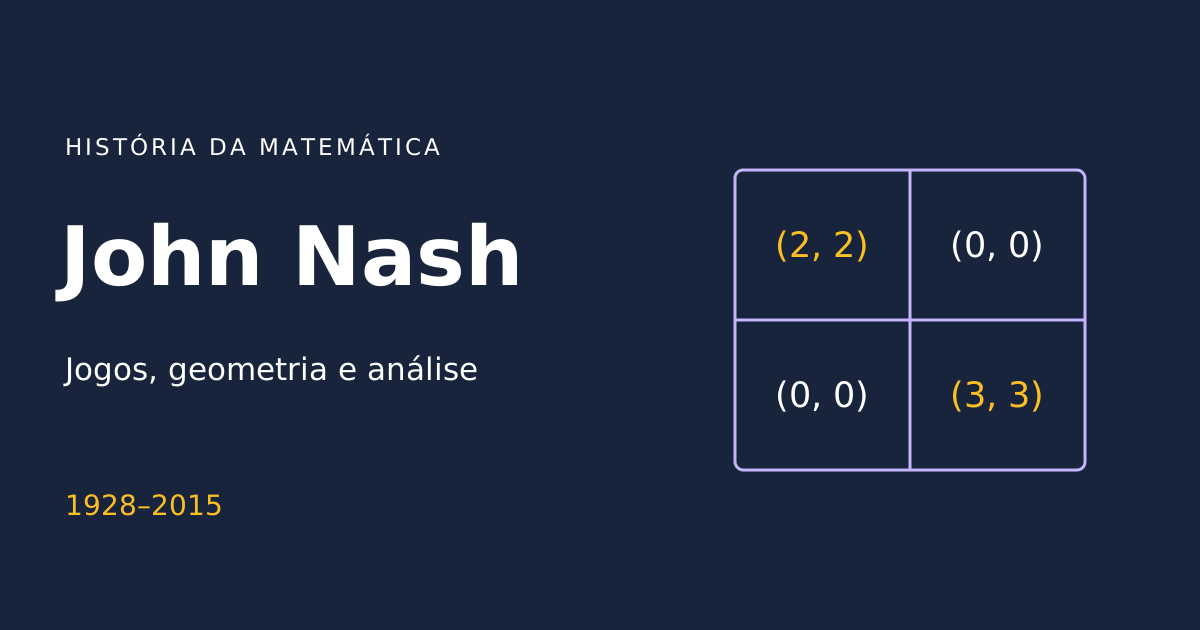
Mixed strategies: the penalty kick and odds and evens

Every finite game has an equilibrium point. — John Nash, Non-Cooperative Games, doctoral thesis (1950) Some games have no equilibrium at all if each player picks a fixed move. The simplest is odds and evens. Ana calls “evens”, Bruno calls “odds”, and each shows one or two fingers. If the sum is even, Ana wins a point; if it is odd, Bruno wins. Reducing each choice to “one” or “two” fingers, the payoffs are:

October 14, 2026 Read
Hero Image
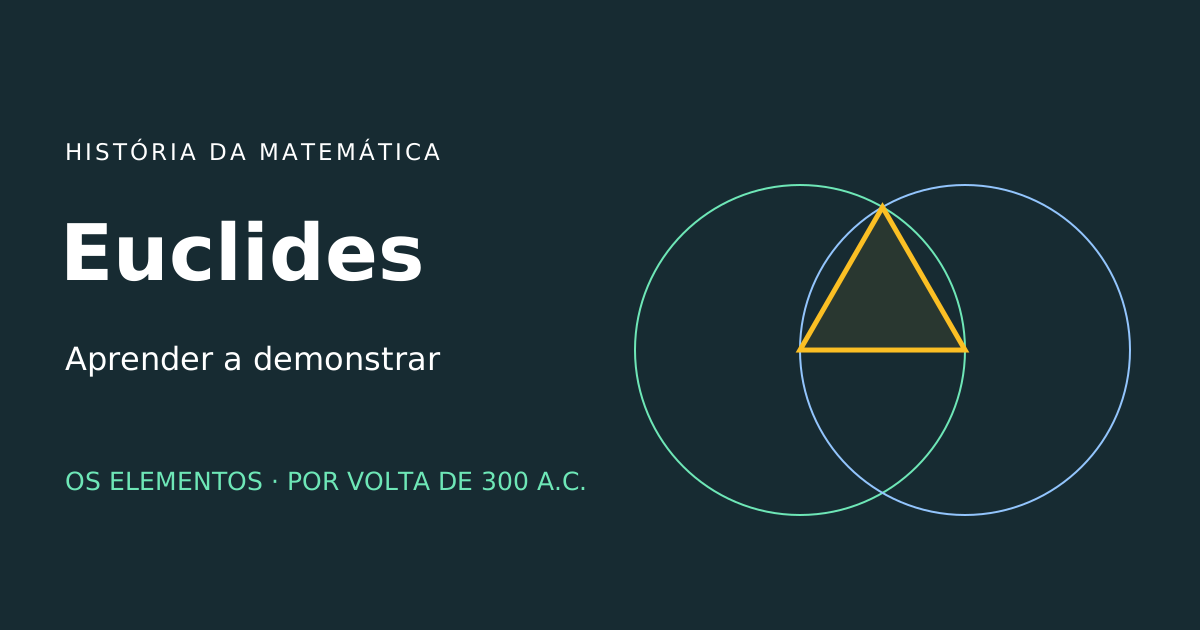
Pythagoras's theorem, Euclid's way

In right-angled triangles the square on the side subtending the right angle is equal to the squares on the sides containing the right angle. — Euclid, Elements, Proposition I.47 Long before the Greeks, the surveyors of Egypt, who re-marked the fields after each Nile flood, were called rope-stretchers. The story goes that they used a rope with 12 equally spaced knots: stretched into a triangle with sides 3, 4 and 5, it gave a right angle. The Babylonians knew much more: a clay tablet from around 1800 BC, Plimpton 322, lists right triangles with whole-number sides, some of them huge, such as 3,367, 3,456 and 4,825.

October 14, 2026 Read
Hero Image
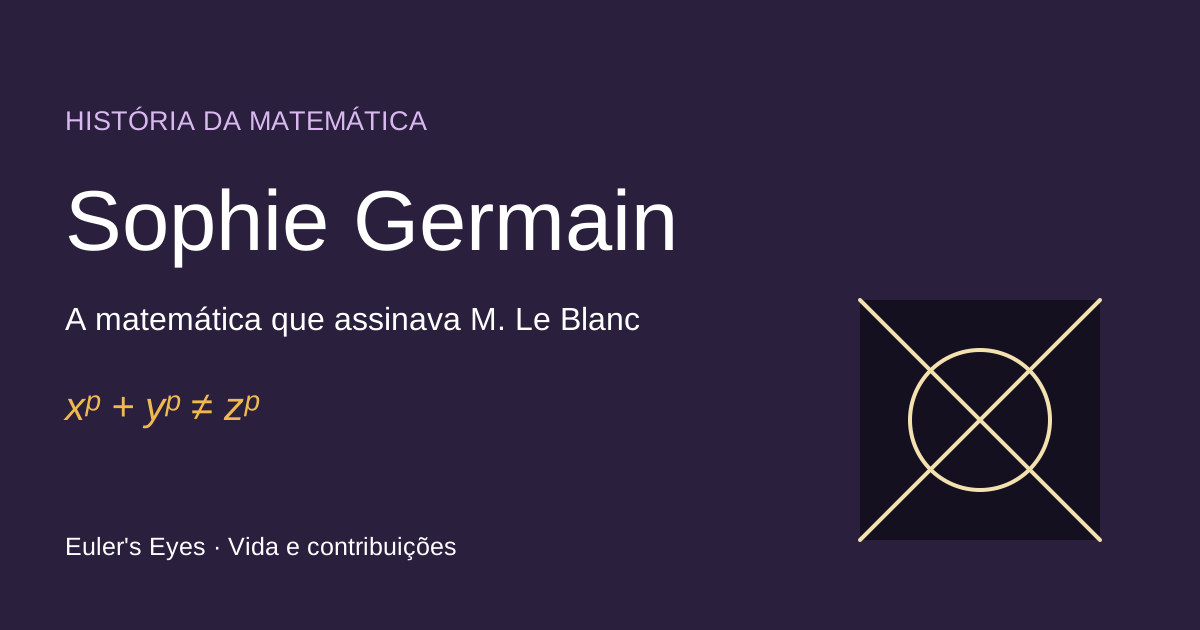
Sophie Germain primes and cryptography

A prime number $p$ is a Sophie Germain prime when $2p+1$ is also prime. 5 is one, because 11 is prime. 7 is not, because $15=3\cdot5$. The list begins: $$2,\ 3,\ 5,\ 11,\ 23,\ 29,\ 41,\ 53,\ 83,\ 89,\ 113,\ 131,\ldots$$The prime $2p+1$ that goes with each is called a safe prime: $5, 7, 11, 23, 47, 59, 83, \ldots$ Sophie Germain needed them for her theorem on Fermat. Two centuries later, they protect internet connections.
October 14, 2026 Read
Hero Image
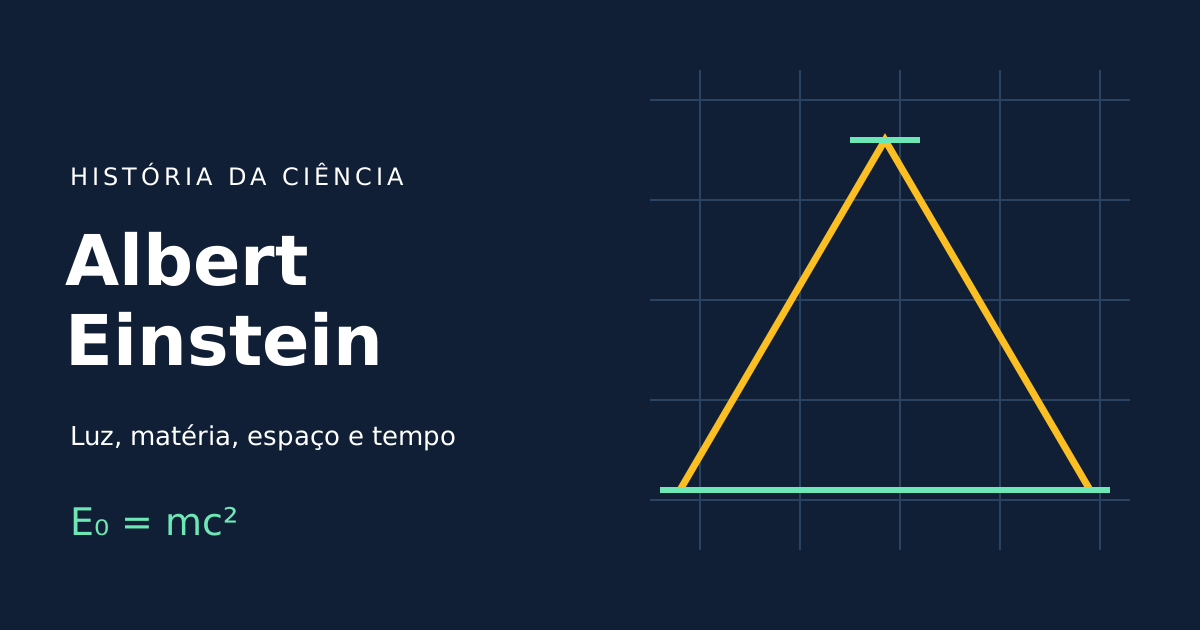
Special relativity: a clock made of light

If I pursue a beam of light with the velocity c, the velocity of light in a vacuum, I should observe such a beam of light as an electromagnetic field at rest though spatially oscillating. There seems to be no such thing, however. — Albert Einstein, Autobiographical Notes (1949) At 16, at school in Aarau, Einstein asked himself a question: what would I see if I ran alongside a beam of light, at the same speed? According to Newton’s physics, the light would seem to stand still, like a car beside ours on the motorway. But Maxwell’s equations do not allow light at rest: for them, light always travels at $c\approx300{,}000$ km/s. Someone was wrong. Einstein took ten years to find out who.

October 14, 2026 Read
Hero Image
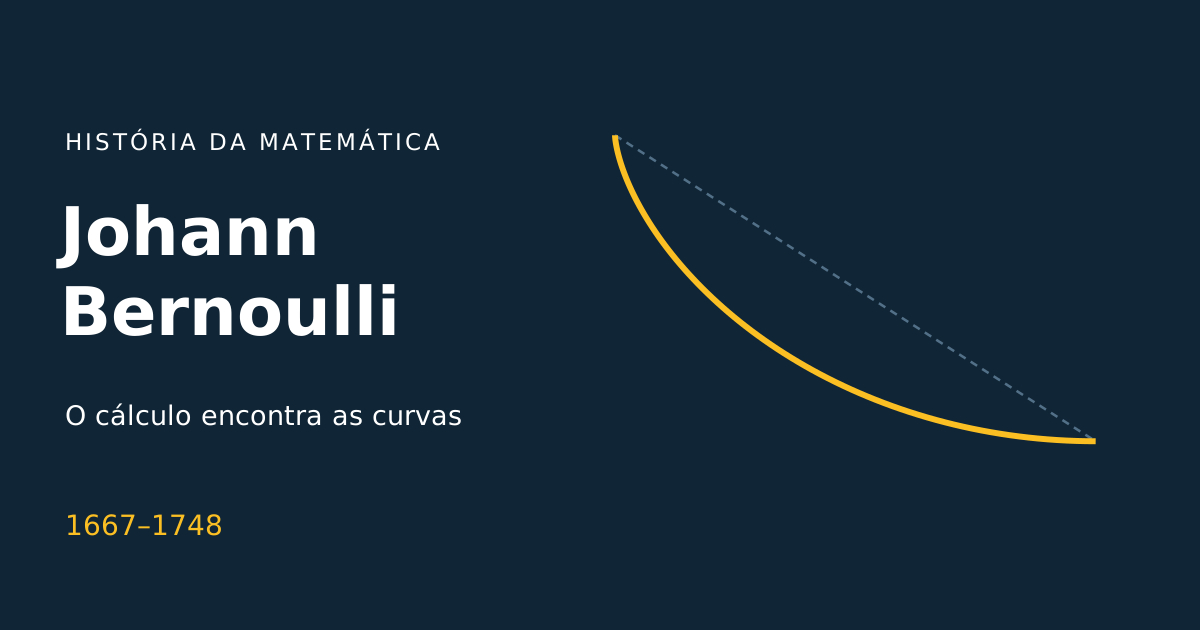
The brachistochrone: the challenge of 1696

Given two points A and B in a vertical plane, to find the curve AMB along which a moving body M, descending under its own weight, passes from A to B in the shortest possible time. — Johann Bernoulli, Acta Eruditorum (June 1696) In June 1696, in the Acta Eruditorum, Johann Bernoulli challenged “the most acute mathematicians of the whole world”. The question sounds like something from a funfair: what is the shape of the fastest slide between two points? The name of the problem comes from Greek: brachistos, shortest, and chronos, time. Brachistochrone, the curve of least time.

October 14, 2026 Read
Hero Image
The Lagrange points: where gravity balances

On 25 December 2021 a rocket lifted off from French Guiana carrying the James Webb Space Telescope. It was not placed in orbit around the Earth, like Hubble. It travelled for a month to an empty point in space, 1.5 million kilometres from here, always on the side opposite the Sun, and stayed there. The address of that point comes from a prize-winning paper by Lagrange, from 1772. It is called L2.

October 14, 2026 Read
Hero Image
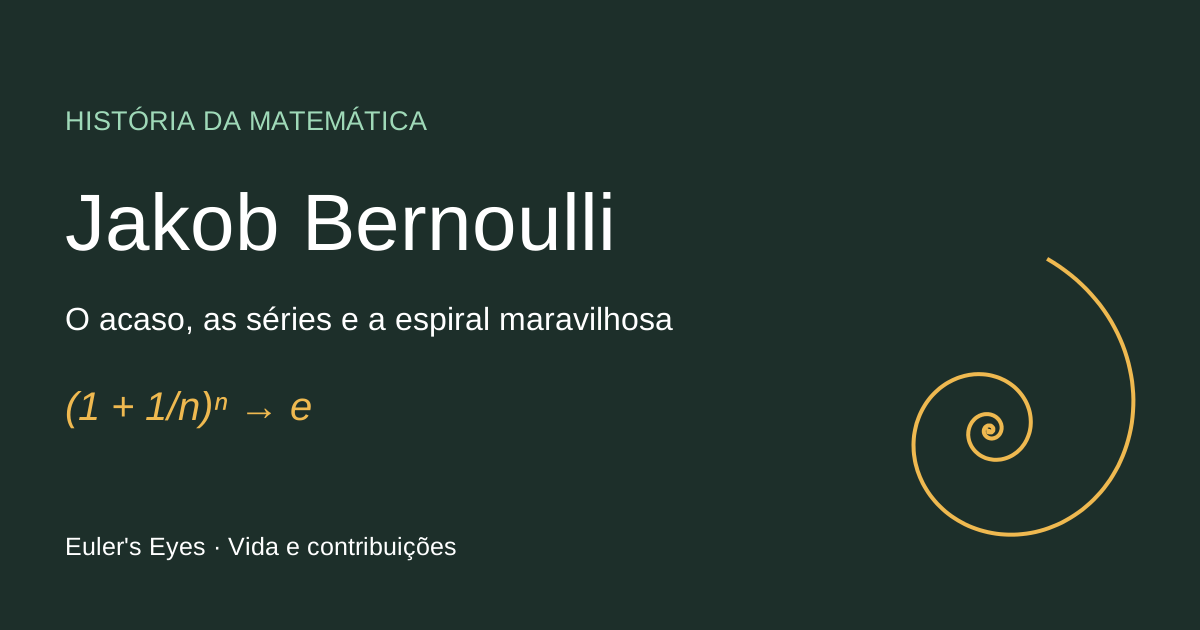
The marvellous spiral and the lemniscate

With Leibniz’s calculus in hand, the Bernoulli brothers went hunting for curves. For each one they asked: what is the tangent, what is the length, what is the area, what is the curvature? Many of these curves had been known since the Greeks, but only now could these questions be answered by a general rule. Two of them kept Jakob’s name forever. The spiral that does not change shape The logarithmic spiral had already been studied by Descartes and by Torricelli. In polar coordinates, where each point is given by its distance $r$ from the centre and by the angle $\theta$, it is

October 14, 2026 Read
Hero Image
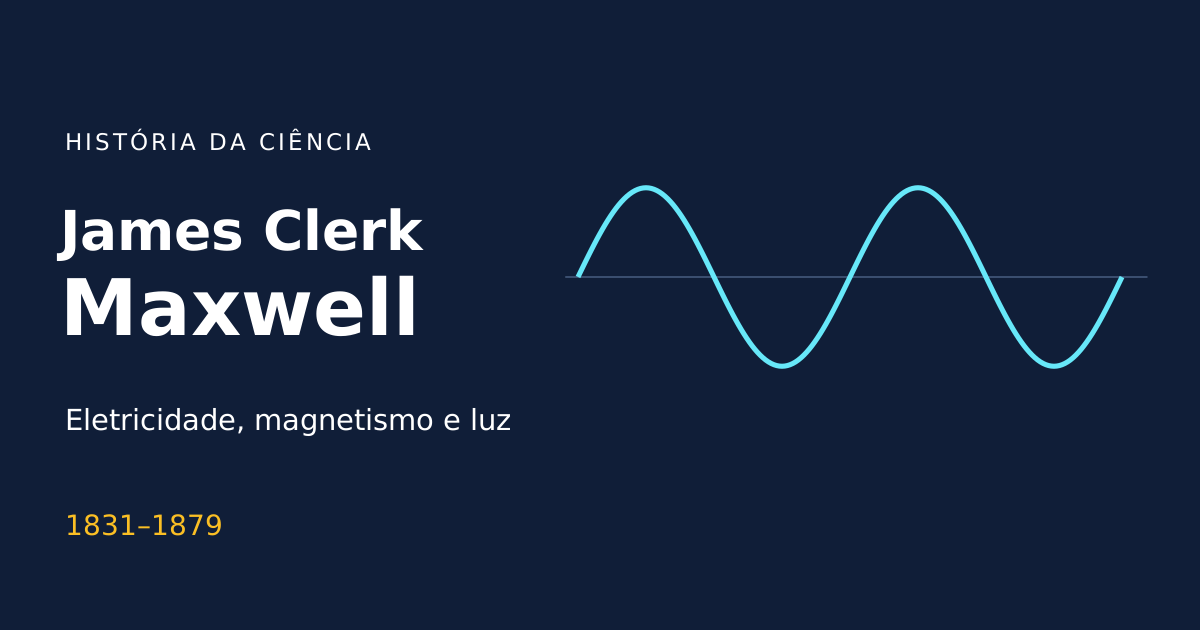
The speeds of molecules: the Maxwell distribution

I have been occupied lately with some questions about the motions and collisions of perfectly elastic spheres, as an exercise in mechanics. — James Clerk Maxwell, letter to George Stokes (30 May 1859) A litre of air contains about $2.5\times10^{22}$ molecules, all moving and colliding billions of times a second. Following each one is impossible. In 1859 Maxwell had an idea that changed physics: not to ask what each molecule does, but what fraction of them has each speed. It was the first time probabilities had been used in a law of physics. He presented the result at a meeting in Aberdeen in 1859 and published it in 1860.

October 14, 2026 Read
Hero Image
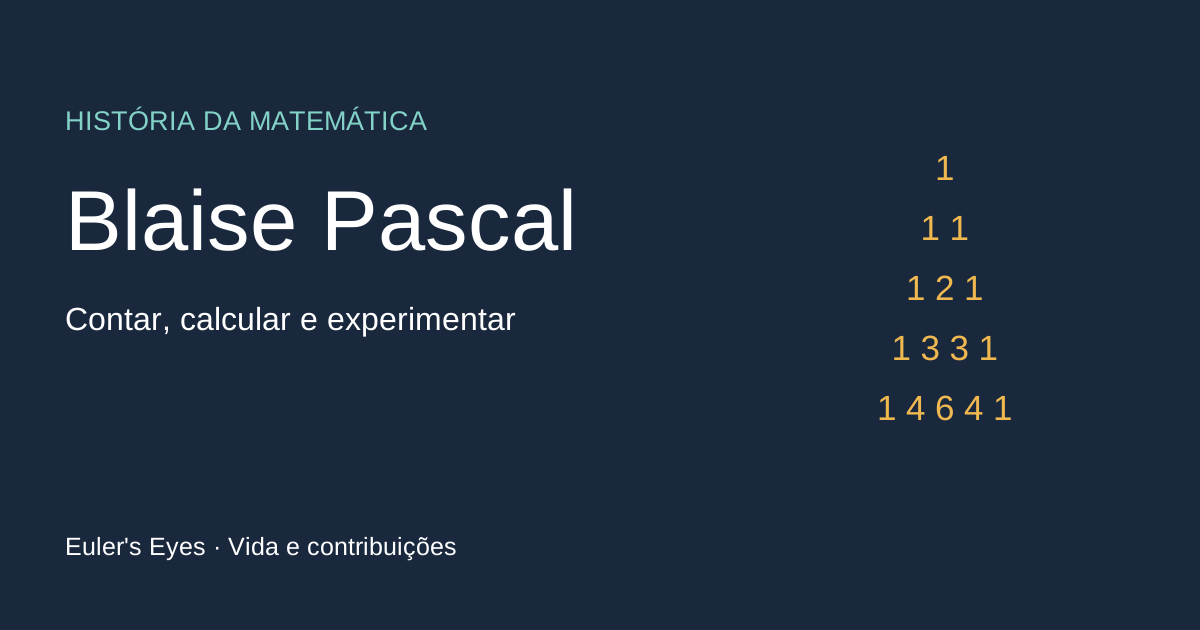
The Chevalier de Méré's dice and the fair split

Antoine Gombaud, who styled himself the Chevalier de Méré, was a writer at the French court and a passionate gambler. Around 1654 he brought Pascal two questions about bets. Pascal found them so good that he wrote to Pierre de Fermat, and probability theory was born from those letters. About his friend, Pascal remarked to Fermat: He has a very good mind, but he is not a geometer; and that, as you know, is a great defect. — Blaise Pascal, letter to Fermat (29 July 1654)

October 11, 2026 Read
Hero Image
Fermat's little theorem: powers and remainders

Take the number 2 and raise it to larger and larger powers. Divide each result by 7 and note the remainder: Power $2^1$ $2^2$ $2^3$ $2^4$ $2^5$ $2^6$ Value 2 4 8 16 32 64 Remainder mod 7 2 4 1 2 4 1 At $2^6$ the remainder is 1. Now try 3 and the prime 5: $3^4=81$, which leaves remainder 1 when divided by 5. And 10 and the prime 13: $10^{12}=1{,}000{,}000{,}000{,}000$, which also leaves remainder 1 when divided by 13.

October 11, 2026 Read
Hero Image
The ∫ sign: from sum to accumulation

On 29 October 1675 Leibniz was in Paris working on a problem about areas. Until then he had written omn., short for the Latin omnia, “all”, to mean the sum of all the lines of a figure, as the Italian Cavalieri did. Halfway down the page he wrote: It will be useful to write ∫ instead of omn. — Leibniz, manuscript of 29 October 1675 The symbol $\int$ is a long S, for summa, sum. At the time the long s was an ordinary letter in handwriting. It has never been replaced since.

October 11, 2026 Read
  • ««
  • «
  • 4
  • 5
  • 6
  • 7
  • 8
  • »
  • »»
Navigation
  • Start here
  • Recent posts
  • About Euler
  • App
  • Privacy
Contact me:
  • hirowat2@gmail.com

Euler's Eyes
© 2021 Euler Eyes.
Powered by Hugo Logo