Other contributions and legacy
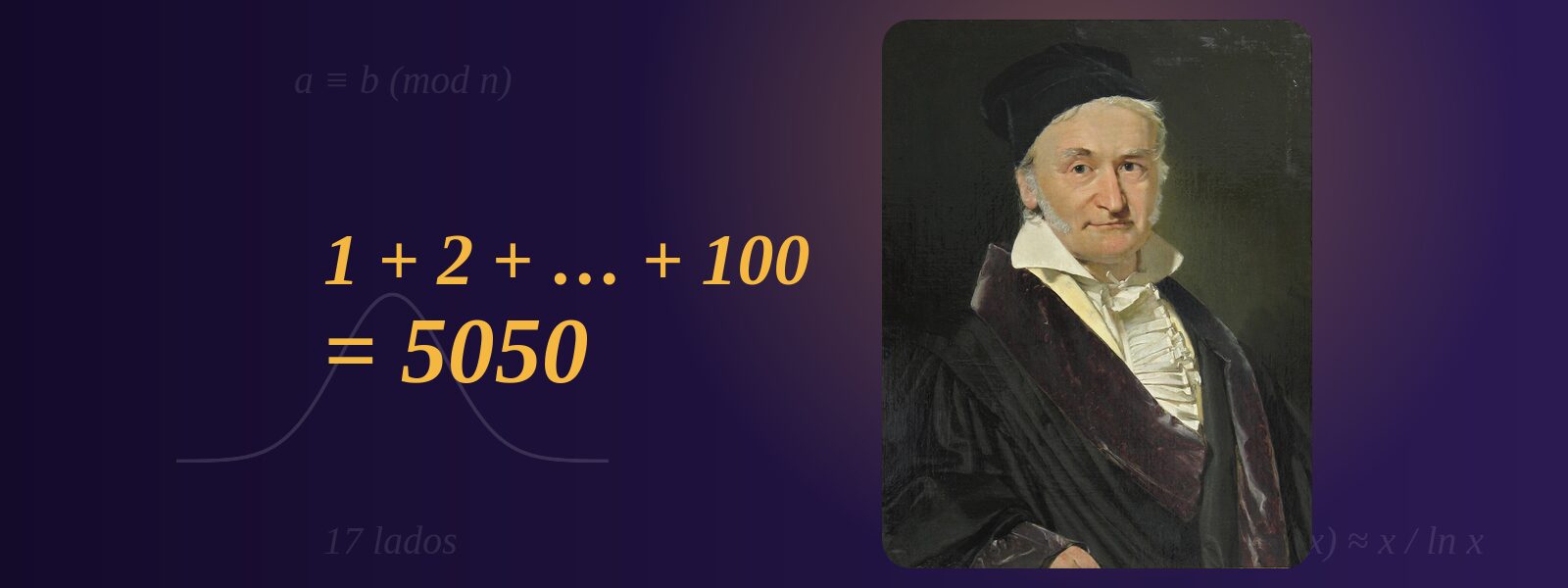
Other contributions Physics: Gauss’s law of electromagnetism, the study of Earth’s magnetism and the Gauss unit. Complex numbers: Gaussian integers, numbers $a + bi$ with $a$ and $b$ integers. Astronomy and geodesy: orbits of planets and comets, the heliotrope and the Hannover measurement. Algorithms: a method for calculating the date of Easter and, in a manuscript by 1805, a version of the fast Fourier transform, rediscovered in 1965 and used today in every cell phone. To remember Gauss was born poor in Braunschweig, studied under a duke and spent his life in Göttingen. Added from 1 to 100 by joining pairs: $1 + 2 + \cdots + n = \frac{n(n+1)}{2}$. At 18 years he showed how to construct a polygon with 17 sides, using only square roots. He created the congruence notation, $a \equiv b \pmod n$, the mathematics of the clock and nines-out. He proved that every polynomial of degree $n$ has $n$ complex roots. Estimated the number of primes: $\pi(x) \approx x / \ln x$. He rediscovered Ceres with the least squares method, which shows why the average is the best estimate. He gave the name to the normal curve, the Gaussian bell. He showed that curvature can be measured from within the surface: this is why there is no perfect flat map. He named the determinant and organized the elimination that solves systems of equations. With two well-chosen points, $\pm 1/\sqrt{3}$, he calculated exact integrals for polynomials up to degree 3. All topics by Carl Friedrich Gauss · ← Gaussian quadrature: integrate with two points · Image credits →