Logo Euler's Eyes
  • Dark Theme
    Light Theme Dark Theme System Theme
Logo Inverted Logo
  • Tags
  • 1 Phase
  • 1st Phase
  • 2 Phase
  • 2 Phase,
  • 2nd Phase
  • 2° Degree Equation
  • Alan Turing
  • Algebra
  • Algebraic Expressions
  • Analysis
  • Analytic Geometry
  • Analytical Geometry
  • Angle Bisector
  • Angle Measurements
  • Angles
  • Apothem
  • Arc Capable
  • Arc Properties
  • Archimedes
  • Area
  • Arithmetic Progression
  • Artificial Intelligence
  • Axioms and Postulates
  • Basic Concepts of Statistics
  • Bernoulli
  • Bhaskara
  • Binary Numbers
  • Binomial
  • Biography
  • Calculating Machine
  • Calculation
  • Calculus
  • Calculus of Variations
  • Cartesian Plane
  • Cartesian Product of Sets
  • Cauchy
  • Central Angle
  • Centroid
  • Children
  • Circle
  • Circle Area
  • Circumcenter
  • Circumference
  • Circumference Ratio
  • Circumferences
  • Circumscript Segments
  • Classification in Mathematics
  • Combinatorial Analysis
  • Combinatorics
  • Comparison of Angles
  • Complement
  • Complex Numbers
  • Compound Interest
  • Computing
  • Concave Region
  • Congruence
  • Congruence of Triangles
  • Convex Region
  • Correspondence Law
  • Cosine Theorem
  • Count
  • Cryptography
  • Decision Theory
  • Demo
  • Derivative
  • Descartes
  • Diagonals
  • Diamond
  • Differential Equations
  • Dispersion Measures
  • Distance
  • Division
  • Domain and Image
  • Einstein
  • Elasticity
  • Electromagnetism
  • Elementary Descriptive Statistics
  • Elementary School I
  • Elementary School II
  • ENEM 2021
  • ENEM 2022
  • ENEM 2023
  • ENEM 2024
  • ENEM 2025
  • Entrance Exam
  • Equality
  • Equations
  • Equiprobable Events
  • Equivalence Between Sets
  • Equivalence Relations
  • Euclid
  • Euclid's Postulate
  • Euler
  • Euler Project
  • Even Numbers
  • Exercises for Adding Natural Numbers
  • Exponential Function
  • External Angles
  • Fees
  • Fermat
  • Fermat's Last Theorem
  • Financial Mathematics
  • First Degree Equations
  • First Degree Functions
  • Flat
  • Flat Figures
  • Flat Geometry
  • Fractions
  • Function Concept
  • Function Discovery
  • Functions
  • FUVEST 2021
  • FUVEST 2022
  • FUVEST 2023
  • FUVEST 2024
  • FUVEST 2025
  • FUVEST 2026
  • Galois
  • Game Theory
  • Gauss
  • Geometric Constructions
  • Geometric Shapes
  • Geometry
  • Geometry With Natural Numbers
  • Geometry With Sequences of Numbers
  • Golden Segment
  • Graph Reading
  • Graphics
  • Graphs for Integers
  • Gravitation
  • Greatest Common Divisor
  • Group Theory
  • Groups
  • Hamilton
  • Height
  • History of Mathematics
  • Incenter
  • Increases and Discounts
  • Inequalities
  • Inscribable Quadrilateral
  • Inscribed Angle
  • Integral
  • Internal Angles
  • Interval Operations
  • Intervals
  • Introduction
  • Introduction to Angles
  • Introduction to Circumference
  • Introduction to Function Theory
  • Introduction to Geometry
  • Introduction to Integers
  • Introduction to Logarithm Table
  • Introduction to Polygons
  • Introduction to Probability
  • Introduction to Quadrilaterals
  • Introduction to Radiciation
  • Introduction to Rational Numbers
  • Introduction to Real Numbers
  • Introduction to Sets
  • Introduction to Statistics
  • Introduction to Triangles
  • Johann Bernoulli
  • John Napier
  • John Nash
  • Kids
  • Lagrange
  • Language
  • Law of Cosines
  • Law of Sines
  • Least Common Multiple
  • Leibniz
  • Level 1
  • Level 2
  • Level 3
  • Limit
  • Linear Systems
  • Logarithm
  • Logarithm Properties
  • Logarithms
  • Logic
  • Magnification
  • Math Elements
  • Mathematical Biology
  • Mathematical Logic
  • Mathematical Notation
  • Mathematical Programming
  • Mathematics Education
  • Mathematics Elements
  • Mathematics for Children
  • Mathematics for Kids
  • Matrices
  • Maxwell
  • Measure
  • Mechanics
  • Medium Base
  • Metric Relationships
  • Midpoint
  • Modular Function
  • Multiplication
  • Napier
  • Natural Number Subtraction Exercises
  • Newton
  • Niels Henrik Abel
  • Notable Points of the Triangle
  • Notation
  • Notion of Infinity
  • Notions of Probability
  • Nth Root
  • Number And
  • Number Theory
  • Number Π
  • Numbering Systems
  • Numerical Calculation
  • Numerical Methods
  • OBMEP
  • OBMEP 2023
  • Obmep,
  • Odd Numbers
  • Operations With Rational Numbers
  • Operations With Sets
  • Operations With Venn-Euler Diagrams
  • Optics
  • Optimization
  • Orthocenter
  • Parallelism
  • Parallelogram
  • Parallels
  • Partial Derivatives
  • Pascal
  • Pascal's Triangle
  • Peano Axioms
  • Peirce
  • Percentage
  • Percentage Basics
  • Perimeter
  • Perpendicular Bisector
  • Perpendicularity
  • Perpendiculars
  • Philosophy
  • Physical
  • Physics
  • Pi Number
  • Pi Numbers
  • Pitot
  • Plane Geometry
  • Point
  • Point Power
  • Polygons
  • Polynomials
  • Position Measurements
  • Position Relative to the Circumference
  • Postulates
  • Potentiation of Integers
  • Power With Negative Exponent
  • Prime Numbers
  • Primitive Notions
  • Principia
  • Probability
  • Progressions
  • Proof
  • Properties
  • Properties of Polygons
  • Proportion
  • Proportionality
  • Proportions
  • Proportions and Geometry
  • Pure Mathematics
  • Pythagoras Theorem
  • Pythagorean Suits
  • Quadratic Function
  • Quadrilateral
  • Quadrilaterals
  • Quantifier
  • Quantity Analysis
  • Quaternions
  • R Programming
  • Real Numbers
  • Rectangle
  • Rectangle Triangles
  • Reduction
  • Reflection
  • Regions in Planes
  • Regular Polygons
  • Relations
  • Relationship Properties
  • Relativity
  • Rhombus
  • Right Angle
  • Right Triangle
  • Right Triangle Relationships
  • Rule of 3
  • Rule of Three
  • Saussure
  • Segment Angle
  • Semi-Inscribed Angle
  • Semi-Straight
  • Semiotics
  • Sequences
  • Series
  • Set Family
  • Set Partition
  • Set Theory
  • Signal Rule
  • Similarity
  • Similarity of Triangles
  • Simple Interest
  • Sines Theorem
  • Sophie Germain
  • Spatial Geometry
  • Square
  • Square Root
  • Statistic
  • Stewart Ratio
  • Straight
  • Straight Lines
  • Straight Segment
  • Sum of Angles
  • Supplement
  • Symmetry
  • Tangent
  • Thales' Theorem
  • The Number Zero
  • Theorems
  • Trapezium
  • Trapezius
  • Triangle
  • Triangles
  • Triangular Inequality
  • Trigonometry
  • Truth Table
  • Understanding Relationships
  • Vectors
  • Venn-Euler Diagrams
  • Whole Numbers
  • Wiles
  • Women in Mathematics
  • Year 2018
  • Year 2019
  • Year 2021
  • Year 2022
  • Évariste Galois
Hero Image
The normal curve, Gauss's bell

If measurement errors are random, how are they distributed? In Theoria motus, Gauss started from the idea that the mean is the best estimate and arrived at the shape of the error curve: $$f(x) = \frac{1}{\sigma\sqrt{2\pi}}\, e^{-\frac{(x - \mu)^2}{2\sigma^2}},$$ where $\mu$ is the mean and $\sigma$ is the standard deviation. It is the normal curve, or Gaussian bell: high in medium, symmetrical, and increasingly lower away from the mean. It appears everywhere, from the heights of the people to the errors of a machine.

October 10, 2026 Read
Hero Image
Descartes and the idea of ​​function

Descartes never used the word “function”. But it was he who made the idea possible: in Geometry, a curve stops being just a drawing and becomes a relationship between two numbers, $x$ and $y$. When one changes, the other changes along with it, following a rule. In this part, we tell you how this idea gained name, symbol and graphic. The following five topics develop this reading and the subsequent history of the idea of ​​function.

October 10, 2026 Read
Hero Image
$V - A + F = 2$ and the soccer ball

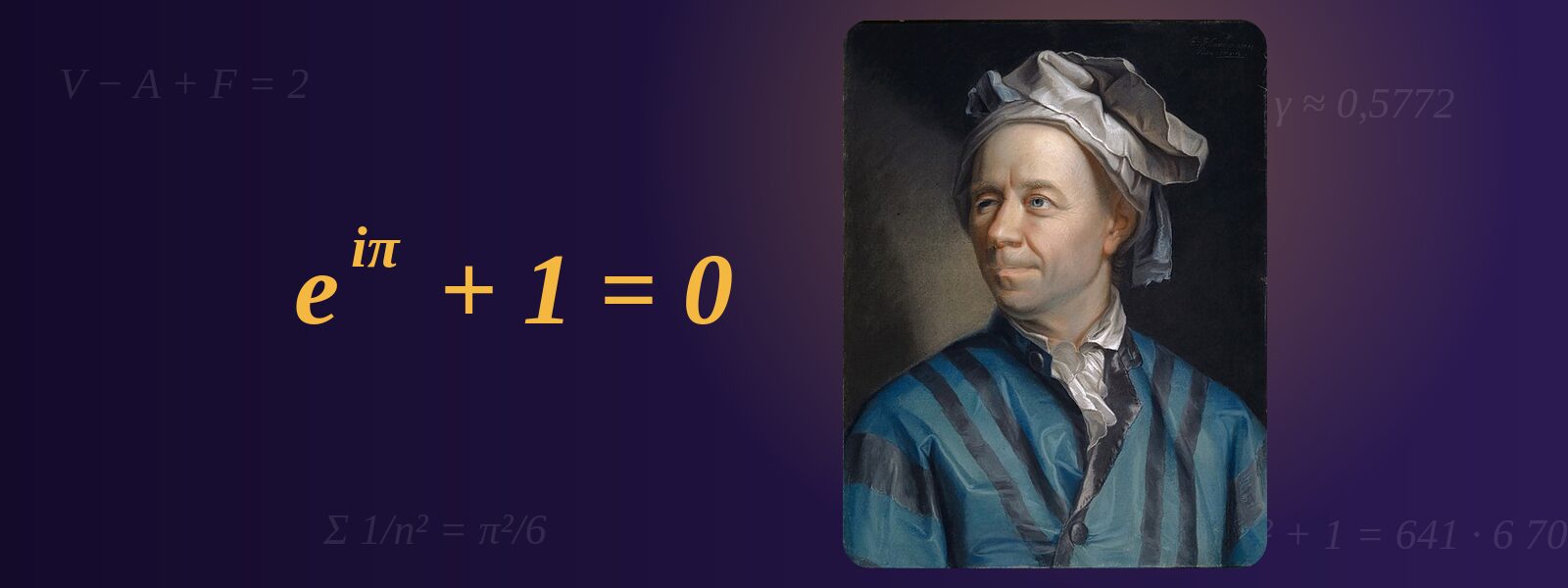
In 1750, in a letter to mathematician Christian Goldbach, Euler noted a relationship between the number of vertices ($V$), edges ($A$) and faces ($F$) of a convex polyhedron: $$V - A + F = 2.$$ Rotate the polyhedra with your finger or mouse and check the calculation: V, A and F are counted by the program from the drawing itself. In all cases it gives 2. Ative o JavaScript para ver esta figura interativa.

October 10, 2026 Read
Hero Image
Leibniz's legacy

The calculus war Leibniz published calculus in 1684 and 1686. Newton had reached the same ideas in 1665–1666 but kept everything in manuscripts. For fifteen years nobody disputed anything. In 1699 the Swiss mathematician Nicolas Fatio de Duillier, a friend of Newton, hinted in a book that Leibniz had drawn on Newton. In 1708 the Scot John Keill went further and accused Leibniz of plagiarism. The argument: in 1676 Leibniz had visited London and seen a copy of Newton’s De analysi.

October 11, 2026 Read
Hero Image
Newton's legacy

Newton was the greatest genius who ever lived, and the most fortunate, for there is only one universe to discover, and it can be discovered only once. — Joseph-Louis Lagrange, as reported by his contemporaries The calculus war Newton created the method of fluxions in 1665–1666 but did not publish it. Leibniz reached calculus independently in 1675 and published in 1684. For some years nobody quarrelled. In 1676 the two even exchanged cordial letters through Henry Oldenburg, and Newton hid his ideas in an anagram.

October 11, 2026 Read
Hero Image
The Egregium Theorem and curvature

Measuring Hannover, Gauss thought a lot about how to make maps of a curved Earth. In 1827 published the result he called Theorema Egregium, the “remarkable theorem”: the curvature of a surface can be measured by those who live inside it, without going out to look from the outside. A consequence: in a plane, the angles of a triangle add up to 180°. In a sphere, they add up to more. Take the triangle with one vertex at the north pole and the other two at the equator:

October 10, 2026 Read
Hero Image
A reading of the Cogito: listening and speaking

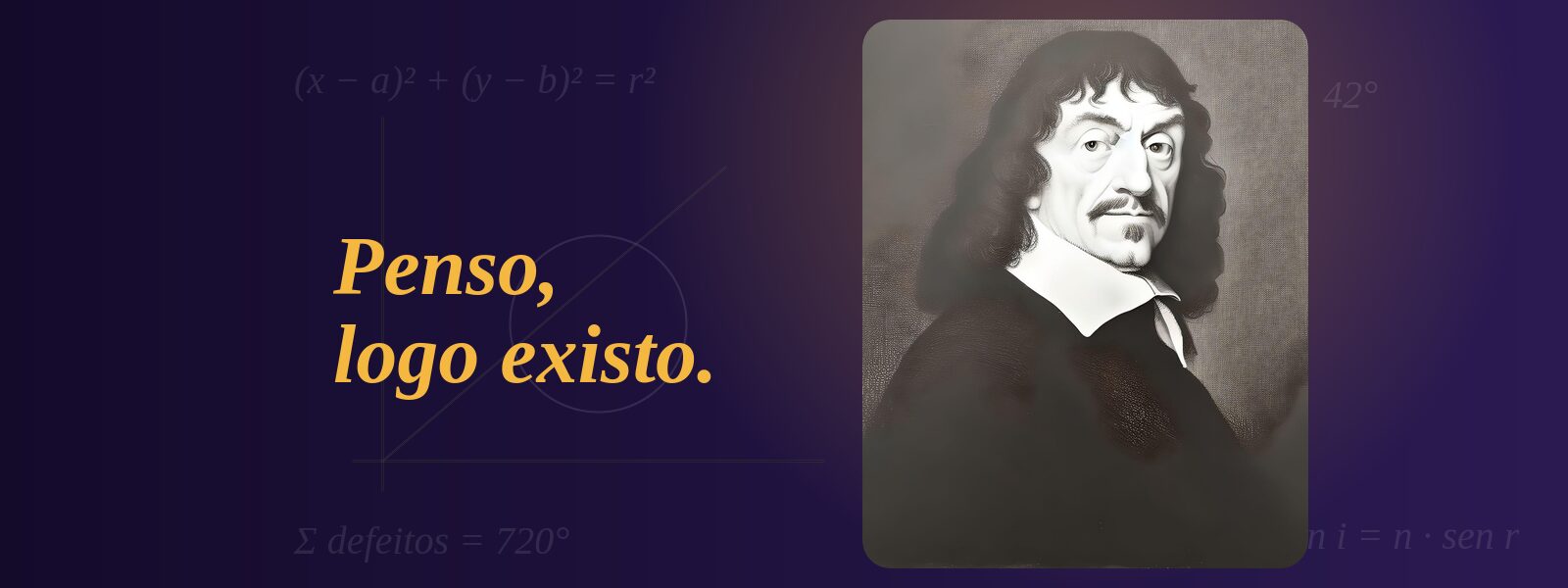
Cogito ergo sum drawn on the Cartesian plane.Euler’s Eyes Collection Here at Euler’s Eyes we like to read “I think, therefore I am” as a little machine. The thought hears something (in Latin, audire) and speaks another (fabulari). The rule that binds what What you hear is the function. Method words physis: nature; methode: the reasoning, the path; graphiko’s: the lines, the drawing; máthema: what is learned, the act of deciphering; functus: who fulfills a task; dominus: the lord, where the word dominion comes from. An example: “say what you hear twice”. Empty parentheses act as a waiting ear a number:

October 10, 2026 Read
Hero Image
Infinitely many prime numbers from a sum

Euclid had already proven, around 300 BC, that there are infinitely many prime numbers. In 1737 Euler found a completely different proof, which linked the primes to calculus. For each prime $p$, the sum of a geometric progression gives $$\frac{1}{1 - \frac{1}{p}} = 1 + \frac{1}{p} + \frac{1}{p^2} + \frac{1}{p^3} + \cdots$$ Multiply these expressions to $p = 2, 3, 5, 7, \dots$ Each product of terms has the form $\frac{1}{2^a 3^b 5^c \cdots}$. As every natural number is written in a single way as a product of primes, each fraction $\frac{1}{n}$ appears exactly once:

October 10, 2026 Read
Hero Image
Fermat's legacy

The father of number theory Title page of the 1670 edition of Diophantus’s Arithmetica, printed in Toulouse “with the observations of P. de Fermat”. It was through this book, published by his son five years after his death, that the margin notes reached Euler.Bernard Bosc, Toulouse (1670) · Wikimedia Commons · public domain Before Fermat, problems about whole numbers were seen as riddles, Diophantus’s puzzles. Fermat turned them into an area of mathematics, with deep questions and methods of its own. For almost a century hardly anyone followed him. It was Euler, from 1730 onwards, who read Fermat’s notes, proved many of them and made number theory a central branch of mathematics. Then came Lagrange, Legendre and Gauss.

October 11, 2026 Read
Hero Image
Systems of equations: the determinant and Gaussian elimination

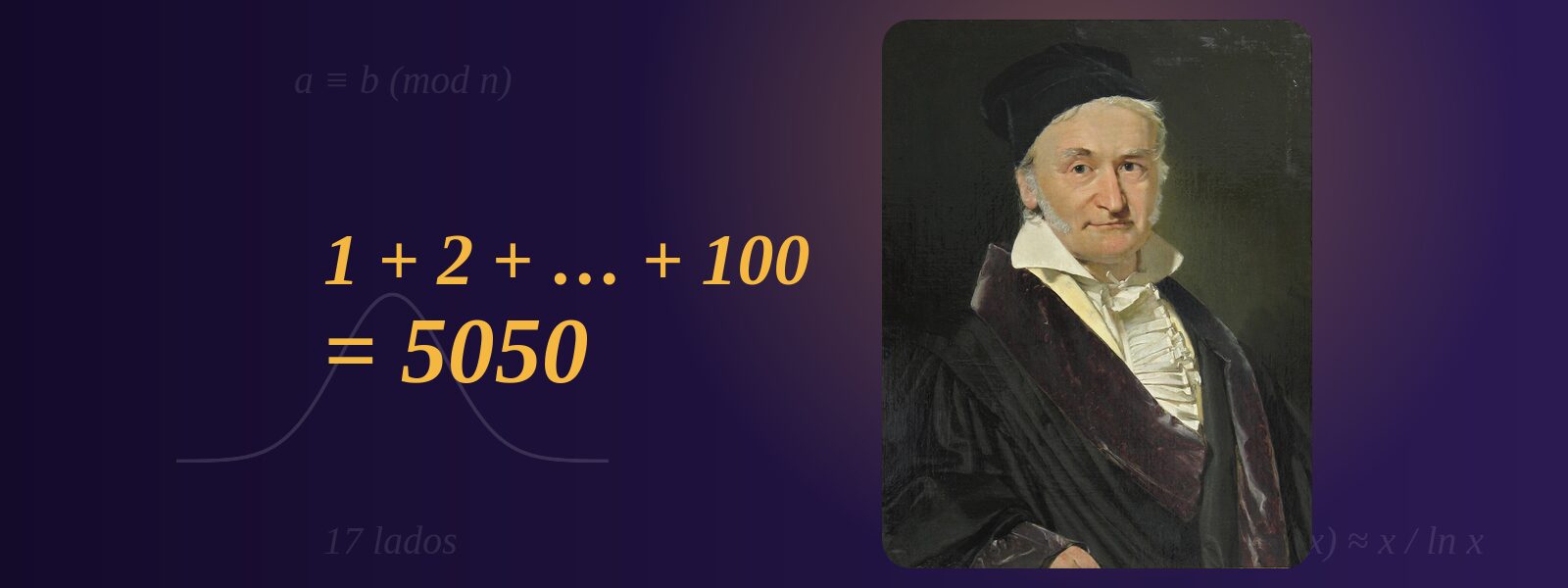
To calculate orbits using least squares, Gauss needed to solve systems of equations with many unknowns. Two names that every student knows come from this story: the determinant and the Gaussian elimination. The determinant. Take a system with two equations: $$\begin{cases} a\,x + b\,y = e \\ c\,x + d\,y = f \end{cases} \quad\Longrightarrow\quad x = \frac{e\,d - b\,f}{a\,d - b\,c}, \qquad y = \frac{a\,f - e\,c}{a\,d - b\,c}.$$ It all depends on the number $ad - bc$ in the denominator: if it is not zero, the system has a single solution. This number “determines” the system.
October 10, 2026 Read
Hero Image
Descartes and the problem of cannons

Cannons and artillerymen in an old engraving.Euler’s Eyes Collection Descartes experienced war up close. In 1618 he served as a volunteer in the army of Maurice of Nassau and, according to his first biographer, Adrien Baillet, he was in 1628 at the siege of La Rochelle, led by Cardinal Richelieu. On the battlefields, a practical problem occupied the artillerymen: with what angle tilt the cannon to hit a target at a certain distance?

October 10, 2026 Read
Hero Image
Fermat's number that was not prime

Pierre de Fermat believed that all numbers of the form $2^{2^n} + 1$ were prime. For $n = 0, 1, 2, 3, 4$ works: 3, 5, 17, 257 and 65 537 are primes. The next one is $$2^{32} + 1 = 4\,294\,967\,297.$$ Testing all dividers by hand is impractical. In 1732, Euler showed that this number is divisible by 641. An elegant way to look at this uses two ways of writing 641:

October 10, 2026 Read
  • ««
  • «
  • 1
  • 2
  • 3
  • 4
  • »
  • »»
Navigation
  • Start here
  • Recent posts
  • About Euler
  • App
  • Privacy
Contact me:
  • hirowat2@gmail.com

Euler's Eyes
© 2021 Euler Eyes.
Powered by Hugo Logo