Logo Euler's Eyes
  • Dark Theme
    Light Theme Dark Theme System Theme
Logo Inverted Logo
  • Tags
  • 1 Phase
  • 1st Phase
  • 2 Phase
  • 2 Phase,
  • 2nd Phase
  • 2° Degree Equation
  • Alan Turing
  • Algebra
  • Algebraic Expressions
  • Analysis
  • Analytic Geometry
  • Analytical Geometry
  • Angle Bisector
  • Angle Measurements
  • Angles
  • Apothem
  • Arc Capable
  • Arc Properties
  • Archimedes
  • Area
  • Arithmetic Progression
  • Artificial Intelligence
  • Axioms and Postulates
  • Basic Concepts of Statistics
  • Bernoulli
  • Bhaskara
  • Binary Numbers
  • Binomial
  • Biography
  • Calculating Machine
  • Calculation
  • Calculus
  • Calculus of Variations
  • Cartesian Plane
  • Cartesian Product of Sets
  • Cauchy
  • Central Angle
  • Centroid
  • Children
  • Circle
  • Circle Area
  • Circumcenter
  • Circumference
  • Circumference Ratio
  • Circumferences
  • Circumscript Segments
  • Classification in Mathematics
  • Combinatorial Analysis
  • Combinatorics
  • Comparison of Angles
  • Complement
  • Complex Numbers
  • Compound Interest
  • Computing
  • Concave Region
  • Congruence
  • Congruence of Triangles
  • Convex Region
  • Correspondence Law
  • Cosine Theorem
  • Count
  • Cryptography
  • Decision Theory
  • Demo
  • Derivative
  • Descartes
  • Diagonals
  • Diamond
  • Differential Equations
  • Dispersion Measures
  • Distance
  • Division
  • Domain and Image
  • Einstein
  • Elasticity
  • Electromagnetism
  • Elementary Descriptive Statistics
  • Elementary School I
  • Elementary School II
  • ENEM 2021
  • ENEM 2022
  • ENEM 2023
  • ENEM 2024
  • ENEM 2025
  • Entrance Exam
  • Equality
  • Equations
  • Equiprobable Events
  • Equivalence Between Sets
  • Equivalence Relations
  • Euclid
  • Euclid's Postulate
  • Euler
  • Euler Project
  • Even Numbers
  • Exercises for Adding Natural Numbers
  • Exponential Function
  • External Angles
  • Fees
  • Fermat
  • Fermat's Last Theorem
  • Financial Mathematics
  • First Degree Equations
  • First Degree Functions
  • Flat
  • Flat Figures
  • Flat Geometry
  • Fractions
  • Function Concept
  • Function Discovery
  • Functions
  • FUVEST 2021
  • FUVEST 2022
  • FUVEST 2023
  • FUVEST 2024
  • FUVEST 2025
  • FUVEST 2026
  • Galois
  • Game Theory
  • Gauss
  • Geometric Constructions
  • Geometric Shapes
  • Geometry
  • Geometry With Natural Numbers
  • Geometry With Sequences of Numbers
  • Golden Segment
  • Graph Reading
  • Graphics
  • Graphs for Integers
  • Gravitation
  • Greatest Common Divisor
  • Group Theory
  • Groups
  • Hamilton
  • Height
  • History of Mathematics
  • Incenter
  • Increases and Discounts
  • Inequalities
  • Inscribable Quadrilateral
  • Inscribed Angle
  • Integral
  • Internal Angles
  • Interval Operations
  • Intervals
  • Introduction
  • Introduction to Angles
  • Introduction to Circumference
  • Introduction to Function Theory
  • Introduction to Geometry
  • Introduction to Integers
  • Introduction to Logarithm Table
  • Introduction to Polygons
  • Introduction to Probability
  • Introduction to Quadrilaterals
  • Introduction to Radiciation
  • Introduction to Rational Numbers
  • Introduction to Real Numbers
  • Introduction to Sets
  • Introduction to Statistics
  • Introduction to Triangles
  • Johann Bernoulli
  • John Napier
  • John Nash
  • Kids
  • Lagrange
  • Language
  • Law of Cosines
  • Law of Sines
  • Least Common Multiple
  • Leibniz
  • Level 1
  • Level 2
  • Level 3
  • Limit
  • Linear Systems
  • Logarithm
  • Logarithm Properties
  • Logarithms
  • Logic
  • Magnification
  • Math Elements
  • Mathematical Biology
  • Mathematical Logic
  • Mathematical Notation
  • Mathematical Programming
  • Mathematics Education
  • Mathematics Elements
  • Mathematics for Children
  • Mathematics for Kids
  • Matrices
  • Maxwell
  • Measure
  • Mechanics
  • Medium Base
  • Metric Relationships
  • Midpoint
  • Modular Function
  • Multiplication
  • Napier
  • Natural Number Subtraction Exercises
  • Newton
  • Niels Henrik Abel
  • Notable Points of the Triangle
  • Notation
  • Notion of Infinity
  • Notions of Probability
  • Nth Root
  • Number And
  • Number Theory
  • Number Π
  • Numbering Systems
  • Numerical Calculation
  • Numerical Methods
  • OBMEP
  • OBMEP 2023
  • Obmep,
  • Odd Numbers
  • Operations With Rational Numbers
  • Operations With Sets
  • Operations With Venn-Euler Diagrams
  • Optics
  • Optimization
  • Orthocenter
  • Parallelism
  • Parallelogram
  • Parallels
  • Partial Derivatives
  • Pascal
  • Pascal's Triangle
  • Peano Axioms
  • Peirce
  • Percentage
  • Percentage Basics
  • Perimeter
  • Perpendicular Bisector
  • Perpendicularity
  • Perpendiculars
  • Philosophy
  • Physical
  • Physics
  • Pi Number
  • Pi Numbers
  • Pitot
  • Plane Geometry
  • Point
  • Point Power
  • Polygons
  • Polynomials
  • Position Measurements
  • Position Relative to the Circumference
  • Postulates
  • Potentiation of Integers
  • Power With Negative Exponent
  • Prime Numbers
  • Primitive Notions
  • Principia
  • Probability
  • Progressions
  • Proof
  • Properties
  • Properties of Polygons
  • Proportion
  • Proportionality
  • Proportions
  • Proportions and Geometry
  • Pure Mathematics
  • Pythagoras Theorem
  • Pythagorean Suits
  • Quadratic Function
  • Quadrilateral
  • Quadrilaterals
  • Quantifier
  • Quantity Analysis
  • Quaternions
  • R Programming
  • Real Numbers
  • Rectangle
  • Rectangle Triangles
  • Reduction
  • Reflection
  • Regions in Planes
  • Regular Polygons
  • Relations
  • Relationship Properties
  • Relativity
  • Rhombus
  • Right Angle
  • Right Triangle
  • Right Triangle Relationships
  • Rule of 3
  • Rule of Three
  • Saussure
  • Segment Angle
  • Semi-Inscribed Angle
  • Semi-Straight
  • Semiotics
  • Sequences
  • Series
  • Set Family
  • Set Partition
  • Set Theory
  • Signal Rule
  • Similarity
  • Similarity of Triangles
  • Simple Interest
  • Sines Theorem
  • Sophie Germain
  • Spatial Geometry
  • Square
  • Square Root
  • Statistic
  • Stewart Ratio
  • Straight
  • Straight Lines
  • Straight Segment
  • Sum of Angles
  • Supplement
  • Symmetry
  • Tangent
  • Thales' Theorem
  • The Number Zero
  • Theorems
  • Trapezium
  • Trapezius
  • Triangle
  • Triangles
  • Triangular Inequality
  • Trigonometry
  • Truth Table
  • Understanding Relationships
  • Vectors
  • Venn-Euler Diagrams
  • Whole Numbers
  • Wiles
  • Women in Mathematics
  • Year 2018
  • Year 2019
  • Year 2021
  • Year 2022
  • Évariste Galois
Hero Image
Areas and integration: the inverse of fluxions

Measuring the area of curved figures is one of the oldest problems in mathematics. Around 250 BC Archimedes showed that the area of a parabolic segment is $\frac43$ of the area of a triangle inscribed in it. It was a stroke of genius, but made to measure: every new curve needed a new idea. By the 17th century, Fermat, Cavalieri, Wallis and others could already compute the area under $y=x^n$ for many values of $n$. What was missing was a general rule. And what was missing was the realization that Newton and Leibniz each reached in their own way: computing areas and computing rates of change are inverse operations.

October 11, 2026 Read
Hero Image
Clock arithmetic

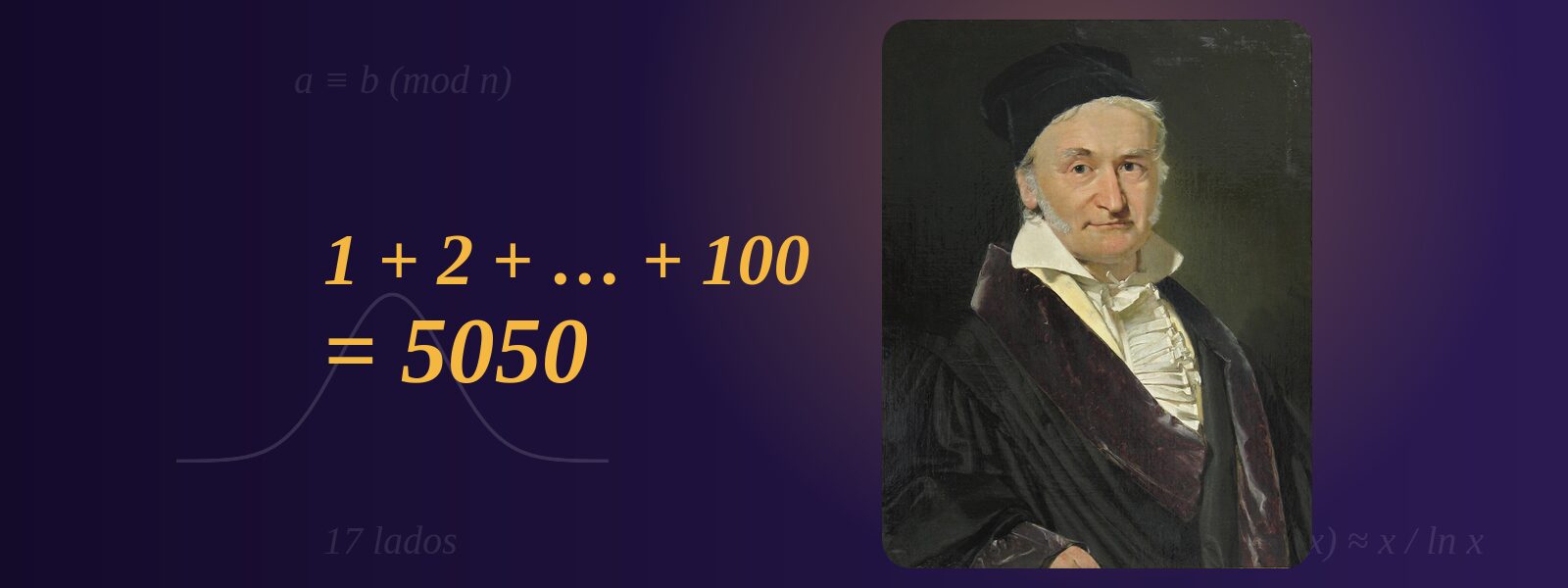
If it is 15h now, what time will it be in 10 hours? It’s not “25 h”, but 1 am: on the clock, after 24 the count starts again. Gauss gave a name and symbol to this idea in Disquisitiones: $$25 \equiv 1 \pmod{24}$$ It reads “25 is congruous to 1, modulo 24”: both leave the same remainder when divided by 24. The symbol $\equiv$ works almost like an equals sign: you can add and multiply on both sides.

October 10, 2026 Read
Hero Image
The rule of signs

How many positive roots can a polynomial have? Descartes gave a simple rule: the number of roots positive is at most the number of sign changes between consecutive coefficients (and, as proved then differs from it by an even number). See with $x^3 - 6x^2 + 11x - 6$. The signs of the coefficients are $+\ -\ +\ -$: three changes. So there is 3 or 1 positive roots. In fact,

October 10, 2026 Read
Hero Image
The number $e$ and compound interest

Banca, trapeza, mensa: the table of the first bankers, between 1450 and 1650. Hence the words bank and banking come from.Euler’s Eyes Collection Before reaching Euler, the number $e$ passed through the banks. The vocabulary of money comes from Latin: depositum (what was put, from ponere), creditum (what was trusted, from credere, to believe) and juro (from jus, juris, the right).

October 10, 2026 Read
Hero Image
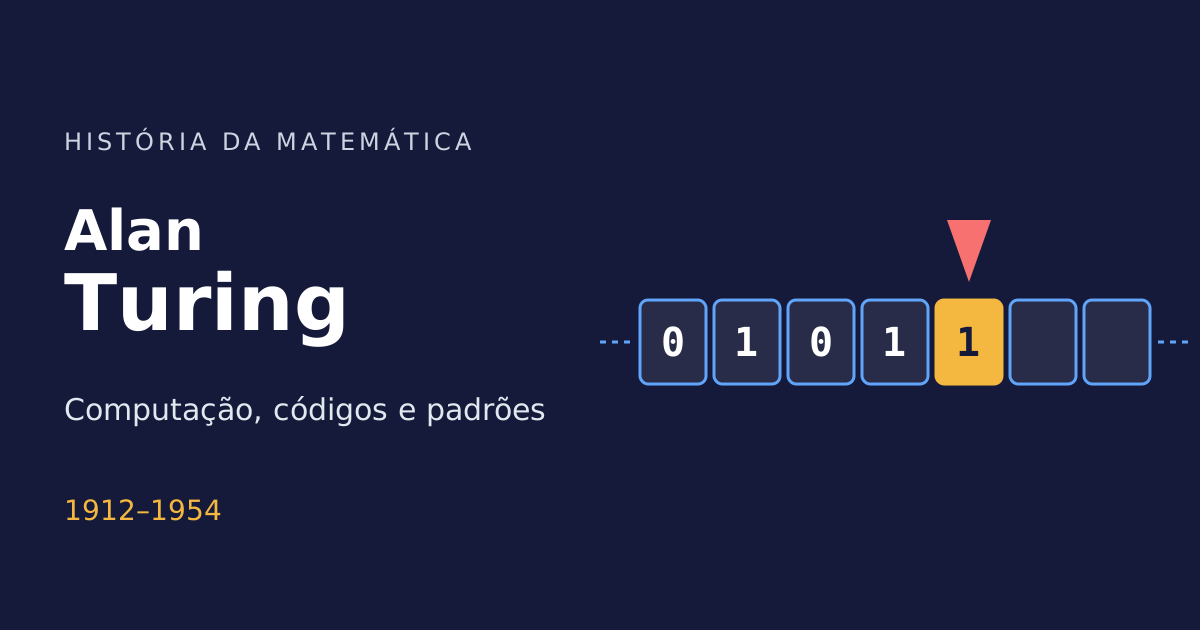
The universal machine: the program is data too

Each Turing machine does one thing only. The one that adds 1 adds 1; the one that writes $\frac17$ writes $\frac17$. To do a different calculation, you would need a different machine. In 1936 that was normal: mechanical calculators, punched-card tabulators and tide-predicting machines were built for one task, and changing task meant changing machine or rewiring. In the same paper, Turing showed that this is not necessary. A machine that reads machines The table of rules of any machine can be written as text on a tape. Turing then described a special machine, $U$, the universal machine, which does the following:

October 16, 2026 Read
Hero Image
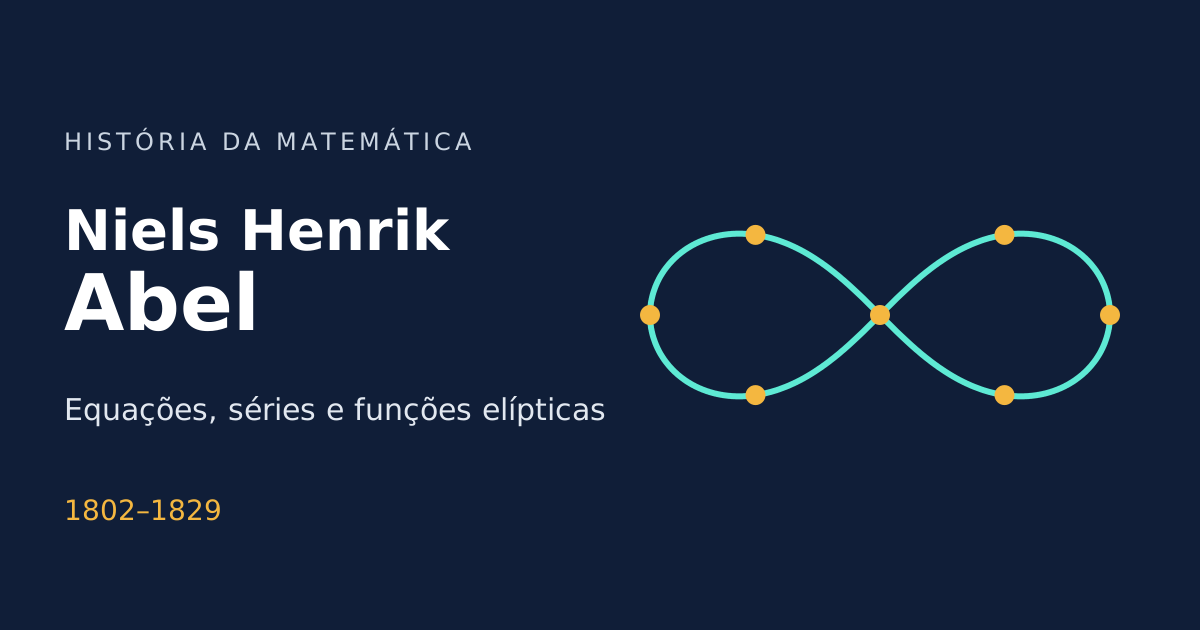
Dividing the lemniscate with ruler and compass

In 1694 Jakob Bernoulli studied a curve shaped like a figure eight lying on its side, which he called lemniscus, a ribbon bow. With its foci at the points $(\pm\frac1{\sqrt2},0)$, it is the set of points whose distances to the two foci have product $\frac12$. Its equation is $$(x^2+y^2)^2=x^2-y^2,$$or, in polar coordinates, $r^2=\cos2\theta$. A century and a half later Abel proved about it a theorem that seems to have come out of Euclid’s book: for which numbers $n$ can the lemniscate be divided into $n$ arcs of equal length using only ruler and compass?

October 15, 2026 Read
Hero Image
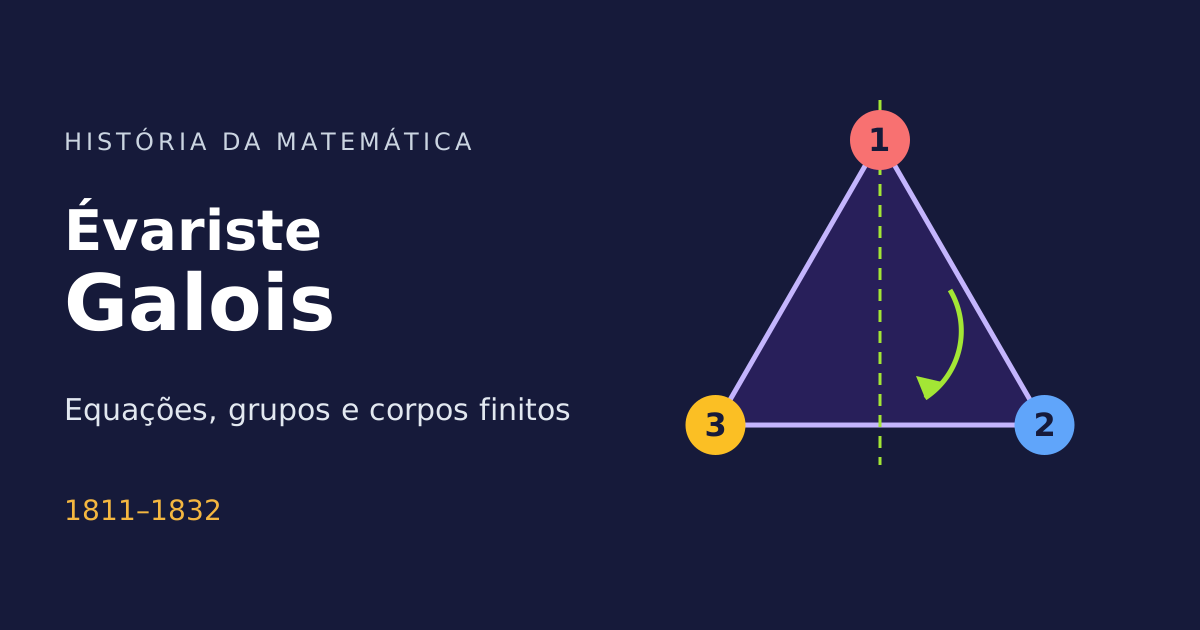
Galois imaginaries: finite fields

In June 1830, aged 18, Galois published a short paper, On the theory of numbers, in a Paris scientific bulletin. In it he invented new numbers, which he called imaginaries, for a world in which only finitely many numbers exist. For more than a century the paper looked like a curiosity. Today it is inside every mobile phone. Counting with remainders In clock arithmetic we count only with the remainders of division by a fixed number. With the number 5 there are only $0, 1, 2, 3, 4$, and the sums “wrap around”:

October 15, 2026 Read
Hero Image
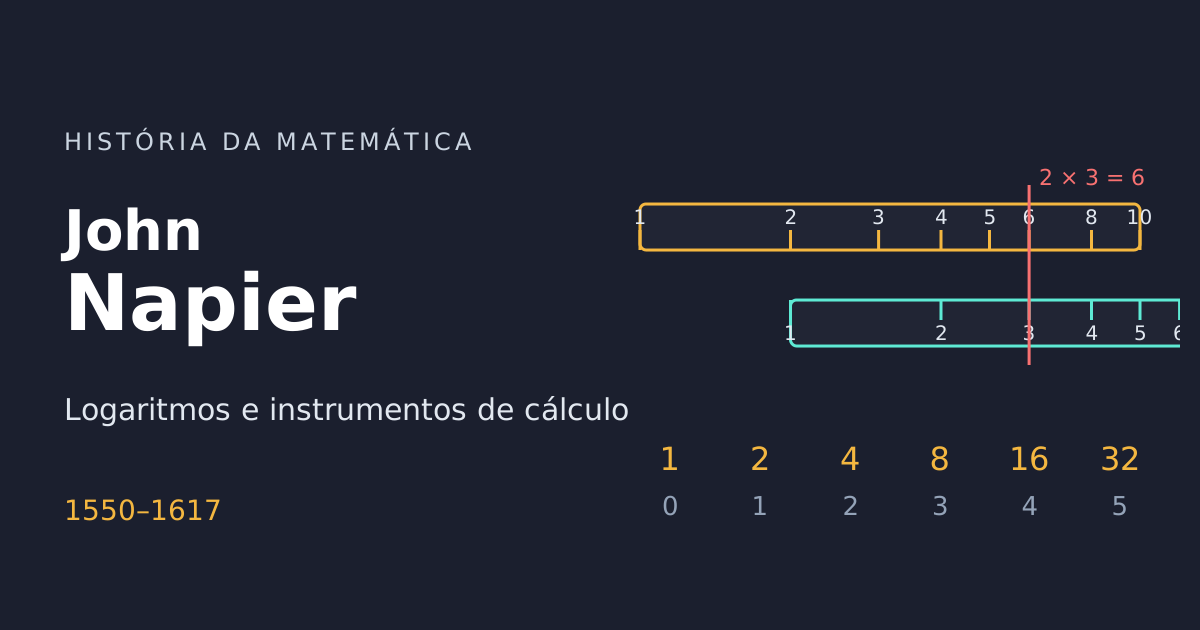
Napier's bones: multiplying with rods

Logarithms were meant for the great calculations of astronomy. For everyday sums Napier invented something else, published in 1617, the year of his death, in a little book called Rabdologia, from the Greek rhabdos, rod, and lógos, calculation: calculation with rods. The rods Each rod, or “bone”, because the most expensive ones were made of ivory, carries at the top a digit from 0 to 9 and, below it, its multiples from 1 to 9, in nine small squares cut by a diagonal. The tens go above the diagonal and the units below. The rod for 7, for example, shows $0/7$, $1/4$, $2/1$, $2/8$, $3/5$, $4/2$, $4/9$, $5/6$, $6/3$.
October 15, 2026 Read
Hero Image
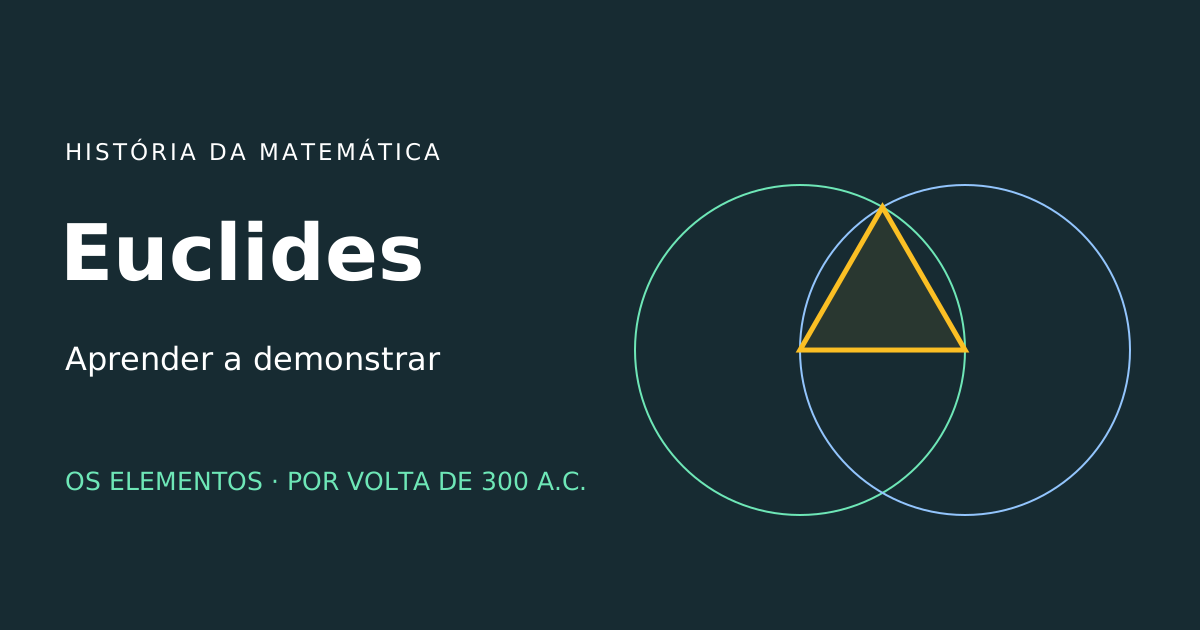
Algebra done with squares and rectangles

If a straight line is cut at random, the square on the whole equals the squares on the segments plus twice the rectangle contained by the segments. — Euclid, Elements, Proposition II.4 The Greeks had no letters for unknowns, no plus or minus signs, no equals sign. When they wanted to speak of $a\cdot b$, they spoke of a rectangle with sides $a$ and $b$; when they wanted $a^2$, they spoke of a square with side $a$. The words “square” and “cube” that we use for powers come from this. Book II of the Elements is made entirely in this way: it consists of identities of algebra, stated and proved as facts about areas. Historians call it geometric algebra.

October 14, 2026 Read
Hero Image
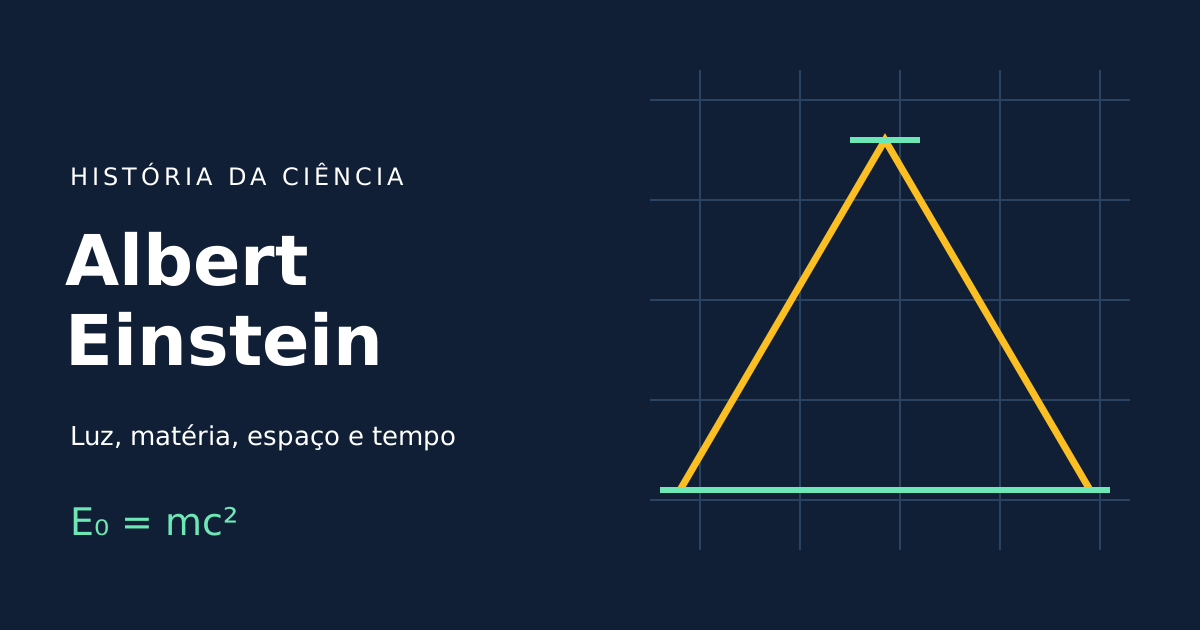
E = mc²: the energy hidden in mass

One more consequence of the paper on electrodynamics has occurred to me. The principle of relativity, together with Maxwell’s equations, requires that mass be a direct measure of the energy contained in a body. The idea is amusing and enticing; but for all I know, the Lord may be laughing over the whole thing and leading me around by the nose. — Albert Einstein, letter to Conrad Habicht (summer 1905) In September 1905, three months after the relativity paper, Einstein sent the Annalen der Physik a supplement of just three pages, with a title in the form of a question: “Does the inertia of a body depend upon its energy content?”. The answer was yes, and the conclusion, written in words and with other letters, is the most famous formula in physics:

October 14, 2026 Read
Hero Image
Four squares are enough

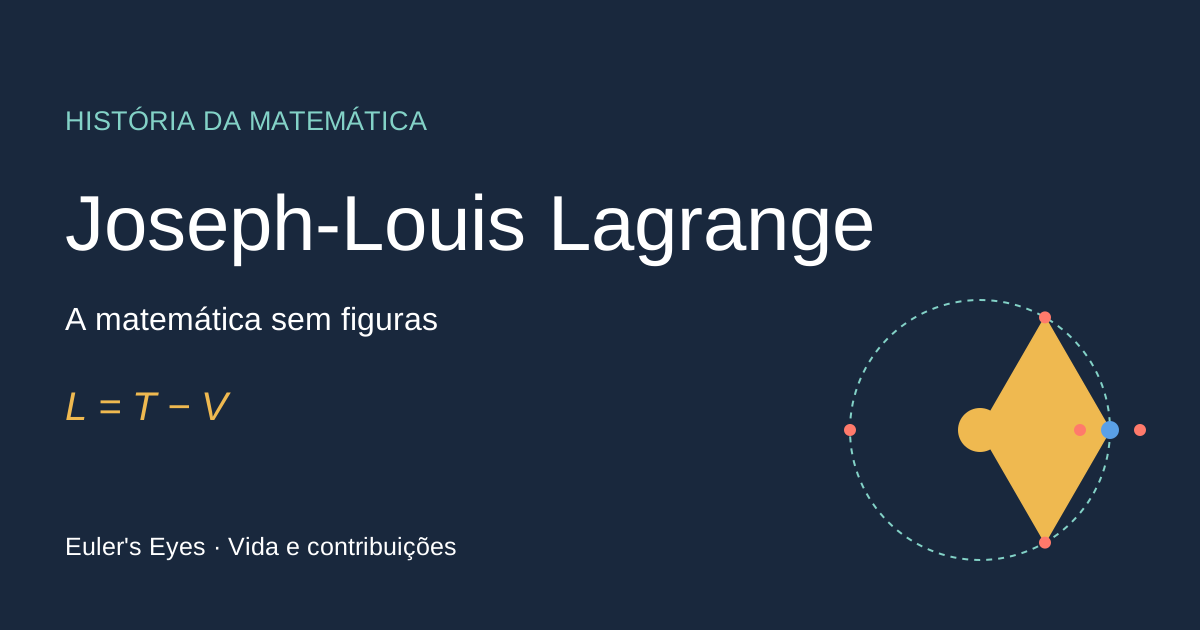
Take any positive whole number and try to write it as a sum of perfect squares, $0, 1, 4, 9, 16, 25, \ldots$, using as few terms as possible: $$\begin{aligned} 5&=4+1,\\ 6&=4+1+1,\\ 7&=4+1+1+1,\\ 30&=25+4+1,\\ 2026&=2025+1=45^2+1^2. \end{aligned}$$Some numbers are squares, others need two, others three. The number 7 needs four: there is no other way. Could some number need five? In 1770 Lagrange proved that no number does: Every positive whole number is a sum of four squares of integers.

October 14, 2026 Read
Hero Image
Maxwell's equations: from Faraday's lines of force to vectors

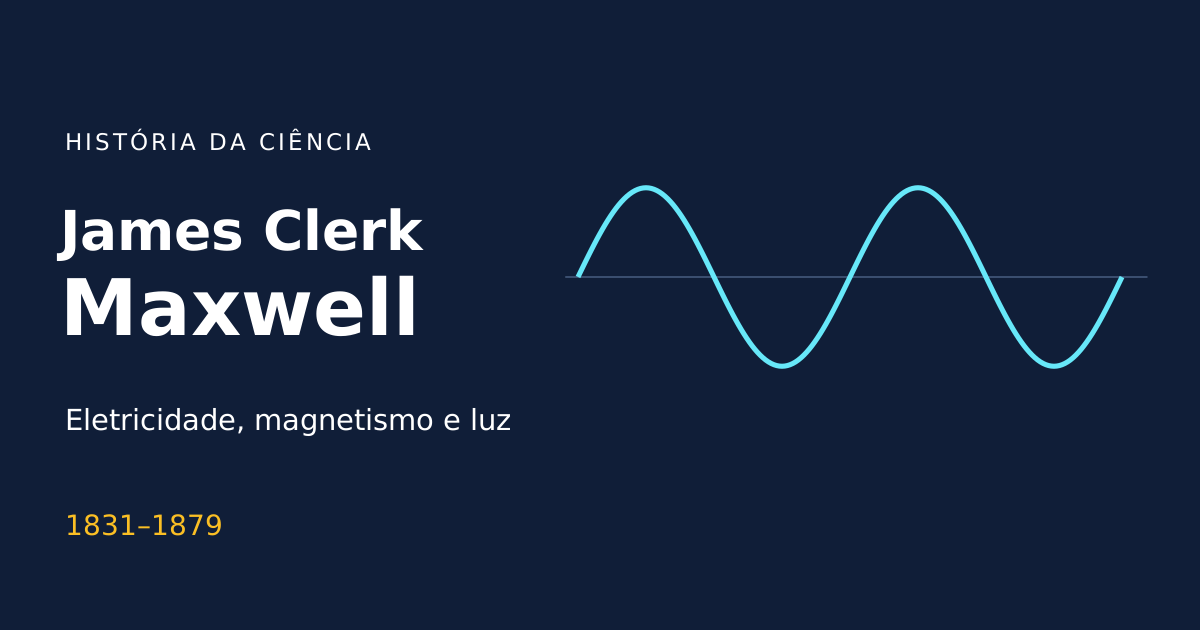
I was at first almost frightened when I saw such mathematical force made to bear upon the subject, and then wondered to see that the subject stood it so well. — Michael Faraday, letter to Maxwell (25 March 1857) Until 1820, electricity and magnetism were separate subjects. Electricity made sparks and raised the hair on your head; magnetism made compasses point north. That year, during a lecture at the University of Copenhagen, the Dane Hans Christian Oersted connected a battery to a wire and saw a nearby magnetic needle move. Electric current produced magnetism.

October 14, 2026 Read
  • ««
  • «
  • 5
  • 6
  • 7
  • 8
  • 9
  • »
  • »»
Navigation
  • Start here
  • Recent posts
  • About Euler
  • App
  • Privacy
Contact me:
  • hirowat2@gmail.com

Euler's Eyes
© 2021 Euler Eyes.
Powered by Hugo Logo