Logo Euler's Eyes
  • Dark Theme
    Light Theme Dark Theme System Theme
Logo Inverted Logo
  • Tags
  • 1 Phase
  • 1st Phase
  • 2 Phase
  • 2 Phase,
  • 2nd Phase
  • 2° Degree Equation
  • Alan Turing
  • Algebra
  • Algebraic Expressions
  • Analysis
  • Analytic Geometry
  • Analytical Geometry
  • Angle Bisector
  • Angle Measurements
  • Angles
  • Apothem
  • Arc Capable
  • Arc Properties
  • Archimedes
  • Area
  • Arithmetic Progression
  • Artificial Intelligence
  • Axioms and Postulates
  • Basic Concepts of Statistics
  • Bernoulli
  • Bhaskara
  • Binary Numbers
  • Binomial
  • Biography
  • Calculating Machine
  • Calculation
  • Calculus
  • Calculus of Variations
  • Cartesian Plane
  • Cartesian Product of Sets
  • Cauchy
  • Central Angle
  • Centroid
  • Children
  • Circle
  • Circle Area
  • Circumcenter
  • Circumference
  • Circumference Ratio
  • Circumferences
  • Circumscript Segments
  • Classification in Mathematics
  • Combinatorial Analysis
  • Combinatorics
  • Comparison of Angles
  • Complement
  • Complex Numbers
  • Compound Interest
  • Computing
  • Concave Region
  • Congruence
  • Congruence of Triangles
  • Convex Region
  • Correspondence Law
  • Cosine Theorem
  • Count
  • Cryptography
  • Decision Theory
  • Demo
  • Derivative
  • Descartes
  • Diagonals
  • Diamond
  • Differential Equations
  • Dispersion Measures
  • Distance
  • Division
  • Domain and Image
  • Einstein
  • Elasticity
  • Electromagnetism
  • Elementary Descriptive Statistics
  • Elementary School I
  • Elementary School II
  • ENEM 2021
  • ENEM 2022
  • ENEM 2023
  • ENEM 2024
  • ENEM 2025
  • Entrance Exam
  • Equality
  • Equations
  • Equiprobable Events
  • Equivalence Between Sets
  • Equivalence Relations
  • Euclid
  • Euclid's Postulate
  • Euler
  • Euler Project
  • Even Numbers
  • Exercises for Adding Natural Numbers
  • Exponential Function
  • External Angles
  • Fees
  • Fermat
  • Fermat's Last Theorem
  • Financial Mathematics
  • First Degree Equations
  • First Degree Functions
  • Flat
  • Flat Figures
  • Flat Geometry
  • Fractions
  • Function Concept
  • Function Discovery
  • Functions
  • FUVEST 2021
  • FUVEST 2022
  • FUVEST 2023
  • FUVEST 2024
  • FUVEST 2025
  • FUVEST 2026
  • Galois
  • Game Theory
  • Gauss
  • Geometric Constructions
  • Geometric Shapes
  • Geometry
  • Geometry With Natural Numbers
  • Geometry With Sequences of Numbers
  • Golden Segment
  • Graph Reading
  • Graphics
  • Graphs for Integers
  • Gravitation
  • Greatest Common Divisor
  • Group Theory
  • Groups
  • Hamilton
  • Height
  • History of Mathematics
  • Incenter
  • Increases and Discounts
  • Inequalities
  • Inscribable Quadrilateral
  • Inscribed Angle
  • Integral
  • Internal Angles
  • Interval Operations
  • Intervals
  • Introduction
  • Introduction to Angles
  • Introduction to Circumference
  • Introduction to Function Theory
  • Introduction to Geometry
  • Introduction to Integers
  • Introduction to Logarithm Table
  • Introduction to Polygons
  • Introduction to Probability
  • Introduction to Quadrilaterals
  • Introduction to Radiciation
  • Introduction to Rational Numbers
  • Introduction to Real Numbers
  • Introduction to Sets
  • Introduction to Statistics
  • Introduction to Triangles
  • Johann Bernoulli
  • John Napier
  • John Nash
  • Kids
  • Lagrange
  • Language
  • Law of Cosines
  • Law of Sines
  • Least Common Multiple
  • Leibniz
  • Level 1
  • Level 2
  • Level 3
  • Limit
  • Linear Systems
  • Logarithm
  • Logarithm Properties
  • Logarithms
  • Logic
  • Magnification
  • Math Elements
  • Mathematical Biology
  • Mathematical Logic
  • Mathematical Notation
  • Mathematical Programming
  • Mathematics Education
  • Mathematics Elements
  • Mathematics for Children
  • Mathematics for Kids
  • Matrices
  • Maxwell
  • Measure
  • Mechanics
  • Medium Base
  • Metric Relationships
  • Midpoint
  • Modular Function
  • Multiplication
  • Napier
  • Natural Number Subtraction Exercises
  • Newton
  • Niels Henrik Abel
  • Notable Points of the Triangle
  • Notation
  • Notion of Infinity
  • Notions of Probability
  • Nth Root
  • Number And
  • Number Theory
  • Number Π
  • Numbering Systems
  • Numerical Calculation
  • Numerical Methods
  • OBMEP
  • OBMEP 2023
  • Obmep,
  • Odd Numbers
  • Operations With Rational Numbers
  • Operations With Sets
  • Operations With Venn-Euler Diagrams
  • Optics
  • Optimization
  • Orthocenter
  • Parallelism
  • Parallelogram
  • Parallels
  • Partial Derivatives
  • Pascal
  • Pascal's Triangle
  • Peano Axioms
  • Peirce
  • Percentage
  • Percentage Basics
  • Perimeter
  • Perpendicular Bisector
  • Perpendicularity
  • Perpendiculars
  • Philosophy
  • Physical
  • Physics
  • Pi Number
  • Pi Numbers
  • Pitot
  • Plane Geometry
  • Point
  • Point Power
  • Polygons
  • Polynomials
  • Position Measurements
  • Position Relative to the Circumference
  • Postulates
  • Potentiation of Integers
  • Power With Negative Exponent
  • Prime Numbers
  • Primitive Notions
  • Principia
  • Probability
  • Progressions
  • Proof
  • Properties
  • Properties of Polygons
  • Proportion
  • Proportionality
  • Proportions
  • Proportions and Geometry
  • Pure Mathematics
  • Pythagoras Theorem
  • Pythagorean Suits
  • Quadratic Function
  • Quadrilateral
  • Quadrilaterals
  • Quantifier
  • Quantity Analysis
  • Quaternions
  • R Programming
  • Real Numbers
  • Rectangle
  • Rectangle Triangles
  • Reduction
  • Reflection
  • Regions in Planes
  • Regular Polygons
  • Relations
  • Relationship Properties
  • Relativity
  • Rhombus
  • Right Angle
  • Right Triangle
  • Right Triangle Relationships
  • Rule of 3
  • Rule of Three
  • Saussure
  • Segment Angle
  • Semi-Inscribed Angle
  • Semi-Straight
  • Semiotics
  • Sequences
  • Series
  • Set Family
  • Set Partition
  • Set Theory
  • Signal Rule
  • Similarity
  • Similarity of Triangles
  • Simple Interest
  • Sines Theorem
  • Sophie Germain
  • Spatial Geometry
  • Square
  • Square Root
  • Statistic
  • Stewart Ratio
  • Straight
  • Straight Lines
  • Straight Segment
  • Sum of Angles
  • Supplement
  • Symmetry
  • Tangent
  • Thales' Theorem
  • The Number Zero
  • Theorems
  • Trapezium
  • Trapezius
  • Triangle
  • Triangles
  • Triangular Inequality
  • Trigonometry
  • Truth Table
  • Understanding Relationships
  • Vectors
  • Venn-Euler Diagrams
  • Whole Numbers
  • Wiles
  • Women in Mathematics
  • Year 2018
  • Year 2019
  • Year 2021
  • Year 2022
  • Évariste Galois
Hero Image
Fermat and Pascal: fairly dividing an interrupted game

Two players bet the same amount on a game of several rounds: whoever first wins a certain number of rounds takes everything. Midway through, the game has to be stopped. How should the money be divided fairly? This is the problem of points. It looks simple, but it defeated mathematicians for more than 150 years. The wrong answer In 1494 the Italian friar Luca Pacioli proposed dividing the prize in proportion to the rounds already won. If A has won 2 rounds and B has won 1, A takes $\frac23$ of the prize.

October 11, 2026 Read
Hero Image
Leibniz's machine: turning sums into motion

In 1642 the young Blaise Pascal built a machine to help his father, a tax collector. The Pascaline added and subtracted by turning gears. To multiply, however, you had to repeat the addition by hand, many times. Leibniz saw a Pascaline in Paris and wanted to go further: a machine that would multiply and divide on its own. Multiplying is adding and shifting The trick is the same as in long multiplication at school. To multiply $23\times14$, we split 14 into $4+10$:

October 11, 2026 Read
Hero Image
The laws of motion: forces and changes in velocity

For Aristotle, a body moves only while something pushes it. Stop pushing the cart and it stops. It seems obvious, and it was accepted for almost two thousand years. Galileo had his doubts. Rolling balls down inclined planes, he noticed that the smoother the surface, the further the ball went. With no friction at all, it would never stop. Descartes reached a similar idea. Newton put these clues together and, in the Principia of 1687, wrote three laws that became the foundation of all mechanics.

October 11, 2026 Read
Hero Image
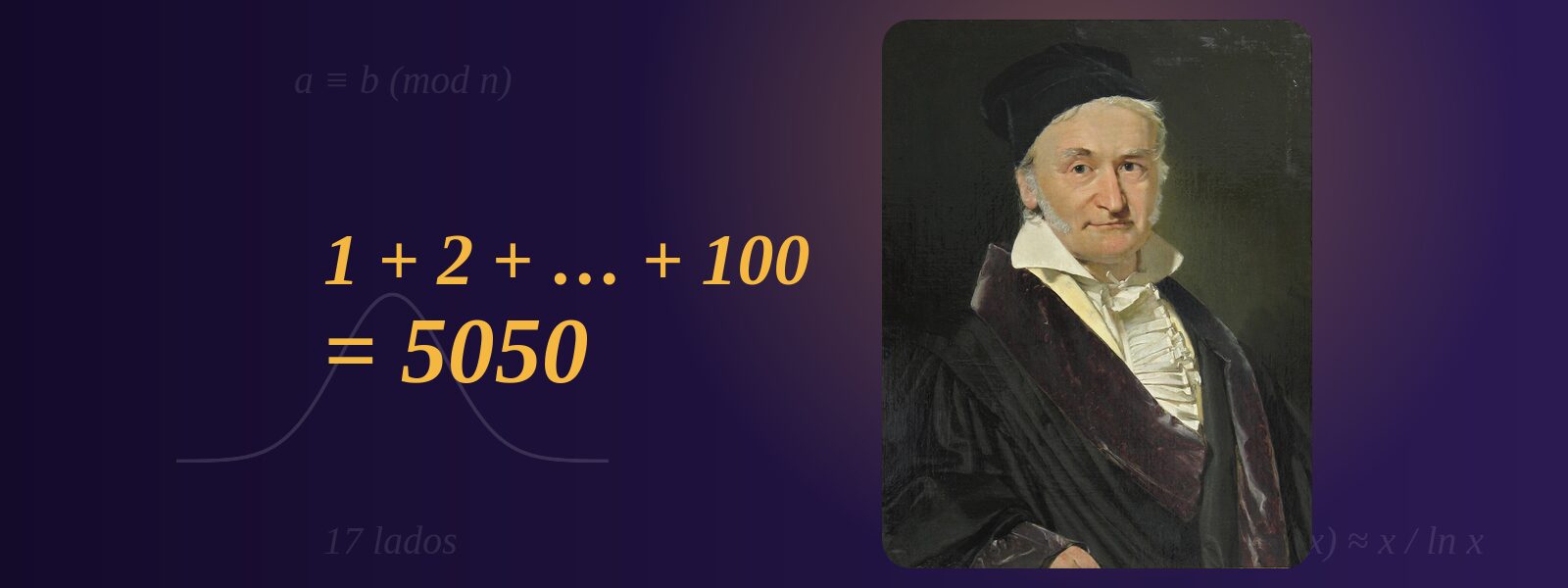
Counting prime numbers

Euler proved that the primes never end (see his chapter). But how many are there? At 15 years old, Gauss He spent his free time counting cousins in tables, one thousand at a time. Did you notice that, close to a number $x$, more or less 1 in every $\ln x$ number is prime. Hence the estimate: the number of primes up to $x$, which we call $\pi(x)$, is similar to

October 10, 2026 Read
Hero Image
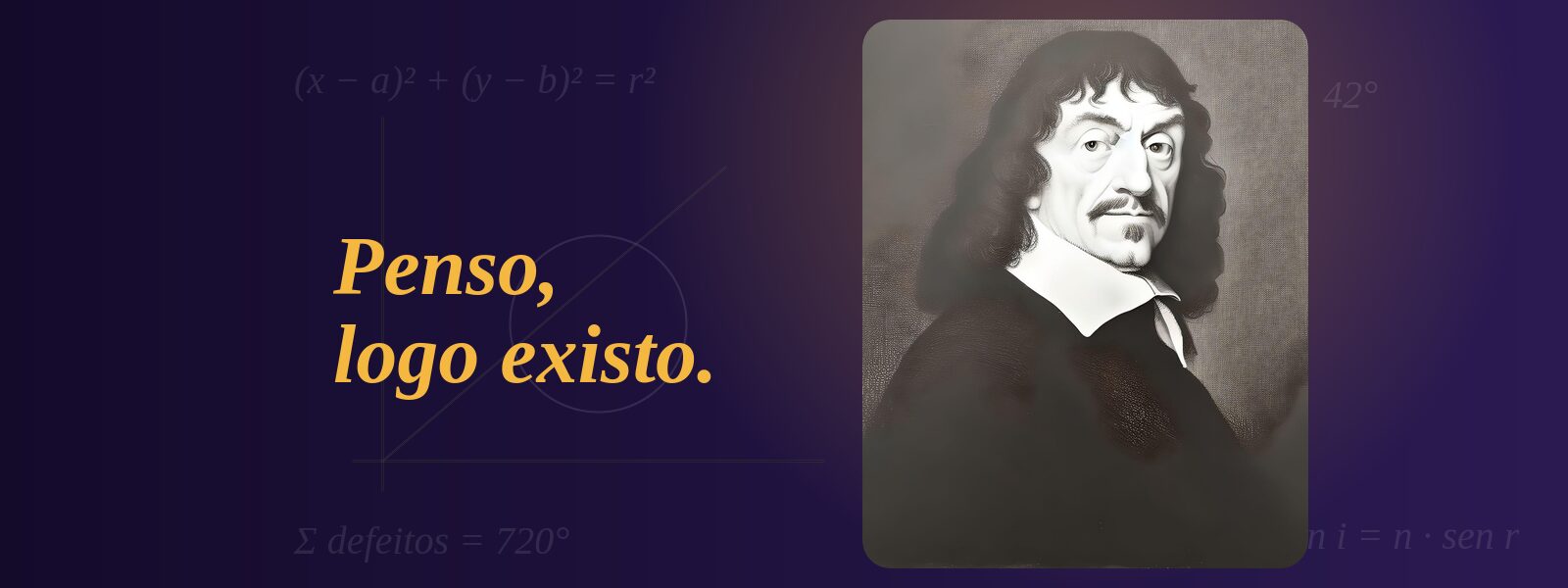
The kissing circles theorem

In 1643’s letter to Princess Elisabeth, Descartes dealt with four tangent circles two by two. Call the curvature of a circle the inverse of the radius, $k = \frac{1}{r}$. The theorem says that the curvatures satisfy $$(k_1 + k_2 + k_3 + k_4)^2 = 2\left(k_1^2 + k_2^2 + k_3^2 + k_4^2\right).$$ Application: three equal coins of radius 1 touch each other two by two. What is the radius of the circle that fits in the hole between them? With $k_1 = k_2 = k_3 = 1$ and $k_4 = k$:

October 10, 2026 Read
Hero Image
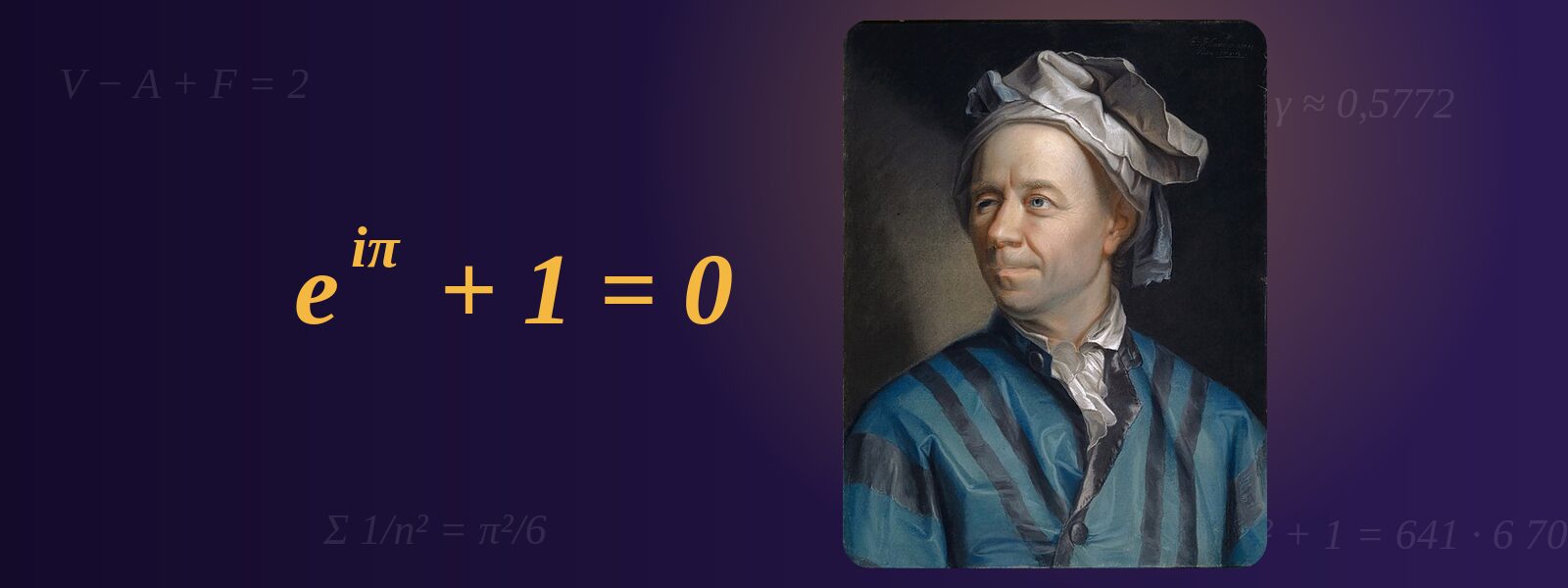
The spring and differential equations

A differential equation is an equation in which the unknown is a function, and the equation speaks of its derivatives. Euler organized this path into a scheme that we still use today: observe a phenomenon, write the equation, find the function that solves it and draw the graph. Euler’s scheme: phenomenon → differential equation → solution function → graph. The derivative also points to the maximum and minimum points.Euler’s Eyes Collection The phenomenon. In 1678, Robert Hooke summarized the behavior of a spring in Latin: ut tensio, sic vis, “as extension, so strength.” A spring of constant $k$, stretched by $x$, pulls back with strength $F = -kx$.

October 10, 2026 Read
Hero Image
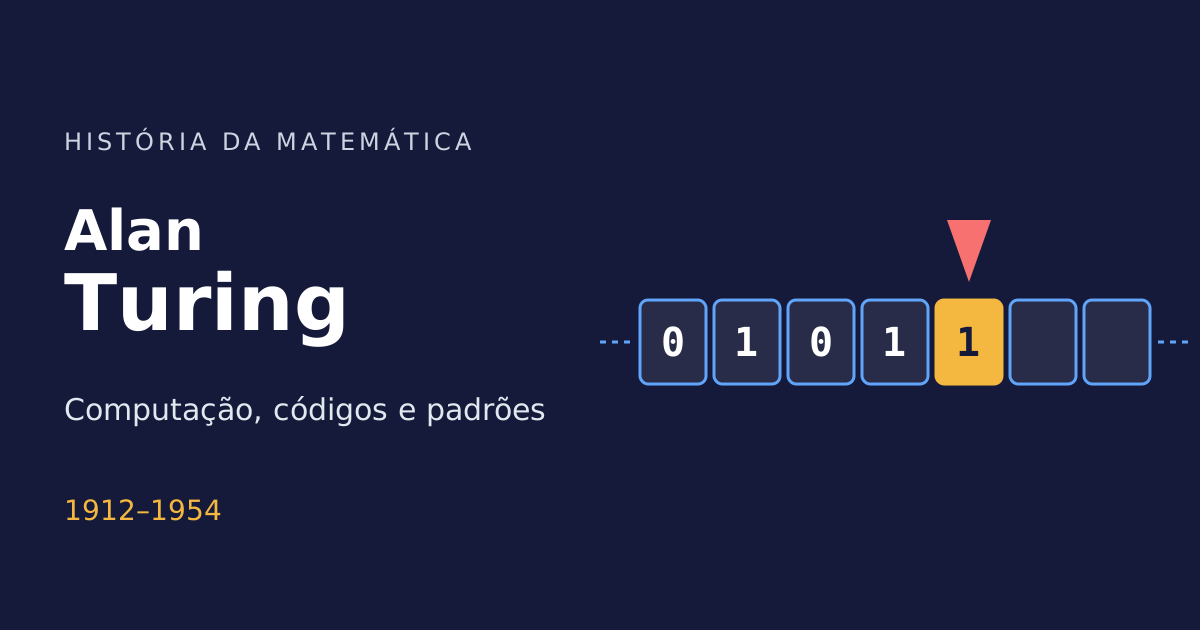
Banburismus: weighing evidence in decibans

The bombe was fast, but not fast enough to test every rotor order of the naval Enigma. In 1940 Turing invented a pencil-and-paper method to rule out most of them before switching on the machines. Because the sheets used in the method were printed in the town of Banbury, his colleagues named it Banburismus. The method is statistical. And to devise it, Turing reinvented one of the central ideas of modern statistics.

October 16, 2026 Read
Hero Image
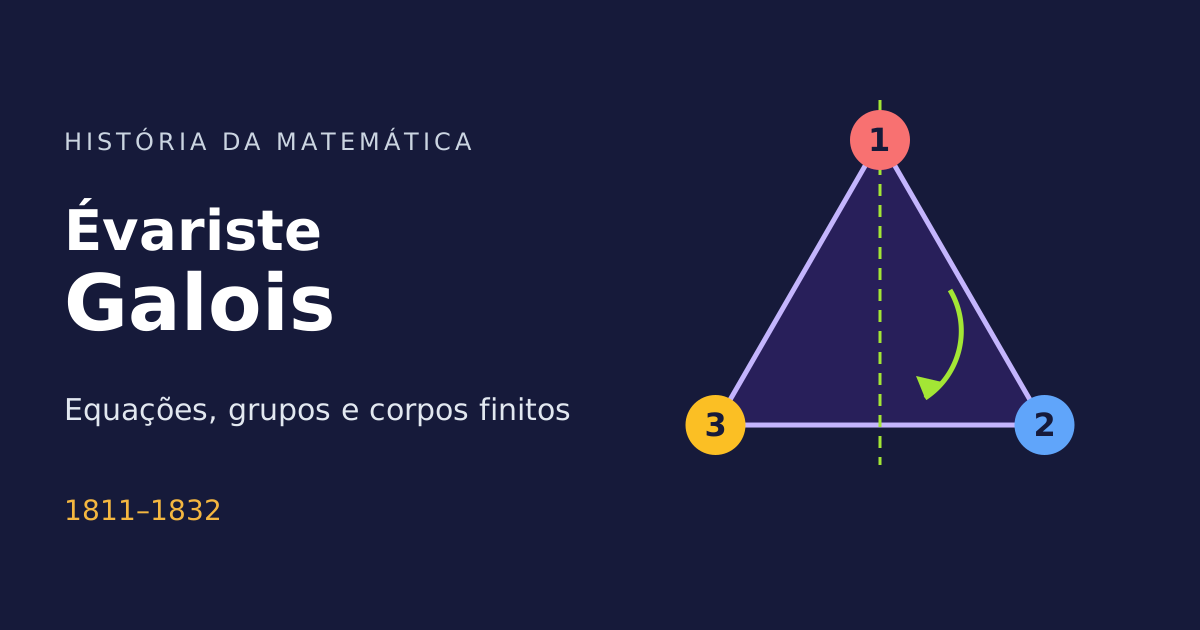
The legacy of Évariste Galois

This letter, if judged by the novelty and profundity of ideas it contains, is perhaps the most substantial piece of writing in the whole literature of mankind. — Hermann Weyl, Symmetry (1952) Galois left some sixty pages of mathematics, much of it written in haste. It took half a century for them to be understood. When they were, they changed the very idea of what mathematics is: instead of studying numbers and figures, studying the transformations that leave them unchanged.

October 15, 2026 Read
Hero Image
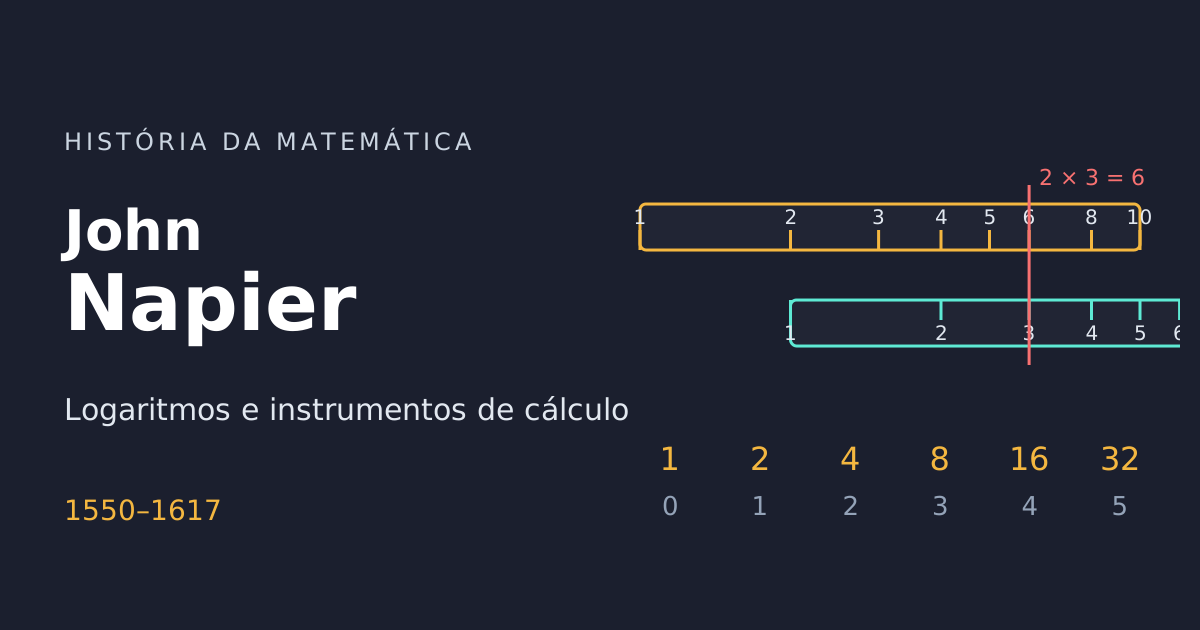
The legacy of John Napier

By shortening the labours, the invention of logarithms doubled, so to speak, the life of the astronomer. — Saying attributed to Pierre-Simon Laplace Few inventions spread so quickly. In less than ten years logarithms were in use in England, Holland, Germany and Italy. For three and a half centuries they were humanity’s main calculating tool. Kepler The first great user was Johannes Kepler, who saw Napier’s tables in 1617 and was delighted. In 1619 he wrote a letter of thanks to the Scottish baron, not knowing he had been dead for two years, and dedicated his Ephemerides of 1620 to him. Kepler computed his own tables of logarithms and used them in the Rudolphine Tables of 1627, the most accurate tables of planetary positions of the time, which confirmed the elliptical orbits.
October 15, 2026 Read
Hero Image
The legacy of Niels Henrik Abel

Abel has left mathematicians enough work for a hundred and fifty years. — Saying attributed to Charles Hermite Abel worked as a mathematician for less than eight years. In that time he settled the oldest question in algebra, brought rigour to series, created elliptic functions and wrote a memoir that was only fully understood decades after his death. His name is now found in more places in mathematics than that of almost anyone else: abelian groups, abelian integrals, abelian functions, abelian varieties, Abel’s theorem, Abel summation, Abel’s test.

October 15, 2026 Read
Hero Image
Light is an electromagnetic wave

We can scarcely avoid the inference that light consists in the transverse undulations of the same medium which is the cause of electric and magnetic phenomena. — James Clerk Maxwell, “On physical lines of force” (1862), with the original italics In the summer of 1861, at Glenlair, far from his books, Maxwell did a calculation with his model of vortices and little wheels: if the medium that transmits electric and magnetic forces were shaken, the disturbance would travel as a wave. At what speed? The calculation gave a number that depended only on two constants measured in the laboratory with magnets and charges. He did not have the values to hand. When he returned to London in October, he looked them up. The number was the speed of light.

October 14, 2026 Read
Hero Image
Mean curvature: how much a surface bends

To write the equation of vibrating plates, Sophie Germain had to answer a question that sounds simple: how much is a surface bent at a point? Her answer, mean curvature, is still used today to study soap bubbles, cell membranes and aircraft skins. The curvature of a curve Let us start with a line. A straight line does not bend, and we say its curvature is zero. A circle bends equally at every point, and the smaller it is, the more it bends. That is why the curvature of a circle of radius $R$ is defined as

October 14, 2026 Read
  • ««
  • «
  • 8
  • 9
  • 10
  • 11
  • 12
  • »
  • »»
Navigation
  • Start here
  • Recent posts
  • About Euler
  • App
  • Privacy
Contact me:
  • hirowat2@gmail.com

Euler's Eyes
© 2021 Euler Eyes.
Powered by Hugo Logo