Logo Euler's Eyes
  • Dark Theme
    Light Theme Dark Theme System Theme
Logo Inverted Logo
  • Tags
  • 1 Phase
  • 1st Phase
  • 2 Phase
  • 2 Phase,
  • 2nd Phase
  • 2° Degree Equation
  • Alan Turing
  • Algebra
  • Algebraic Expressions
  • Analysis
  • Analytic Geometry
  • Analytical Geometry
  • Angle Bisector
  • Angle Measurements
  • Angles
  • Apothem
  • Arc Capable
  • Arc Properties
  • Archimedes
  • Area
  • Arithmetic Progression
  • Artificial Intelligence
  • Axioms and Postulates
  • Basic Concepts of Statistics
  • Bernoulli
  • Bhaskara
  • Binary Numbers
  • Binomial
  • Biography
  • Calculating Machine
  • Calculation
  • Calculus
  • Calculus of Variations
  • Cartesian Plane
  • Cartesian Product of Sets
  • Cauchy
  • Central Angle
  • Centroid
  • Children
  • Circle
  • Circle Area
  • Circumcenter
  • Circumference
  • Circumference Ratio
  • Circumferences
  • Circumscript Segments
  • Classification in Mathematics
  • Combinatorial Analysis
  • Combinatorics
  • Comparison of Angles
  • Complement
  • Complex Numbers
  • Compound Interest
  • Computing
  • Concave Region
  • Congruence
  • Congruence of Triangles
  • Convex Region
  • Correspondence Law
  • Cosine Theorem
  • Count
  • Cryptography
  • Decision Theory
  • Demo
  • Derivative
  • Descartes
  • Diagonals
  • Diamond
  • Differential Equations
  • Dispersion Measures
  • Distance
  • Division
  • Domain and Image
  • Einstein
  • Elasticity
  • Electromagnetism
  • Elementary Descriptive Statistics
  • Elementary School I
  • Elementary School II
  • ENEM 2021
  • ENEM 2022
  • ENEM 2023
  • ENEM 2024
  • ENEM 2025
  • Entrance Exam
  • Equality
  • Equations
  • Equiprobable Events
  • Equivalence Between Sets
  • Equivalence Relations
  • Euclid
  • Euclid's Postulate
  • Euler
  • Euler Project
  • Even Numbers
  • Exercises for Adding Natural Numbers
  • Exponential Function
  • External Angles
  • Fees
  • Fermat
  • Fermat's Last Theorem
  • Financial Mathematics
  • First Degree Equations
  • First Degree Functions
  • Flat
  • Flat Figures
  • Flat Geometry
  • Fractions
  • Function Concept
  • Function Discovery
  • Functions
  • FUVEST 2021
  • FUVEST 2022
  • FUVEST 2023
  • FUVEST 2024
  • FUVEST 2025
  • FUVEST 2026
  • Galois
  • Game Theory
  • Gauss
  • Geometric Constructions
  • Geometric Shapes
  • Geometry
  • Geometry With Natural Numbers
  • Geometry With Sequences of Numbers
  • Golden Segment
  • Graph Reading
  • Graphics
  • Graphs for Integers
  • Gravitation
  • Greatest Common Divisor
  • Group Theory
  • Groups
  • Hamilton
  • Height
  • History of Mathematics
  • Incenter
  • Increases and Discounts
  • Inequalities
  • Inscribable Quadrilateral
  • Inscribed Angle
  • Integral
  • Internal Angles
  • Interval Operations
  • Intervals
  • Introduction
  • Introduction to Angles
  • Introduction to Circumference
  • Introduction to Function Theory
  • Introduction to Geometry
  • Introduction to Integers
  • Introduction to Logarithm Table
  • Introduction to Polygons
  • Introduction to Probability
  • Introduction to Quadrilaterals
  • Introduction to Radiciation
  • Introduction to Rational Numbers
  • Introduction to Real Numbers
  • Introduction to Sets
  • Introduction to Statistics
  • Introduction to Triangles
  • Johann Bernoulli
  • John Napier
  • John Nash
  • Kids
  • Lagrange
  • Language
  • Law of Cosines
  • Law of Sines
  • Least Common Multiple
  • Leibniz
  • Level 1
  • Level 2
  • Level 3
  • Limit
  • Linear Systems
  • Logarithm
  • Logarithm Properties
  • Logarithms
  • Logic
  • Magnification
  • Math Elements
  • Mathematical Biology
  • Mathematical Logic
  • Mathematical Notation
  • Mathematical Programming
  • Mathematics Education
  • Mathematics Elements
  • Mathematics for Children
  • Mathematics for Kids
  • Matrices
  • Maxwell
  • Measure
  • Mechanics
  • Medium Base
  • Metric Relationships
  • Midpoint
  • Modular Function
  • Multiplication
  • Napier
  • Natural Number Subtraction Exercises
  • Newton
  • Niels Henrik Abel
  • Notable Points of the Triangle
  • Notation
  • Notion of Infinity
  • Notions of Probability
  • Nth Root
  • Number And
  • Number Theory
  • Number Π
  • Numbering Systems
  • Numerical Calculation
  • Numerical Methods
  • OBMEP
  • OBMEP 2023
  • Obmep,
  • Odd Numbers
  • Operations With Rational Numbers
  • Operations With Sets
  • Operations With Venn-Euler Diagrams
  • Optics
  • Optimization
  • Orthocenter
  • Parallelism
  • Parallelogram
  • Parallels
  • Partial Derivatives
  • Pascal
  • Pascal's Triangle
  • Peano Axioms
  • Peirce
  • Percentage
  • Percentage Basics
  • Perimeter
  • Perpendicular Bisector
  • Perpendicularity
  • Perpendiculars
  • Philosophy
  • Physical
  • Physics
  • Pi Number
  • Pi Numbers
  • Pitot
  • Plane Geometry
  • Point
  • Point Power
  • Polygons
  • Polynomials
  • Position Measurements
  • Position Relative to the Circumference
  • Postulates
  • Potentiation of Integers
  • Power With Negative Exponent
  • Prime Numbers
  • Primitive Notions
  • Principia
  • Probability
  • Progressions
  • Proof
  • Properties
  • Properties of Polygons
  • Proportion
  • Proportionality
  • Proportions
  • Proportions and Geometry
  • Pure Mathematics
  • Pythagoras Theorem
  • Pythagorean Suits
  • Quadratic Function
  • Quadrilateral
  • Quadrilaterals
  • Quantifier
  • Quantity Analysis
  • Quaternions
  • R Programming
  • Real Numbers
  • Rectangle
  • Rectangle Triangles
  • Reduction
  • Reflection
  • Regions in Planes
  • Regular Polygons
  • Relations
  • Relationship Properties
  • Relativity
  • Rhombus
  • Right Angle
  • Right Triangle
  • Right Triangle Relationships
  • Rule of 3
  • Rule of Three
  • Saussure
  • Segment Angle
  • Semi-Inscribed Angle
  • Semi-Straight
  • Semiotics
  • Sequences
  • Series
  • Set Family
  • Set Partition
  • Set Theory
  • Signal Rule
  • Similarity
  • Similarity of Triangles
  • Simple Interest
  • Sines Theorem
  • Sophie Germain
  • Spatial Geometry
  • Square
  • Square Root
  • Statistic
  • Stewart Ratio
  • Straight
  • Straight Lines
  • Straight Segment
  • Sum of Angles
  • Supplement
  • Symmetry
  • Tangent
  • Thales' Theorem
  • The Number Zero
  • Theorems
  • Trapezium
  • Trapezius
  • Triangle
  • Triangles
  • Triangular Inequality
  • Trigonometry
  • Truth Table
  • Understanding Relationships
  • Vectors
  • Venn-Euler Diagrams
  • Whole Numbers
  • Wiles
  • Women in Mathematics
  • Year 2018
  • Year 2019
  • Year 2021
  • Year 2022
  • Évariste Galois
Hero Image
Abelian groups: when order does not matter

Putting on your sock and then your shoe does not give the same result as putting on your shoe and then your sock. Adding 3 and then 5 gives the same as adding 5 and then 3. When the order of two operations does not change the result, we say they commute. The word mathematicians use for structures in which everything commutes is a tribute to Abel: abelian. The last memoir After proving that the general equation of the fifth degree has no formula, Abel wanted to know which equations do have one. In 1829, in one of the last papers he published in Crelle’s Journal, he studied a special family: equations in which all the roots can be obtained from one of them, $x$, by rational functions $\theta_1(x), \theta_2(x),\dots$ that commute with each other:

October 15, 2026 Read
Hero Image
Doubling the cube and trisecting the angle: the impossible constructions

The Greeks left three construction problems that nobody managed to solve with ruler and compass, the tools of Euclid’s Elements: Doubling the cube: constructing the edge of a cube with twice the volume of a given cube. Trisecting the angle: dividing any angle into three equal parts. Squaring the circle: constructing a square with the same area as a given circle. Legend has it that, during a plague, the oracle of Delos told the Athenians to double the altar of Apollo, which had the shape of a cube. They doubled the edge, the volume became eight times larger, and the plague went on. For two thousand years mathematicians tried. The answer only came in the nineteenth century, with the ideas of Gauss and Galois: it is impossible.

October 15, 2026 Read
Hero Image
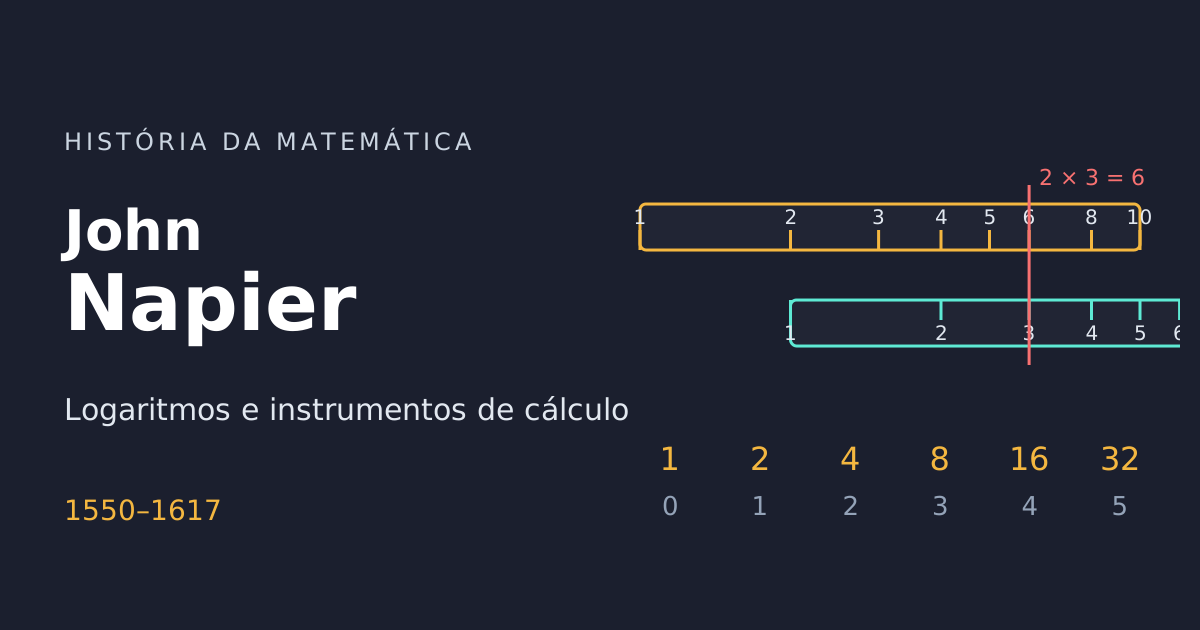
The slide rule: logarithms that slide

A table of logarithms still requires looking numbers up, adding and looking up again. A few years after Napier, the English realised that the logarithms could be put on a ruler and the addition done with the hands. Gunter’s scale In 1620 the astronomer Edmund Gunter, Briggs’s colleague at Gresham College, drew a ruler on which each number $x$ stood at a distance proportional to $\log x$ from the mark for 1:

October 15, 2026 Read
Hero Image
Chladni figures and the prize for vibrating plates

Sprinkle sand on a metal plate held at its centre and draw a violin bow across the edge. The plate begins to sing, and the sand, as if it had a will of its own, flees some places and gathers in others, drawing lines, crosses, stars and symmetrical curves. Change the note, and the drawing changes. These are Chladni figures. How a Chladni plate is excited: the plate is held at the centre and a violin bow is drawn across the edge. Engraving from an 1879 book.Unknown artist, 1879 · Wikimedia Commons · public domain Sound made visible The German Ernst Chladni published these figures in 1787, in a book called Discoveries on the Theory of Sound. The qualitative explanation is simple. When the plate vibrates, almost all its points move up and down and throw the sand away. But some lines stay still: these are the nodal lines. The sand slides there and stays. The drawing is a map of the places where the plate does not move.

October 14, 2026 Read
Hero Image
Crumpling without stretching: the embedding theorem

Take a sheet of paper. You can roll it into a cylinder without tearing or stretching it: distances measured on the sheet, with a flexible ruler, stay the same. But you cannot wrap a ball with it without making folds. The sheet and the sphere have different intrinsic geometries, and Gauss proved in 1827 that this difference, the curvature, does not change when the surface is bent without stretching. In the nineteenth century Bernhard Riemann had an even bolder idea: to describe a surface, or a space of any dimension, by its internal measurements alone, without drawing it anywhere. All it takes is a rule, the metric, that says how to measure the length of any curve. This is how general relativity describes spacetime: from inside, without a larger space around it.
October 14, 2026 Read
Hero Image
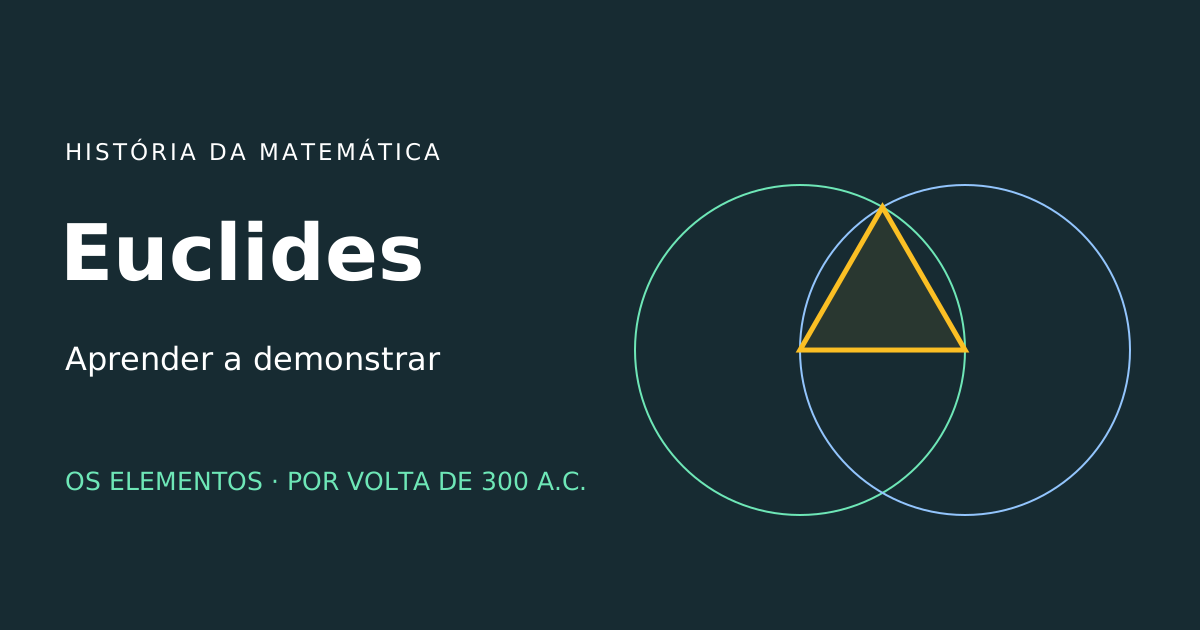
Euclid's algorithm: the greatest common divisor

The Euclidean algorithm is the granddaddy of all algorithms, because it is the oldest nontrivial algorithm that has survived to the present day. — Donald Knuth, The Art of Computer Programming, vol. 2 (1969) You have two rods, one 252 cm long and the other 105 cm, and you want the longest ruler that measures both exactly, a whole number of times. In today’s language you want the greatest common divisor, $\gcd(252,105)$. You could list all the divisors of each number and look for the largest common one, but with big numbers that is impractical. In Book VII of the Elements, Euclid teaches a much faster way.

October 14, 2026 Read
Hero Image
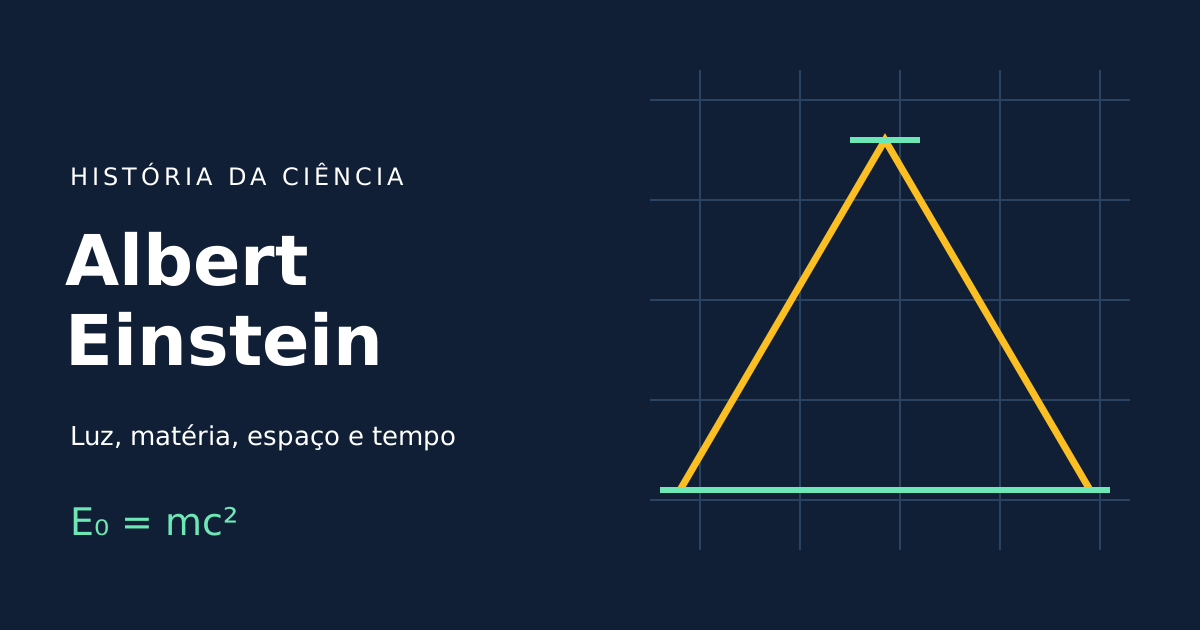
General relativity: from the lift to the Sobral eclipse

I was sitting in a chair in the patent office in Bern when all of a sudden a thought occurred to me: if a person falls freely, he will not feel his own weight. I was startled. This simple thought made a deep impression on me. It impelled me towards a theory of gravitation. — Albert Einstein, on an idea of 1907 The relativity of 1905 had a flaw: it did not include gravity. Newton’s law says the Sun pulls the Earth instantly, across 150 million kilometres, and relativity says nothing travels faster than light. Einstein spent eight years trying to fix this. His starting point was what he called “the happiest thought of my life”.

October 14, 2026 Read
Hero Image
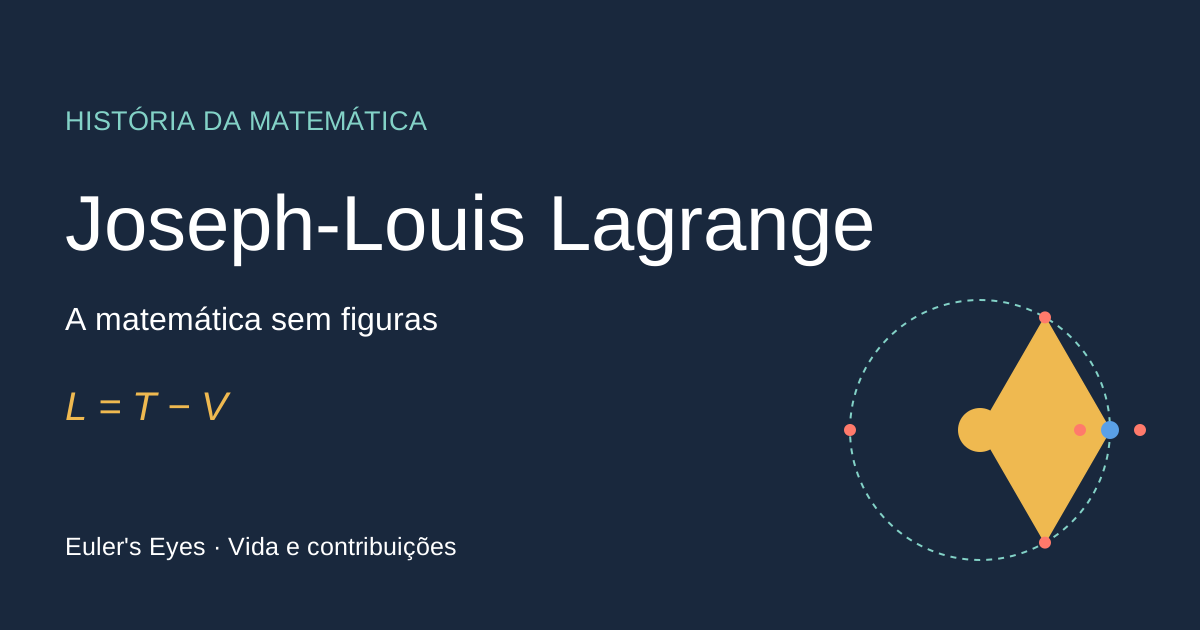
Shuffling the roots: Lagrange's theorem

In 1770 algebra had a problem that had been stuck for more than two centuries. There were formulas for solving equations of degree 2, the quadratic formula, and also of degrees 3 and 4, published by Cardano in 1545. For degree 5, nobody could find anything. The best mathematicians had tried, and every method that worked up to degree 4 jammed at 5. Lagrange did not try yet another method. He asked a different question: why do the old methods work?

October 14, 2026 Read
Hero Image
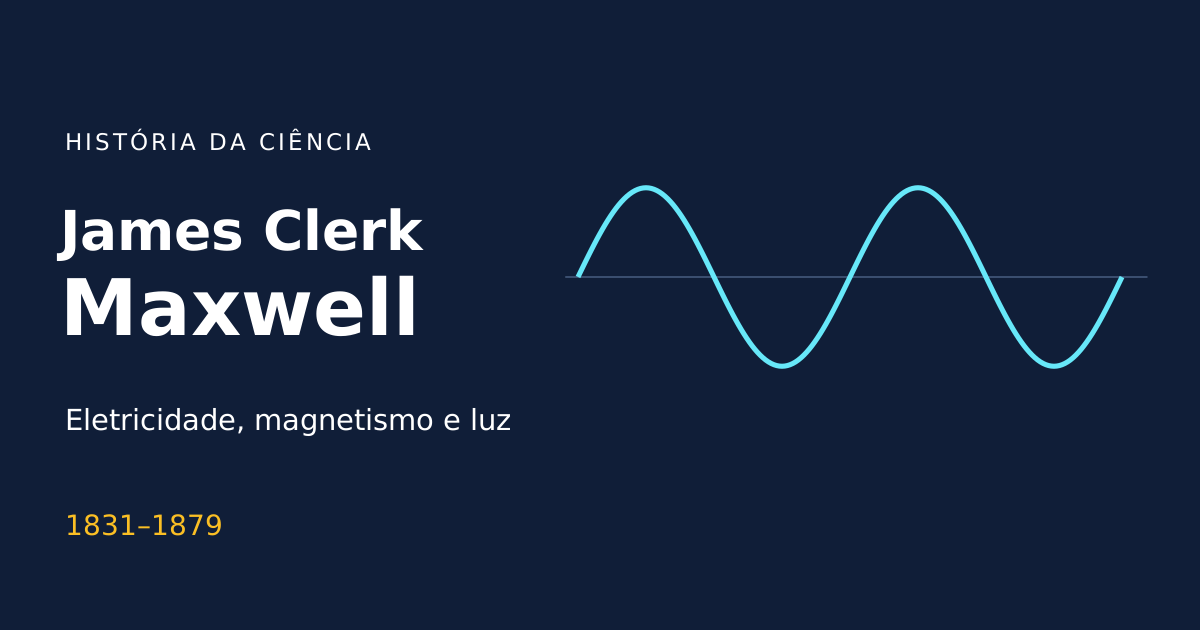
The displacement current: the missing term

Of Maxwell’s four equations, three were already known in some form before him: Gauss’s law, the magnetic law and Faraday’s law. The fourth, Ampère’s, was known too, but it was incomplete. What Maxwell added to it was a single term, $\mu_0\varepsilon_0\frac{\partial\mathbf E}{\partial t}$. It looks like little. It was this term that turned electricity and magnetism into light. Ampère’s law In 1826 the Frenchman André-Marie Ampère found the rule linking a current to the magnetic field around it. In today’s language: if you go round a closed path around a wire and add up the component of the magnetic field along the path, the result is proportional to the current $I$ crossing any surface bounded by that path:

October 14, 2026 Read
Hero Image
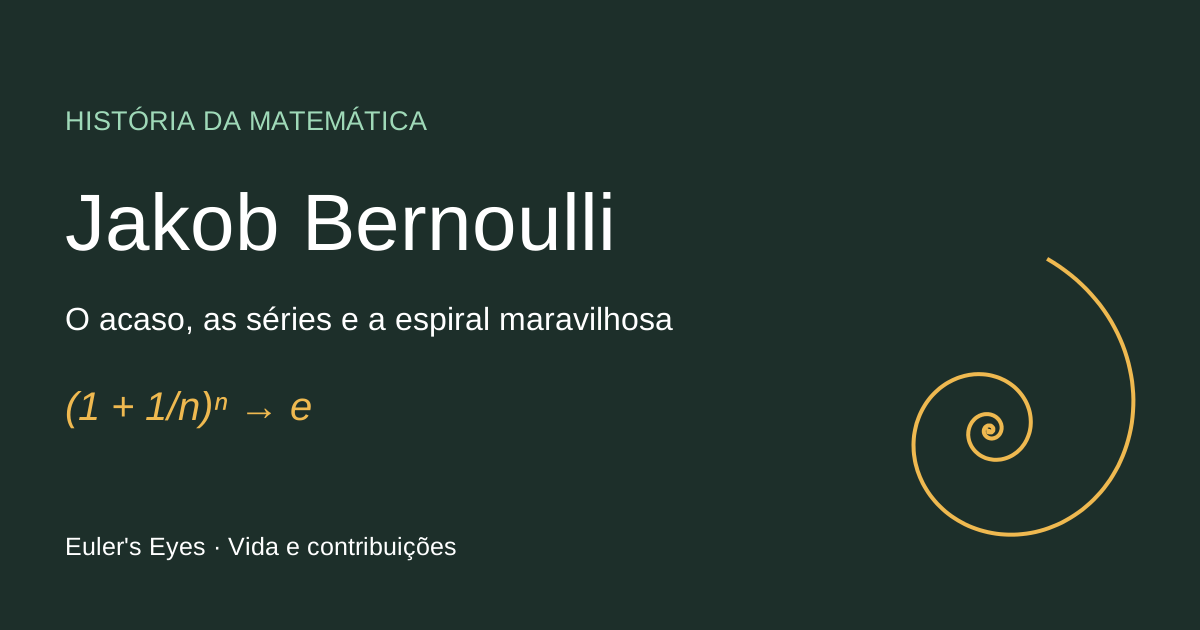
The golden theorem: the law of large numbers

Even the most foolish of men, by some instinct of nature, by himself and without any instruction, is convinced that the more observations have been made, the less danger there is of missing the mark. — Jakob Bernoulli, Ars conjectandi (1713), part IV With a die, we know the chance of each face in advance: $\frac16$. But what is the chance that a man of 40 will live another twenty years? That it will rain tomorrow? That a medicine will work? In these cases there are no equal faces to count. Jakob proposed another route: observe many times and use the frequency as an estimate of the probability. If, of many men aged 40, half reached 60, the chance must be close to one half.

October 14, 2026 Read
Hero Image
The principle of virtual work

In every equilibrium of any forces whatever, in whatever way they are applied, the sum of the positive energies will be equal to the sum of the negative energies. — Johann Bernoulli, letter to Pierre Varignon (26 January 1717) Since Archimedes, each simple machine had had its own explanation. The lever obeyed the law of the arms; the inclined plane, a decomposition of forces invented by Stevin; the pulley, an argument about the ropes; the screw, yet another. In 1717, in a letter to his French friend Pierre Varignon, Johann Bernoulli showed that all these laws are cases of a single principle.

October 14, 2026 Read
Hero Image
The mystic hexagram: six points on a conic

In February 1640 a sheet printed on one side only, like a poster, circulated in Paris under the title Essay on conics. It had no proofs, only definitions, three lemmas and a list of results. The author was 16 years old and his name was Blaise Pascal. When Father Mersenne showed the sheet to Descartes, the reaction was suspicion: Descartes thought the young man had taken everything from Girard Desargues, the architect and geometer Pascal admired. Desargues’s influence was real, and Pascal himself acknowledged it. But the central result on the sheet was new.

October 11, 2026 Read
  • ««
  • «
  • 7
  • 8
  • 9
  • 10
  • 11
  • »
  • »»
Navigation
  • Start here
  • Recent posts
  • About Euler
  • App
  • Privacy
Contact me:
  • hirowat2@gmail.com

Euler's Eyes
© 2021 Euler Eyes.
Powered by Hugo Logo