Logo Euler's Eyes
  • Dark Theme
    Light Theme Dark Theme System Theme
Logo Inverted Logo
  • Tags
  • 1 Phase
  • 1st Phase
  • 2 Phase
  • 2 Phase,
  • 2nd Phase
  • 2° Degree Equation
  • Alan Turing
  • Algebra
  • Algebraic Expressions
  • Analysis
  • Analytic Geometry
  • Analytical Geometry
  • Angle Bisector
  • Angle Measurements
  • Angles
  • Apothem
  • Arc Capable
  • Arc Properties
  • Archimedes
  • Area
  • Arithmetic Progression
  • Artificial Intelligence
  • Axioms and Postulates
  • Basic Concepts of Statistics
  • Bernoulli
  • Bhaskara
  • Binary Numbers
  • Binomial
  • Biography
  • Calculating Machine
  • Calculation
  • Calculus
  • Calculus of Variations
  • Cartesian Plane
  • Cartesian Product of Sets
  • Cauchy
  • Central Angle
  • Centroid
  • Children
  • Circle
  • Circle Area
  • Circumcenter
  • Circumference
  • Circumference Ratio
  • Circumferences
  • Circumscript Segments
  • Classification in Mathematics
  • Combinatorial Analysis
  • Combinatorics
  • Comparison of Angles
  • Complement
  • Complex Numbers
  • Compound Interest
  • Computing
  • Concave Region
  • Congruence
  • Congruence of Triangles
  • Convex Region
  • Correspondence Law
  • Cosine Theorem
  • Count
  • Cryptography
  • Decision Theory
  • Demo
  • Derivative
  • Descartes
  • Diagonals
  • Diamond
  • Differential Equations
  • Dispersion Measures
  • Distance
  • Division
  • Domain and Image
  • Einstein
  • Elasticity
  • Electromagnetism
  • Elementary Descriptive Statistics
  • Elementary School I
  • Elementary School II
  • ENEM 2021
  • ENEM 2022
  • ENEM 2023
  • ENEM 2024
  • ENEM 2025
  • Entrance Exam
  • Equality
  • Equations
  • Equiprobable Events
  • Equivalence Between Sets
  • Equivalence Relations
  • Euclid
  • Euclid's Postulate
  • Euler
  • Euler Project
  • Even Numbers
  • Exercises for Adding Natural Numbers
  • Exponential Function
  • External Angles
  • Fees
  • Fermat
  • Fermat's Last Theorem
  • Financial Mathematics
  • First Degree Equations
  • First Degree Functions
  • Flat
  • Flat Figures
  • Flat Geometry
  • Fractions
  • Function Concept
  • Function Discovery
  • Functions
  • FUVEST 2021
  • FUVEST 2022
  • FUVEST 2023
  • FUVEST 2024
  • FUVEST 2025
  • FUVEST 2026
  • Galois
  • Game Theory
  • Gauss
  • Geometric Constructions
  • Geometric Shapes
  • Geometry
  • Geometry With Natural Numbers
  • Geometry With Sequences of Numbers
  • Golden Segment
  • Graph Reading
  • Graphics
  • Graphs for Integers
  • Gravitation
  • Greatest Common Divisor
  • Group Theory
  • Groups
  • Hamilton
  • Height
  • History of Mathematics
  • Incenter
  • Increases and Discounts
  • Inequalities
  • Inscribable Quadrilateral
  • Inscribed Angle
  • Integral
  • Internal Angles
  • Interval Operations
  • Intervals
  • Introduction
  • Introduction to Angles
  • Introduction to Circumference
  • Introduction to Function Theory
  • Introduction to Geometry
  • Introduction to Integers
  • Introduction to Logarithm Table
  • Introduction to Polygons
  • Introduction to Probability
  • Introduction to Quadrilaterals
  • Introduction to Radiciation
  • Introduction to Rational Numbers
  • Introduction to Real Numbers
  • Introduction to Sets
  • Introduction to Statistics
  • Introduction to Triangles
  • Johann Bernoulli
  • John Napier
  • John Nash
  • Kids
  • Lagrange
  • Language
  • Law of Cosines
  • Law of Sines
  • Least Common Multiple
  • Leibniz
  • Level 1
  • Level 2
  • Level 3
  • Limit
  • Linear Systems
  • Logarithm
  • Logarithm Properties
  • Logarithms
  • Logic
  • Magnification
  • Math Elements
  • Mathematical Biology
  • Mathematical Logic
  • Mathematical Notation
  • Mathematical Programming
  • Mathematics Education
  • Mathematics Elements
  • Mathematics for Children
  • Mathematics for Kids
  • Matrices
  • Maxwell
  • Measure
  • Mechanics
  • Medium Base
  • Metric Relationships
  • Midpoint
  • Modular Function
  • Multiplication
  • Napier
  • Natural Number Subtraction Exercises
  • Newton
  • Niels Henrik Abel
  • Notable Points of the Triangle
  • Notation
  • Notion of Infinity
  • Notions of Probability
  • Nth Root
  • Number And
  • Number Theory
  • Number Π
  • Numbering Systems
  • Numerical Calculation
  • Numerical Methods
  • OBMEP
  • OBMEP 2023
  • Obmep,
  • Odd Numbers
  • Operations With Rational Numbers
  • Operations With Sets
  • Operations With Venn-Euler Diagrams
  • Optics
  • Optimization
  • Orthocenter
  • Parallelism
  • Parallelogram
  • Parallels
  • Partial Derivatives
  • Pascal
  • Pascal's Triangle
  • Peano Axioms
  • Peirce
  • Percentage
  • Percentage Basics
  • Perimeter
  • Perpendicular Bisector
  • Perpendicularity
  • Perpendiculars
  • Philosophy
  • Physical
  • Physics
  • Pi Number
  • Pi Numbers
  • Pitot
  • Plane Geometry
  • Point
  • Point Power
  • Polygons
  • Polynomials
  • Position Measurements
  • Position Relative to the Circumference
  • Postulates
  • Potentiation of Integers
  • Power With Negative Exponent
  • Prime Numbers
  • Primitive Notions
  • Principia
  • Probability
  • Progressions
  • Proof
  • Properties
  • Properties of Polygons
  • Proportion
  • Proportionality
  • Proportions
  • Proportions and Geometry
  • Pure Mathematics
  • Pythagoras Theorem
  • Pythagorean Suits
  • Quadratic Function
  • Quadrilateral
  • Quadrilaterals
  • Quantifier
  • Quantity Analysis
  • Quaternions
  • R Programming
  • Real Numbers
  • Rectangle
  • Rectangle Triangles
  • Reduction
  • Reflection
  • Regions in Planes
  • Regular Polygons
  • Relations
  • Relationship Properties
  • Relativity
  • Rhombus
  • Right Angle
  • Right Triangle
  • Right Triangle Relationships
  • Rule of 3
  • Rule of Three
  • Saussure
  • Segment Angle
  • Semi-Inscribed Angle
  • Semi-Straight
  • Semiotics
  • Sequences
  • Series
  • Set Family
  • Set Partition
  • Set Theory
  • Signal Rule
  • Similarity
  • Similarity of Triangles
  • Simple Interest
  • Sines Theorem
  • Sophie Germain
  • Spatial Geometry
  • Square
  • Square Root
  • Statistic
  • Stewart Ratio
  • Straight
  • Straight Lines
  • Straight Segment
  • Sum of Angles
  • Supplement
  • Symmetry
  • Tangent
  • Thales' Theorem
  • The Number Zero
  • Theorems
  • Trapezium
  • Trapezius
  • Triangle
  • Triangles
  • Triangular Inequality
  • Trigonometry
  • Truth Table
  • Understanding Relationships
  • Vectors
  • Venn-Euler Diagrams
  • Whole Numbers
  • Wiles
  • Women in Mathematics
  • Year 2018
  • Year 2019
  • Year 2021
  • Year 2022
  • Évariste Galois
Hero Image
The Bernoulli numbers: adding a thousand powers in seven minutes

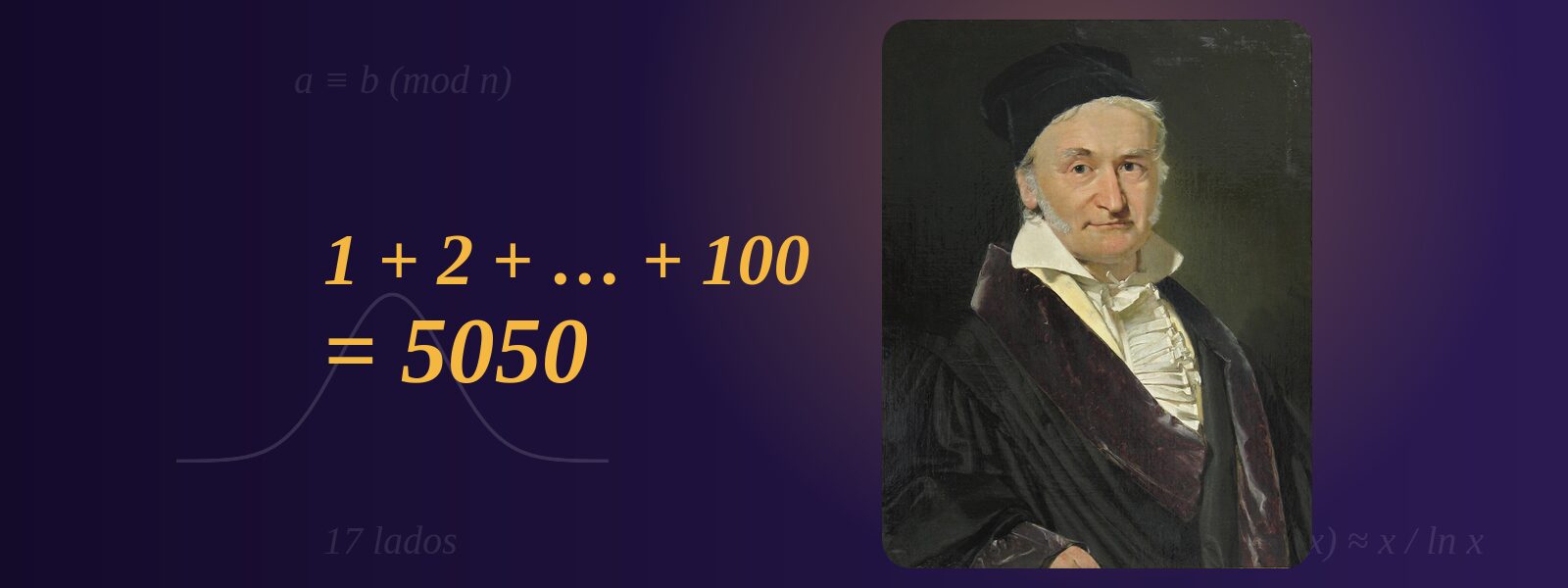
With the help of this table it took me less than half of a quarter of an hour to find that the tenth powers of the first thousand numbers, added together, give 91,409,924,241,424,243,424,241,924,242,500. — Jakob Bernoulli, Ars conjectandi (1713), part II The story goes that young Gauss added the numbers from 1 to 100 in seconds, pairing the first with the last: $1+2+\cdots+n=\frac{n(n+1)}2$. For squares and cubes there are formulas too, known since Archimedes and the Arab mathematicians:

October 14, 2026 Read
Hero Image
The derivative without infinitesimals and the mean value theorem

At the end of the eighteenth century, calculus worked very well and nobody could properly explain why. Leibniz’s $dx$ were “infinitely small” quantities: sometimes they were treated as if they were different from zero, so that one could divide by them, and right afterwards as if they were zero, so that one could discard them. Bishop Berkeley had mocked this in 1734, calling them “ghosts of departed quantities”. Lagrange was bothered by it. In 1797 he published a book whose subtitle is a whole programme:

October 14, 2026 Read
Hero Image
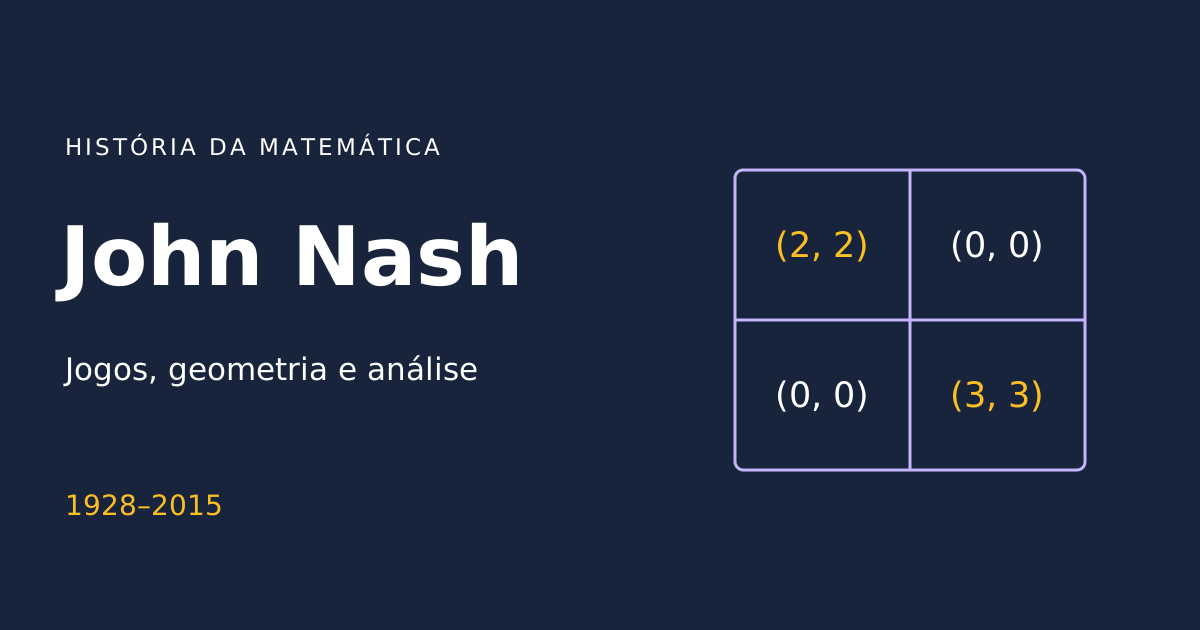
The heat equation and the regularity of De Giorgi and Nash

In 1900, at the International Congress of Mathematicians in Paris, David Hilbert presented a list of 23 problems that, in his view, would guide twentieth-century mathematics. Problem 19 asked, in simple terms: are the solutions of the “well-behaved” problems of the calculus of variations always smooth functions? Half a century later, the question was still open for an important class of equations. In 1956 Nash heard about it from a colleague and decided to attack it.

October 14, 2026 Read
Hero Image
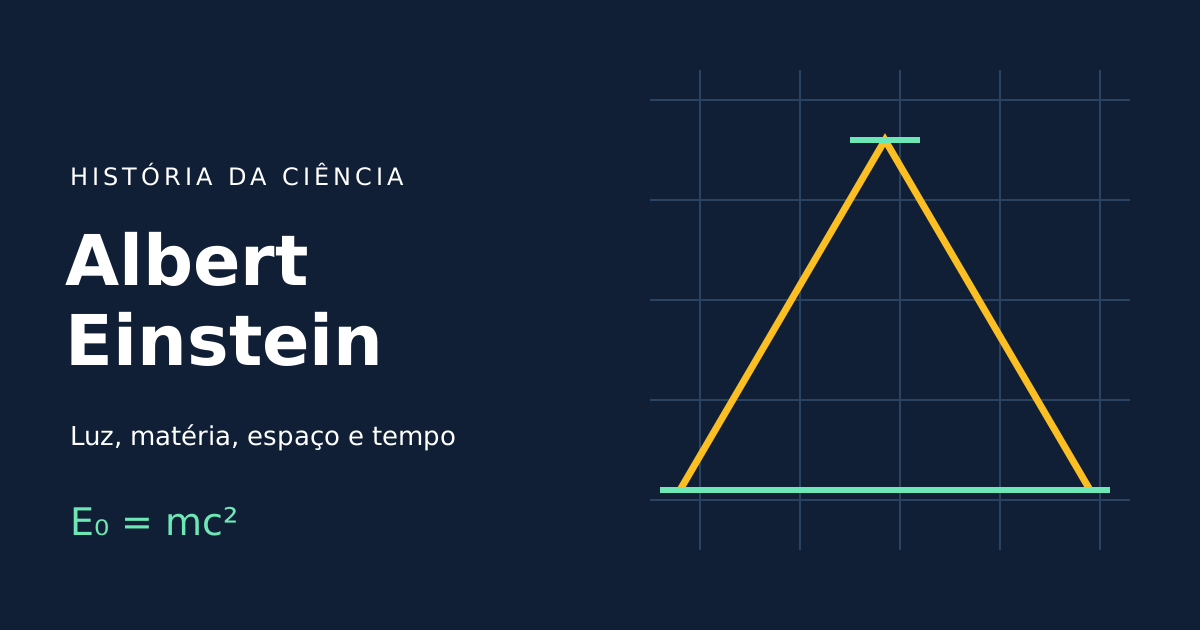
The legacy of Albert Einstein

Imagination is more important than knowledge. Knowledge is limited; imagination encircles the world. — Albert Einstein, interview in the Saturday Evening Post (1929) Einstein is the only scientist whose face everyone recognises. But his legacy is not on the posters: it is in devices we use without thinking and in questions physicists are still trying to answer. Several of his predictions were only confirmed decades after his death. The laser In 1917, studying how matter absorbs and emits light, Einstein realised that, besides absorbing and emitting photons spontaneously, an excited atom can be stimulated by a photon to emit another, identical one, in the same direction. It was a theoretical observation. Forty years later it became the laser, the acronym for “light amplification by stimulated emission of radiation”. Barcode readers, optical fibres, eye surgery and lecture pointers are all applications of stimulated emission.

October 14, 2026 Read
Hero Image
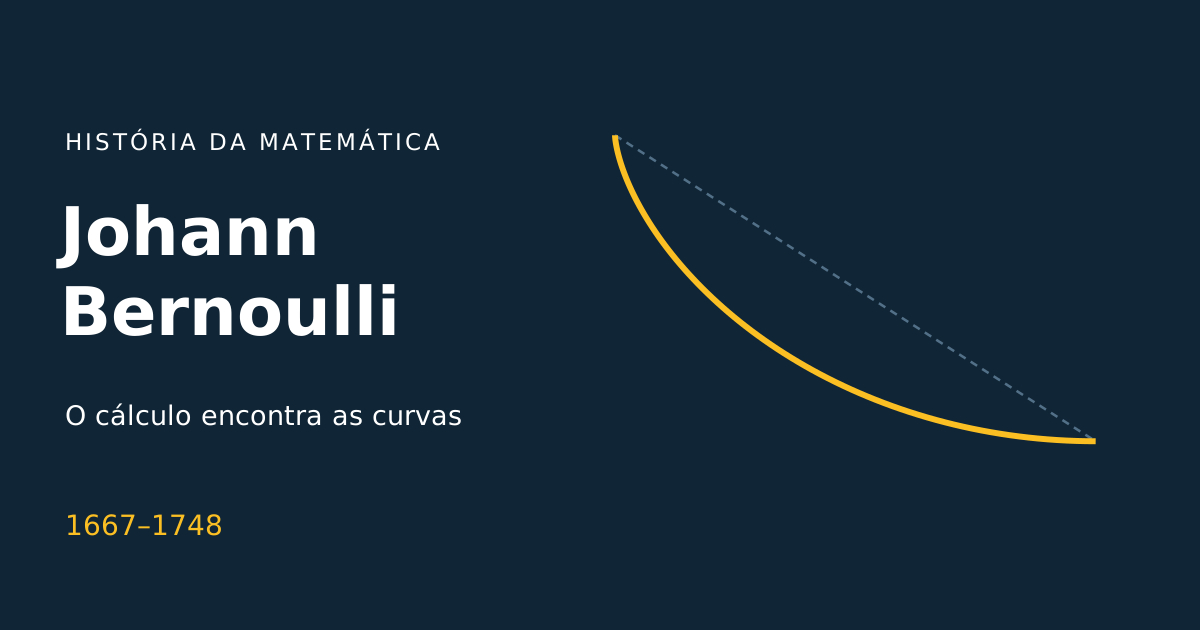
The legacy of Johann Bernoulli

Johann Bernoulli did not write a great book, as his brother wrote the Ars conjectandi or Newton the Principia. His most famous book came out under someone else’s name. What he left was a way of working: turning every problem of physics or geometry into an equation and solving it with Leibniz’s calculus. And he left pupils. Leibniz’s champion In the dispute over who had invented the calculus, Newton or Leibniz, Johann was the most combative soldier on Leibniz’s side. When the Royal Society, presided over by Newton, published at the beginning of 1713 a report giving priority to Newton, Leibniz replied with an anonymous broadsheet, the Charta volans, which quoted the judgement of “an eminent mathematician”: it was Johann. In the years that followed, Johann challenged the English mathematicians with hard problems, which he thought impossible with Newton’s method. Leibniz died in 1716, and Johann carried on the fight alone for years. The dispute cut English mathematics off from that of the Continent for almost a century.

October 14, 2026 Read
Hero Image
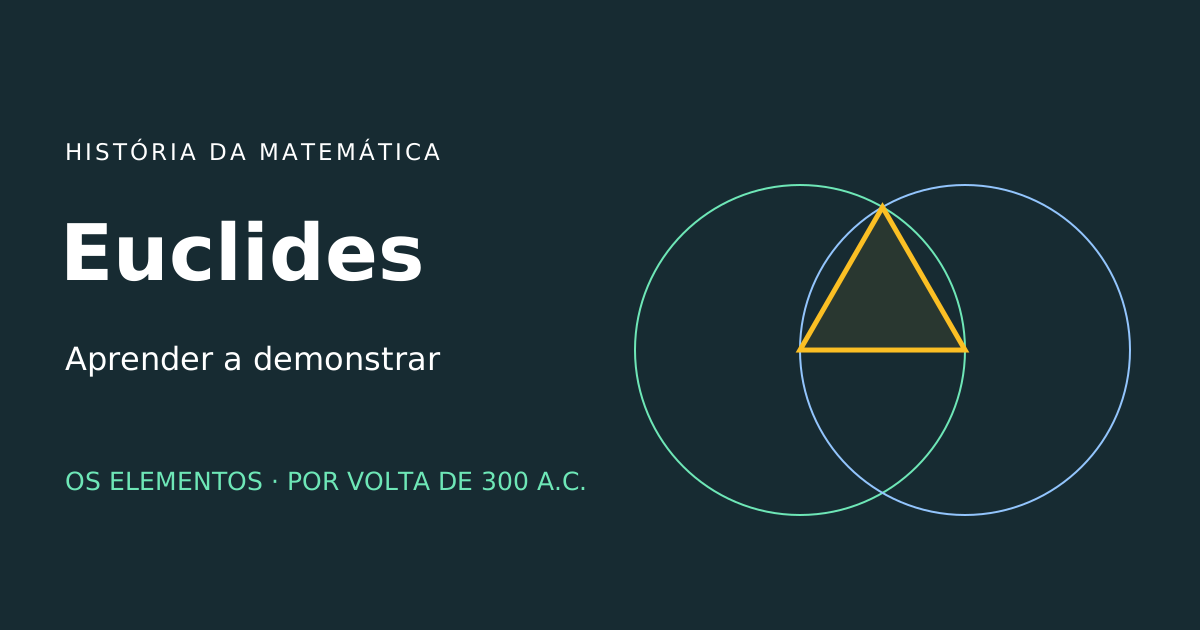
The primes never run out

Prime numbers are more than any assigned multitude of prime numbers. — Euclid, Elements, Proposition IX.20 A prime number is an integer greater than 1 that can only be divided by 1 and by itself: 2, 3, 5, 7, 11, 13, … All the others, such as $12=2\cdot2\cdot3$, are products of primes. The primes are the atoms of arithmetic. The further you go, the rarer they become. Between 1 and 100 there are 25 primes; between 1,000,001 and 1,000,100, only 6. Do they run out at some point? Euclid showed that they do not, with a four-line argument that the English mathematician G. H. Hardy considered one of the most beautiful in all of mathematics.
October 14, 2026 Read
Hero Image
The cycloid: the toothache curve

Paint a dot on a bicycle tyre and push the bike in a straight line. The dot rises, makes an arch and comes back down to touch the ground, once for every turn of the wheel. The curve it traces is called the cycloid. In the 17th century it was the fashionable curve. The French called it the roulette. So many mathematicians quarrelled over discoveries about it that it earned a nickname: the Helen of geometers, after Helen of Troy, who started a war.

October 11, 2026 Read
Hero Image
Fermat's principle: light takes the fastest path

A lifeguard is on the sand and sees someone drowning in the sea, further out and off to one side. Which path should the lifeguard take? The straight line is the shortest path but not the fastest: running on sand is much quicker than swimming. It pays to run a bit further along the beach so as to swim less. Fermat realized that light makes exactly this choice. Reflection: the shortest path The oldest idea concerns mirrors. In the 1st century, Heron of Alexandria had already noticed that light, when reflected, follows the shortest path between two points by way of the mirror.

October 11, 2026 Read
Hero Image
The Leibniz series for π: a simple, slow sum

The number $\pi$ comes from the geometry of the circle. The odd numbers come from arithmetic. There is no apparent reason for them to meet. But they do: $$\frac{\pi}{4}=1-\frac13+\frac15-\frac17+\frac19-\cdots$$Add and subtract the reciprocals of the odd numbers, alternating signs, and the result, multiplied by 4, is $\pi$. One discovery, three times Leibniz found this formula in 1673, in Paris, while he was still learning mathematics from Huygens. He showed the result to his teacher, who was impressed and praised him. It was Leibniz’s first great discovery and what convinced him he could be a mathematician.

October 11, 2026 Read
Hero Image
Gravitation: from the apple to the Moon

If the apple falls, why doesn’t the Moon? Before Newton the answer seemed simple: heaven and Earth followed different rules. On Earth, things fall. In the heavens, the stars and planets turn in perfect circles forever. Newton’s great idea was to distrust that separation: perhaps the Moon is falling all the time. Newton’s cannon The apple tree in the orchard of Woolsthorpe Manor that tradition identifies as “Newton’s tree”.David Smith · Wikimedia Commons · CC BY-SA 2.0 In a draft for the Principia, Newton proposed a thought experiment. Imagine a cannon on top of a very high mountain, firing horizontally. With little powder, the ball lands nearby. With more, it lands further away. But the Earth is round: if the ball is fast enough, the ground curves away beneath it exactly as fast as it falls. The ball falls forever and never reaches the ground. It is in orbit.

October 11, 2026 Read
Hero Image
Ceres and the least squares method

On January 1, 1801, astronomer Giuseppe Piazzi, in Palermo, discovered a tiny dot that moved among the stars: it was Ceres, today classified as a dwarf planet. Piazzi accompanied him for 41 days, until it disappeared in the Sun’s glare. With so few observations, no one knew how to calculate the orbit, and Ceres seemed lost forever. Gauss, at 24 years old, created a new method and calculated the orbit in a few weeks. On the night of 31 December 1801, astronomer Franz von Zach pointed the telescope where Gauss indicated, and there it was Ceres.

October 10, 2026 Read
Hero Image
Why does the rainbow appear at 42°

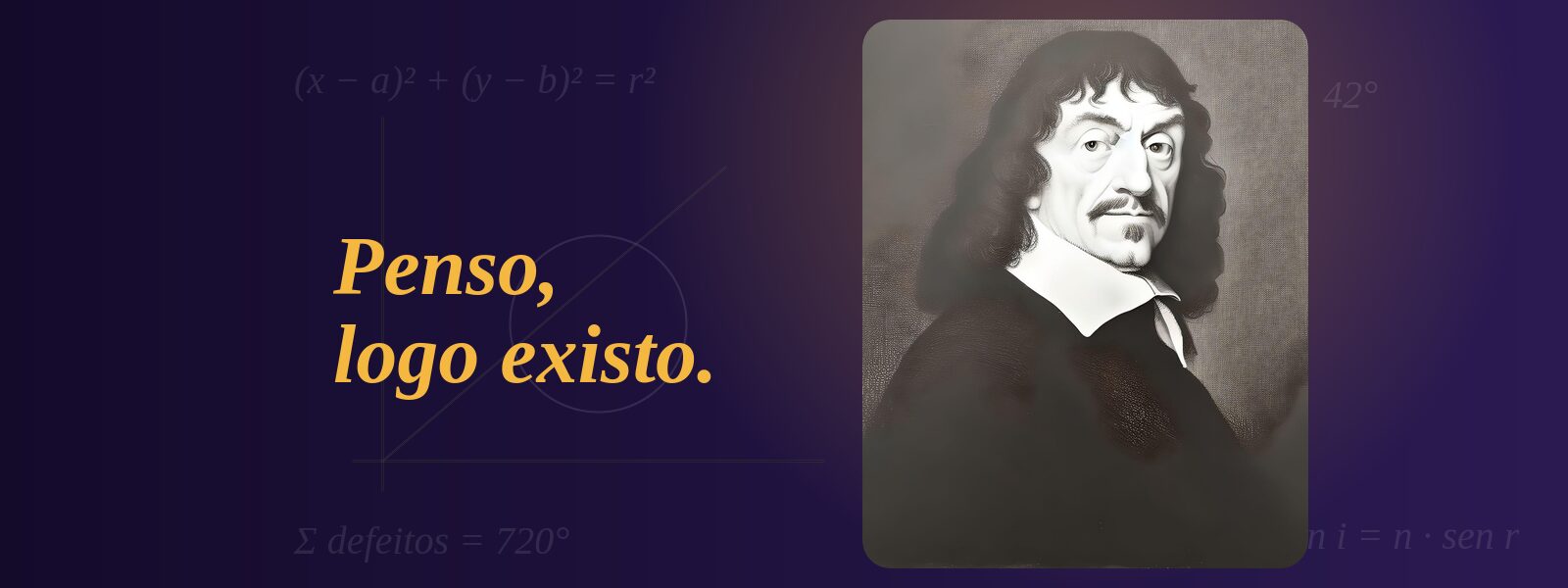
In The Meteors, Descartes explained the rainbow using the law of refraction, which he published in The Dioptric. When light passes from air to water, it bends $$\sin i = n \cdot \sin r,$$ where $i$ is the entry angle, $r$ the angle into the water and $n \approx \frac{4}{3}$ for the water. (The Dutchman Willebrord Snell had found the same law before, but did not publish it. That is why it is called Snell-Descartes law.)

October 10, 2026 Read
  • ««
  • «
  • 9
  • 10
  • 11
  • 12
  • 13
  • »
  • »»
Navigation
  • Start here
  • Recent posts
  • About Euler
  • App
  • Privacy
Contact me:
  • hirowat2@gmail.com

Euler's Eyes
© 2021 Euler Eyes.
Powered by Hugo Logo