Logo Euler's Eyes
  • Dark Theme
    Light Theme Dark Theme System Theme
Logo Inverted Logo
  • Tags
  • 1 Phase
  • 1st Phase
  • 2 Phase
  • 2 Phase,
  • 2nd Phase
  • 2° Degree Equation
  • Alan Turing
  • Algebra
  • Algebraic Expressions
  • Analysis
  • Analytic Geometry
  • Analytical Geometry
  • Angle Bisector
  • Angle Measurements
  • Angles
  • Apothem
  • Arc Capable
  • Arc Properties
  • Archimedes
  • Area
  • Arithmetic Progression
  • Artificial Intelligence
  • Axioms and Postulates
  • Basic Concepts of Statistics
  • Bernoulli
  • Bhaskara
  • Binary Numbers
  • Binomial
  • Biography
  • Calculating Machine
  • Calculation
  • Calculus
  • Calculus of Variations
  • Cartesian Plane
  • Cartesian Product of Sets
  • Cauchy
  • Central Angle
  • Centroid
  • Children
  • Circle
  • Circle Area
  • Circumcenter
  • Circumference
  • Circumference Ratio
  • Circumferences
  • Circumscript Segments
  • Classification in Mathematics
  • Combinatorial Analysis
  • Combinatorics
  • Comparison of Angles
  • Complement
  • Complex Numbers
  • Compound Interest
  • Computing
  • Concave Region
  • Congruence
  • Congruence of Triangles
  • Convex Region
  • Correspondence Law
  • Cosine Theorem
  • Count
  • Cryptography
  • Decision Theory
  • Demo
  • Derivative
  • Descartes
  • Diagonals
  • Diamond
  • Differential Equations
  • Dispersion Measures
  • Distance
  • Division
  • Domain and Image
  • Einstein
  • Elasticity
  • Electromagnetism
  • Elementary Descriptive Statistics
  • Elementary School I
  • Elementary School II
  • ENEM 2021
  • ENEM 2022
  • ENEM 2023
  • ENEM 2024
  • ENEM 2025
  • Entrance Exam
  • Equality
  • Equations
  • Equiprobable Events
  • Equivalence Between Sets
  • Equivalence Relations
  • Euclid
  • Euclid's Postulate
  • Euler
  • Euler Project
  • Even Numbers
  • Exercises for Adding Natural Numbers
  • Exponential Function
  • External Angles
  • Fees
  • Fermat
  • Fermat's Last Theorem
  • Financial Mathematics
  • First Degree Equations
  • First Degree Functions
  • Flat
  • Flat Figures
  • Flat Geometry
  • Fractions
  • Function Concept
  • Function Discovery
  • Functions
  • FUVEST 2021
  • FUVEST 2022
  • FUVEST 2023
  • FUVEST 2024
  • FUVEST 2025
  • FUVEST 2026
  • Galois
  • Game Theory
  • Gauss
  • Geometric Constructions
  • Geometric Shapes
  • Geometry
  • Geometry With Natural Numbers
  • Geometry With Sequences of Numbers
  • Golden Segment
  • Graph Reading
  • Graphics
  • Graphs for Integers
  • Gravitation
  • Greatest Common Divisor
  • Group Theory
  • Groups
  • Hamilton
  • Height
  • History of Mathematics
  • Incenter
  • Increases and Discounts
  • Inequalities
  • Inscribable Quadrilateral
  • Inscribed Angle
  • Integral
  • Internal Angles
  • Interval Operations
  • Intervals
  • Introduction
  • Introduction to Angles
  • Introduction to Circumference
  • Introduction to Function Theory
  • Introduction to Geometry
  • Introduction to Integers
  • Introduction to Logarithm Table
  • Introduction to Polygons
  • Introduction to Probability
  • Introduction to Quadrilaterals
  • Introduction to Radiciation
  • Introduction to Rational Numbers
  • Introduction to Real Numbers
  • Introduction to Sets
  • Introduction to Statistics
  • Introduction to Triangles
  • Johann Bernoulli
  • John Napier
  • John Nash
  • Kids
  • Lagrange
  • Language
  • Law of Cosines
  • Law of Sines
  • Least Common Multiple
  • Leibniz
  • Level 1
  • Level 2
  • Level 3
  • Limit
  • Linear Systems
  • Logarithm
  • Logarithm Properties
  • Logarithms
  • Logic
  • Magnification
  • Math Elements
  • Mathematical Biology
  • Mathematical Logic
  • Mathematical Notation
  • Mathematical Programming
  • Mathematics Education
  • Mathematics Elements
  • Mathematics for Children
  • Mathematics for Kids
  • Matrices
  • Maxwell
  • Measure
  • Mechanics
  • Medium Base
  • Metric Relationships
  • Midpoint
  • Modular Function
  • Multiplication
  • Napier
  • Natural Number Subtraction Exercises
  • Newton
  • Niels Henrik Abel
  • Notable Points of the Triangle
  • Notation
  • Notion of Infinity
  • Notions of Probability
  • Nth Root
  • Number And
  • Number Theory
  • Number Π
  • Numbering Systems
  • Numerical Calculation
  • Numerical Methods
  • OBMEP
  • OBMEP 2023
  • Obmep,
  • Odd Numbers
  • Operations With Rational Numbers
  • Operations With Sets
  • Operations With Venn-Euler Diagrams
  • Optics
  • Optimization
  • Orthocenter
  • Parallelism
  • Parallelogram
  • Parallels
  • Partial Derivatives
  • Pascal
  • Pascal's Triangle
  • Peano Axioms
  • Peirce
  • Percentage
  • Percentage Basics
  • Perimeter
  • Perpendicular Bisector
  • Perpendicularity
  • Perpendiculars
  • Philosophy
  • Physical
  • Physics
  • Pi Number
  • Pi Numbers
  • Pitot
  • Plane Geometry
  • Point
  • Point Power
  • Polygons
  • Polynomials
  • Position Measurements
  • Position Relative to the Circumference
  • Postulates
  • Potentiation of Integers
  • Power With Negative Exponent
  • Prime Numbers
  • Primitive Notions
  • Principia
  • Probability
  • Progressions
  • Proof
  • Properties
  • Properties of Polygons
  • Proportion
  • Proportionality
  • Proportions
  • Proportions and Geometry
  • Pure Mathematics
  • Pythagoras Theorem
  • Pythagorean Suits
  • Quadratic Function
  • Quadrilateral
  • Quadrilaterals
  • Quantifier
  • Quantity Analysis
  • Quaternions
  • R Programming
  • Real Numbers
  • Rectangle
  • Rectangle Triangles
  • Reduction
  • Reflection
  • Regions in Planes
  • Regular Polygons
  • Relations
  • Relationship Properties
  • Relativity
  • Rhombus
  • Right Angle
  • Right Triangle
  • Right Triangle Relationships
  • Rule of 3
  • Rule of Three
  • Saussure
  • Segment Angle
  • Semi-Inscribed Angle
  • Semi-Straight
  • Semiotics
  • Sequences
  • Series
  • Set Family
  • Set Partition
  • Set Theory
  • Signal Rule
  • Similarity
  • Similarity of Triangles
  • Simple Interest
  • Sines Theorem
  • Sophie Germain
  • Spatial Geometry
  • Square
  • Square Root
  • Statistic
  • Stewart Ratio
  • Straight
  • Straight Lines
  • Straight Segment
  • Sum of Angles
  • Supplement
  • Symmetry
  • Tangent
  • Thales' Theorem
  • The Number Zero
  • Theorems
  • Trapezium
  • Trapezius
  • Triangle
  • Triangles
  • Triangular Inequality
  • Trigonometry
  • Truth Table
  • Understanding Relationships
  • Vectors
  • Venn-Euler Diagrams
  • Whole Numbers
  • Wiles
  • Women in Mathematics
  • Year 2018
  • Year 2019
  • Year 2021
  • Year 2022
  • Évariste Galois
Hero Image
The Chevalier de Méré's dice and the fair split

Antoine Gombaud, who styled himself the Chevalier de Méré, was a writer at the French court and a passionate gambler. Around 1654 he brought Pascal two questions about bets. Pascal found them so good that he wrote to Pierre de Fermat, and probability theory was born from those letters. About his friend, Pascal remarked to Fermat: He has a very good mind, but he is not a geometer; and that, as you know, is a great defect. — Blaise Pascal, letter to Fermat (29 July 1654)

October 11, 2026 Read
Hero Image
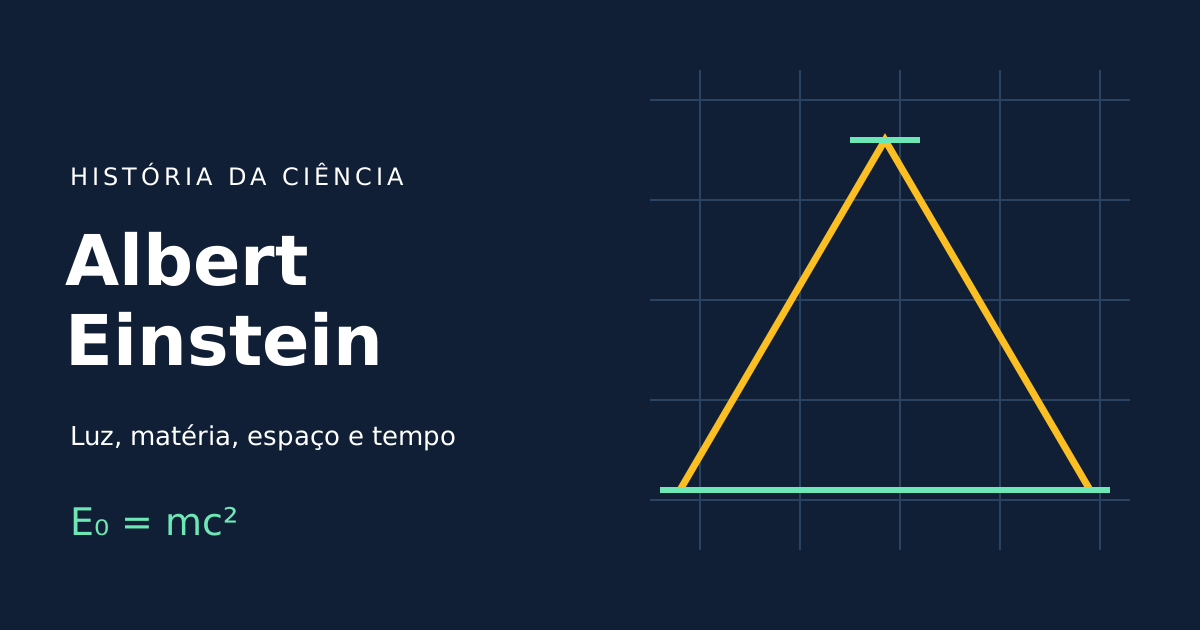
E = mc²: the energy hidden in mass

One more consequence of the paper on electrodynamics has occurred to me. The principle of relativity, together with Maxwell’s equations, requires that mass be a direct measure of the energy contained in a body. The idea is amusing and enticing; but for all I know, the Lord may be laughing over the whole thing and leading me around by the nose. — Albert Einstein, letter to Conrad Habicht (summer 1905) In September 1905, three months after the relativity paper, Einstein sent the Annalen der Physik a supplement of just three pages, with a title in the form of a question: “Does the inertia of a body depend upon its energy content?”. The answer was yes, and the conclusion, written in words and with other letters, is the most famous formula in physics:
October 14, 2026 Read
Hero Image
Maxwell's equations: from Faraday's lines of force to vectors

I was at first almost frightened when I saw such mathematical force made to bear upon the subject, and then wondered to see that the subject stood it so well. — Michael Faraday, letter to Maxwell (25 March 1857) Until 1820, electricity and magnetism were separate subjects. Electricity made sparks and raised the hair on your head; magnetism made compasses point north. That year, during a lecture at the University of Copenhagen, the Dane Hans Christian Oersted connected a battery to a wire and saw a nearby magnetic needle move. Electric current produced magnetism.

October 14, 2026 Read
Hero Image
The Pascaline: a sum made of gears

In 1640 Étienne Pascal was appointed tax commissioner for Normandy. The job meant adding up column after column of figures late into the night, and his son Blaise, then 17, helped. To make matters worse, French money was not decimal: $$1\ \text{livre}=20\ \text{sols},\qquad 1\ \text{sol}=12\ \text{deniers}.$$Adding $3$ livres, $15$ sols and $8$ deniers to $2$ livres, $7$ sols and $9$ deniers needs three kinds of carry: deniers: $8+9=17$, which is $1$ sol and $5$ deniers; sols: $15+7+1=23$, which is $1$ livre and $3$ sols; livres: $3+2+1=6$. Result: $6$ livres, $3$ sols and $5$ deniers. Do that a thousand times a night and you will make mistakes. In 1642 Blaise began building a machine that would not.

October 11, 2026 Read
Hero Image
General relativity: from the lift to the Sobral eclipse

I was sitting in a chair in the patent office in Bern when all of a sudden a thought occurred to me: if a person falls freely, he will not feel his own weight. I was startled. This simple thought made a deep impression on me. It impelled me towards a theory of gravitation. — Albert Einstein, on an idea of 1907 The relativity of 1905 had a flaw: it did not include gravity. Newton’s law says the Sun pulls the Earth instantly, across 150 million kilometres, and relativity says nothing travels faster than light. Einstein spent eight years trying to fix this. His starting point was what he called “the happiest thought of my life”.

October 14, 2026 Read
Hero Image
The displacement current: the missing term

Of Maxwell’s four equations, three were already known in some form before him: Gauss’s law, the magnetic law and Faraday’s law. The fourth, Ampère’s, was known too, but it was incomplete. What Maxwell added to it was a single term, $\mu_0\varepsilon_0\frac{\partial\mathbf E}{\partial t}$. It looks like little. It was this term that turned electricity and magnetism into light. Ampère’s law In 1826 the Frenchman André-Marie Ampère found the rule linking a current to the magnetic field around it. In today’s language: if you go round a closed path around a wire and add up the component of the magnetic field along the path, the result is proportional to the current $I$ crossing any surface bounded by that path:

October 14, 2026 Read
Hero Image
The mystic hexagram: six points on a conic

In February 1640 a sheet printed on one side only, like a poster, circulated in Paris under the title Essay on conics. It had no proofs, only definitions, three lemmas and a list of results. The author was 16 years old and his name was Blaise Pascal. When Father Mersenne showed the sheet to Descartes, the reaction was suspicion: Descartes thought the young man had taken everything from Girard Desargues, the architect and geometer Pascal admired. Desargues’s influence was real, and Pascal himself acknowledged it. But the central result on the sheet was new.

October 11, 2026 Read
Hero Image
The laws of motion: forces and changes in velocity

For Aristotle, a body moves only while something pushes it. Stop pushing the cart and it stops. It seems obvious, and it was accepted for almost two thousand years. Galileo had his doubts. Rolling balls down inclined planes, he noticed that the smoother the surface, the further the ball went. With no friction at all, it would never stop. Descartes reached a similar idea. Newton put these clues together and, in the Principia of 1687, wrote three laws that became the foundation of all mechanics.

October 11, 2026 Read
Hero Image
Light is an electromagnetic wave

We can scarcely avoid the inference that light consists in the transverse undulations of the same medium which is the cause of electric and magnetic phenomena. — James Clerk Maxwell, “On physical lines of force” (1862), with the original italics In the summer of 1861, at Glenlair, far from his books, Maxwell did a calculation with his model of vortices and little wheels: if the medium that transmits electric and magnetic forces were shaken, the disturbance would travel as a wave. At what speed? The calculation gave a number that depended only on two constants measured in the laboratory with magnets and charges. He did not have the values to hand. When he returned to London in October, he looked them up. The number was the speed of light.

October 14, 2026 Read
Hero Image
The legacy of Albert Einstein

Imagination is more important than knowledge. Knowledge is limited; imagination encircles the world. — Albert Einstein, interview in the Saturday Evening Post (1929) Einstein is the only scientist whose face everyone recognises. But his legacy is not on the posters: it is in devices we use without thinking and in questions physicists are still trying to answer. Several of his predictions were only confirmed decades after his death. The laser In 1917, studying how matter absorbs and emits light, Einstein realised that, besides absorbing and emitting photons spontaneously, an excited atom can be stimulated by a photon to emit another, identical one, in the same direction. It was a theoretical observation. Forty years later it became the laser, the acronym for “light amplification by stimulated emission of radiation”. Barcode readers, optical fibres, eye surgery and lecture pointers are all applications of stimulated emission.

October 14, 2026 Read
Hero Image
The cycloid: the toothache curve

Paint a dot on a bicycle tyre and push the bike in a straight line. The dot rises, makes an arch and comes back down to touch the ground, once for every turn of the wheel. The curve it traces is called the cycloid. In the 17th century it was the fashionable curve. The French called it the roulette. So many mathematicians quarrelled over discoveries about it that it earned a nickname: the Helen of geometers, after Helen of Troy, who started a war.

October 11, 2026 Read
Hero Image
Fermat's principle: light takes the fastest path

A lifeguard is on the sand and sees someone drowning in the sea, further out and off to one side. Which path should the lifeguard take? The straight line is the shortest path but not the fastest: running on sand is much quicker than swimming. It pays to run a bit further along the beach so as to swim less. Fermat realized that light makes exactly this choice. Reflection: the shortest path The oldest idea concerns mirrors. In the 1st century, Heron of Alexandria had already noticed that light, when reflected, follows the shortest path between two points by way of the mirror.

October 11, 2026 Read
  • ««
  • «
  • 1
  • 2
  • 3
  • »
  • »»
Navigation
  • Start here
  • Recent posts
  • About Euler
  • App
  • Privacy
Contact me:
  • hirowat2@gmail.com

Euler's Eyes
© 2021 Euler Eyes.
Powered by Hugo Logo