Logo Euler's Eyes
  • Dark Theme
    Light Theme Dark Theme System Theme
Logo Inverted Logo
  • Tags
  • 1 Phase
  • 1st Phase
  • 2 Phase
  • 2 Phase,
  • 2nd Phase
  • 2° Degree Equation
  • Alan Turing
  • Algebra
  • Algebraic Expressions
  • Analysis
  • Analytic Geometry
  • Analytical Geometry
  • Angle Bisector
  • Angle Measurements
  • Angles
  • Apothem
  • Arc Capable
  • Arc Properties
  • Archimedes
  • Area
  • Arithmetic Progression
  • Artificial Intelligence
  • Axioms and Postulates
  • Basic Concepts of Statistics
  • Bernoulli
  • Bhaskara
  • Binary Numbers
  • Binomial
  • Biography
  • Calculating Machine
  • Calculation
  • Calculus
  • Calculus of Variations
  • Cartesian Plane
  • Cartesian Product of Sets
  • Cauchy
  • Central Angle
  • Centroid
  • Children
  • Circle
  • Circle Area
  • Circumcenter
  • Circumference
  • Circumference Ratio
  • Circumferences
  • Circumscript Segments
  • Classification in Mathematics
  • Combinatorial Analysis
  • Combinatorics
  • Comparison of Angles
  • Complement
  • Complex Numbers
  • Compound Interest
  • Computing
  • Concave Region
  • Congruence
  • Congruence of Triangles
  • Convex Region
  • Correspondence Law
  • Cosine Theorem
  • Count
  • Cryptography
  • Decision Theory
  • Demo
  • Derivative
  • Descartes
  • Diagonals
  • Diamond
  • Differential Equations
  • Dispersion Measures
  • Distance
  • Division
  • Domain and Image
  • Einstein
  • Elasticity
  • Electromagnetism
  • Elementary Descriptive Statistics
  • Elementary School I
  • Elementary School II
  • ENEM 2021
  • ENEM 2022
  • ENEM 2023
  • ENEM 2024
  • ENEM 2025
  • Entrance Exam
  • Equality
  • Equations
  • Equiprobable Events
  • Equivalence Between Sets
  • Equivalence Relations
  • Euclid
  • Euclid's Postulate
  • Euler
  • Euler Project
  • Even Numbers
  • Exercises for Adding Natural Numbers
  • Exponential Function
  • External Angles
  • Fees
  • Fermat
  • Fermat's Last Theorem
  • Financial Mathematics
  • First Degree Equations
  • First Degree Functions
  • Flat
  • Flat Figures
  • Flat Geometry
  • Fractions
  • Function Concept
  • Function Discovery
  • Functions
  • FUVEST 2021
  • FUVEST 2022
  • FUVEST 2023
  • FUVEST 2024
  • FUVEST 2025
  • FUVEST 2026
  • Galois
  • Game Theory
  • Gauss
  • Geometric Constructions
  • Geometric Shapes
  • Geometry
  • Geometry With Natural Numbers
  • Geometry With Sequences of Numbers
  • Golden Segment
  • Graph Reading
  • Graphics
  • Graphs for Integers
  • Gravitation
  • Greatest Common Divisor
  • Group Theory
  • Groups
  • Hamilton
  • Height
  • History of Mathematics
  • Incenter
  • Increases and Discounts
  • Inequalities
  • Inscribable Quadrilateral
  • Inscribed Angle
  • Integral
  • Internal Angles
  • Interval Operations
  • Intervals
  • Introduction
  • Introduction to Angles
  • Introduction to Circumference
  • Introduction to Function Theory
  • Introduction to Geometry
  • Introduction to Integers
  • Introduction to Logarithm Table
  • Introduction to Polygons
  • Introduction to Probability
  • Introduction to Quadrilaterals
  • Introduction to Radiciation
  • Introduction to Rational Numbers
  • Introduction to Real Numbers
  • Introduction to Sets
  • Introduction to Statistics
  • Introduction to Triangles
  • Johann Bernoulli
  • John Napier
  • John Nash
  • Kids
  • Lagrange
  • Language
  • Law of Cosines
  • Law of Sines
  • Least Common Multiple
  • Leibniz
  • Level 1
  • Level 2
  • Level 3
  • Limit
  • Linear Systems
  • Logarithm
  • Logarithm Properties
  • Logarithms
  • Logic
  • Magnification
  • Math Elements
  • Mathematical Biology
  • Mathematical Logic
  • Mathematical Notation
  • Mathematical Programming
  • Mathematics Education
  • Mathematics Elements
  • Mathematics for Children
  • Mathematics for Kids
  • Matrices
  • Maxwell
  • Measure
  • Mechanics
  • Medium Base
  • Metric Relationships
  • Midpoint
  • Modular Function
  • Multiplication
  • Napier
  • Natural Number Subtraction Exercises
  • Newton
  • Niels Henrik Abel
  • Notable Points of the Triangle
  • Notation
  • Notion of Infinity
  • Notions of Probability
  • Nth Root
  • Number And
  • Number Theory
  • Number Π
  • Numbering Systems
  • Numerical Calculation
  • Numerical Methods
  • OBMEP
  • OBMEP 2023
  • Obmep,
  • Odd Numbers
  • Operations With Rational Numbers
  • Operations With Sets
  • Operations With Venn-Euler Diagrams
  • Optics
  • Optimization
  • Orthocenter
  • Parallelism
  • Parallelogram
  • Parallels
  • Partial Derivatives
  • Pascal
  • Pascal's Triangle
  • Peano Axioms
  • Peirce
  • Percentage
  • Percentage Basics
  • Perimeter
  • Perpendicular Bisector
  • Perpendicularity
  • Perpendiculars
  • Philosophy
  • Physical
  • Physics
  • Pi Number
  • Pi Numbers
  • Pitot
  • Plane Geometry
  • Point
  • Point Power
  • Polygons
  • Polynomials
  • Position Measurements
  • Position Relative to the Circumference
  • Postulates
  • Potentiation of Integers
  • Power With Negative Exponent
  • Prime Numbers
  • Primitive Notions
  • Principia
  • Probability
  • Progressions
  • Proof
  • Properties
  • Properties of Polygons
  • Proportion
  • Proportionality
  • Proportions
  • Proportions and Geometry
  • Pure Mathematics
  • Pythagoras Theorem
  • Pythagorean Suits
  • Quadratic Function
  • Quadrilateral
  • Quadrilaterals
  • Quantifier
  • Quantity Analysis
  • Quaternions
  • R Programming
  • Real Numbers
  • Rectangle
  • Rectangle Triangles
  • Reduction
  • Reflection
  • Regions in Planes
  • Regular Polygons
  • Relations
  • Relationship Properties
  • Relativity
  • Rhombus
  • Right Angle
  • Right Triangle
  • Right Triangle Relationships
  • Rule of 3
  • Rule of Three
  • Saussure
  • Segment Angle
  • Semi-Inscribed Angle
  • Semi-Straight
  • Semiotics
  • Sequences
  • Series
  • Set Family
  • Set Partition
  • Set Theory
  • Signal Rule
  • Similarity
  • Similarity of Triangles
  • Simple Interest
  • Sines Theorem
  • Sophie Germain
  • Spatial Geometry
  • Square
  • Square Root
  • Statistic
  • Stewart Ratio
  • Straight
  • Straight Lines
  • Straight Segment
  • Sum of Angles
  • Supplement
  • Symmetry
  • Tangent
  • Thales' Theorem
  • The Number Zero
  • Theorems
  • Trapezium
  • Trapezius
  • Triangle
  • Triangles
  • Triangular Inequality
  • Trigonometry
  • Truth Table
  • Understanding Relationships
  • Vectors
  • Venn-Euler Diagrams
  • Whole Numbers
  • Wiles
  • Women in Mathematics
  • Year 2018
  • Year 2019
  • Year 2021
  • Year 2022
  • Évariste Galois
Hero Image
Sophie Germain's legacy

Algebra is nothing but written geometry; geometry is nothing but drawn algebra. — Sophie Germain, General Considerations on the State of the Sciences and Letters (1833) Sophie Germain worked almost always alone, without a degree, a post or students. She had no access to the lectures, journals or discussions through which the mathematicians of her time learned from one another, and this shows in her work: highly original ideas, sometimes with gaps a teacher would have pointed out in time. Even so, she left her name in two fields that barely touch, number theory and the theory of elasticity.

October 14, 2026 Read
Hero Image
The fifth postulate and the other geometries

Out of nothing I have created a strange new universe. — János Bolyai, letter to his father (3 November 1823) Euclid’s first four postulates are short and obvious: draw a line, extend it, draw a circle, all right angles are equal. The fifth is different: If a straight line falling on two straight lines makes the interior angles on the same side less than two right angles, the two straight lines, if extended indefinitely, meet on that side.

October 14, 2026 Read
Hero Image
Infinite descent: a smaller solution leads to a contradiction

Imagine a staircase where each step has a positive whole number. You can go down: 10, 7, 4, 2, 1… but at some point the staircase ends. There is no infinite sequence of ever-smaller positive integers. It seems obvious. Fermat turned this obvious fact into one of the most powerful tools in number theory: infinite descent. How it works To prove that an equation has no solution in positive integers:

October 11, 2026 Read
Hero Image
Image credits for Sophie Germain

Historical images and photos All come from Wikimedia Commons. We use the thumbnails provided by Commons; the portrait was only converted from PNG to JPEG. Portrait of Sophie Germain, drawing by Berthe Chégaray of a medal in her memory, published in 1896: source page · public domain. Figures from the Research on the Theory of Elastic Surfaces, Sophie Germain, 1821, copy in the ETH-Bibliothek Zürich: source page · public domain. Chladni plate excited by a bow, engraving from 1879: source page · public domain. Grave in the Père-Lachaise cemetery, photo by Pierre-Yves Beaudouin, 2015: source page · CC BY-SA 4.0. Blog figures The cover, the nodal lines of a square plate and the drawing of the curvatures of the sphere, cylinder and saddle are original illustrations. The nodal lines were computed with the simplified model described in the text and do not reproduce photos of real plates.

October 14, 2026 Read
Hero Image
Lagrange's legacy

Lagrange is the lofty pyramid of the mathematical sciences. — Napoleon Bonaparte, according to his contemporaries Lagrange left no anecdotes of precocious genius like Pascal, nor a body of work the size of Euler’s. He left something else: a way of doing mathematics. Where others drew, he calculated; where others found a trick for each problem, he looked for the rule that explained all the tricks. Almost everything he did is still in the textbooks under his name: the Euler–Lagrange equation, the Lagrangian, the Lagrange points, Lagrange’s theorem, the Lagrange remainder, Lagrange multipliers.

October 14, 2026 Read
Hero Image
The legacy of Euclid

He studied and nearly mastered the six books of Euclid, since he was a member of Congress. — Abraham Lincoln, autobiographical note (1860) After the Bible, the Elements are one of the most copied, translated and printed books in history. Since the first printed edition, in Venice in 1482, there have been more than a thousand editions. For more than two thousand years, “studying geometry” meant “studying Euclid”. The first printed edition of the Elements, made by Erhard Ratdolt in Venice in 1482, in a Latin translation. The figures are in the margins, beside the text; an early reader filled the pages with notes.Folger Shakespeare Library · Wikimedia Commons · CC BY-SA 4.0 The many faces of a book This site’s old trigonometry course gathered some editions that changed the way Euclid was presented:

October 14, 2026 Read
Hero Image
Fermat's last theorem: from the margin to Wiles's proof

Everyone knows Pythagoras’s theorem: $3^2+4^2=5^2$. There are infinitely many triples of whole numbers like this, such as $5,12,13$ and $8,15,17$. What about cubes? Are there positive integers with $a^3+b^3=c^3$? And with fourth powers? The note in the margin The page of problem II.8 in the 1670 edition of Diophantus’s Arithmetica. Just below the problem comes the “Observatio Domini Petri de Fermat”: the margin note, printed by Fermat’s son.Diophantus, ed. Samuel de Fermat (1670) · Wikimedia Commons · public domain Around 1637, reading Diophantus’s problem about splitting a square into two squares, Fermat wrote in the margin of the book, in Latin:

October 11, 2026 Read
Hero Image
Image credits

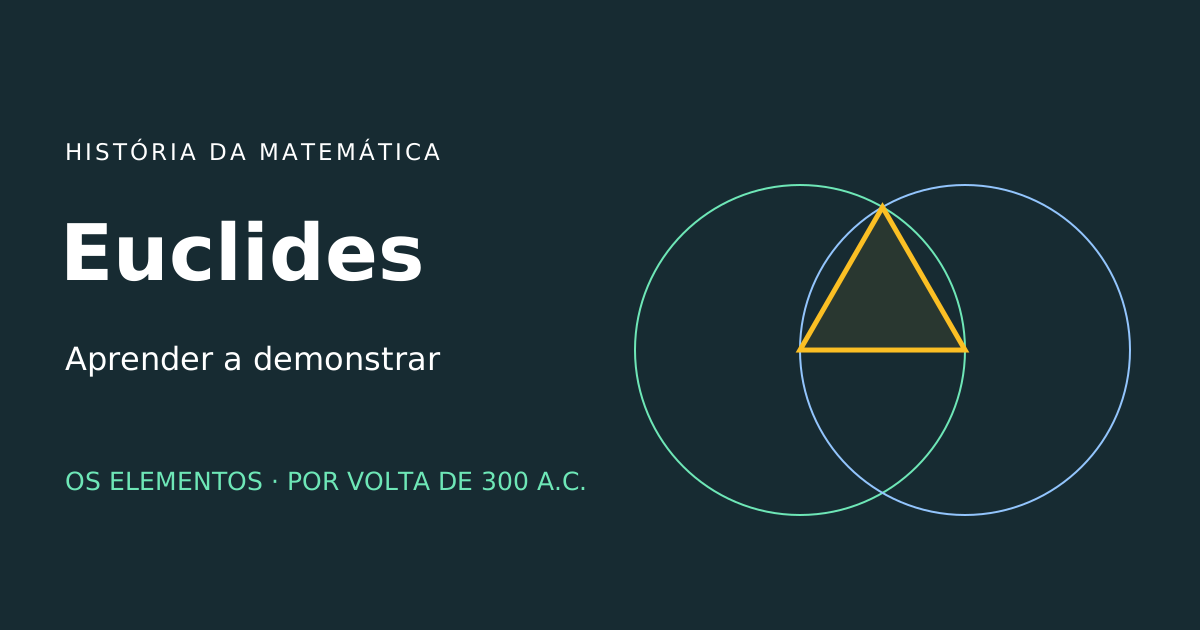
Historical images All come from Wikimedia Commons. We use the thumbnails provided by Commons, unedited. No portrait of Euclid was made in his lifetime; the images of him in circulation are inventions by much later artists. Oxyrhynchus papyrus with Proposition II.5, c. AD 100, University of Pennsylvania Museum: source page · public domain. Detail of the School of Athens, by Raphael, 1509–1511: source page · public domain. Proposition I.47 in Oliver Byrne’s edition, London, 1847, scan by Mirko Junge: source page · public domain. First printed edition of the Elements, Erhard Ratdolt, Venice, 1482, Folger Shakespeare Library: source page · CC BY-SA 4.0. Arabic edition of the Elements, version of Nasir al-Din al-Tusi, Rome, 1594, Houghton Library: source page · public domain. Blog figures The cover, the construction of the equilateral triangle, the figure for Pythagoras’s theorem and the one for completing the square are original illustrations, with versions in each of the site’s languages. The completing-the-square example, $x^2+10x=39$, and the exercise $x^2+8x=65$ come from this site’s old course on the quadratic formula, whose figures were redrawn; the examples 3, 4, 5 and 6, 8, 10 and the table of editions come from the old geometry and trigonometry courses.
October 14, 2026 Read
Hero Image
Image credits for Lagrange

Historical images All come from Wikimedia Commons. We use the thumbnails provided by Commons, unedited. Portrait of Joseph-Louis Lagrange, engraving by an unknown artist: source page · public domain. Medallion with Lagrange’s profile, bronze by Pierre-Jean David d’Angers, Musées d’Angers: source page · CC0. Title page of the Méchanique analitique, Paris, 1788: source page · public domain. Statue of Lagrange in Turin, photo by Twice25, 2009: source page · CC BY-SA 3.0. Blog figures The cover, the diagram of the five Lagrange points and the graph of curves of equal area with the constraint line are original illustrations, with versions in each of the site’s languages. The diagram of the points is not to scale: L1 and L2 are in reality a hundred times closer to the Earth than the Sun is.

October 14, 2026 Read
Hero Image
Fermat's legacy

The father of number theory Title page of the 1670 edition of Diophantus’s Arithmetica, printed in Toulouse “with the observations of P. de Fermat”. It was through this book, published by his son five years after his death, that the margin notes reached Euler.Bernard Bosc, Toulouse (1670) · Wikimedia Commons · public domain Before Fermat, problems about whole numbers were seen as riddles, Diophantus’s puzzles. Fermat turned them into an area of mathematics, with deep questions and methods of its own. For almost a century hardly anyone followed him. It was Euler, from 1730 onwards, who read Fermat’s notes, proved many of them and made number theory a central branch of mathematics. Then came Lagrange, Legendre and Gauss.

October 11, 2026 Read
Hero Image
Image credits

Historical portrait The portrait attributed to Rolland Lefebvre comes from Wikimedia Commons and is in the public domain. We use the thumbnail provided by Commons, without editing, and the caption keeps the attribution given by the collection. Source page. Public domain mark. Blog figures The cover and the refraction sketch are original illustrations. The interactive figures for remainders of powers, the area of rectangles and the division of the interrupted game were created for this trail. They are teaching aids and do not reproduce Fermat’s manuscripts. The division figure, for example, assumes independent rounds and players with equal chances.

October 11, 2026 Read
  • ««
  • «
  • 1
  • 2
  • 3
  • »
  • »»
Navigation
  • Start here
  • Recent posts
  • About Euler
  • App
  • Privacy
Contact me:
  • hirowat2@gmail.com

Euler's Eyes
© 2021 Euler Eyes.
Powered by Hugo Logo