Logo Euler's Eyes
  • Dark Theme
    Light Theme Dark Theme System Theme
Logo Inverted Logo
  • Tags
  • 1 Phase
  • 1st Phase
  • 2 Phase
  • 2 Phase,
  • 2nd Phase
  • 2° Degree Equation
  • Alan Turing
  • Algebra
  • Algebraic Expressions
  • Analysis
  • Analytic Geometry
  • Analytical Geometry
  • Angle Bisector
  • Angle Measurements
  • Angles
  • Apothem
  • Arc Capable
  • Arc Properties
  • Archimedes
  • Area
  • Arithmetic Progression
  • Artificial Intelligence
  • Axioms and Postulates
  • Basic Concepts of Statistics
  • Bernoulli
  • Bhaskara
  • Binary Numbers
  • Binomial
  • Biography
  • Calculating Machine
  • Calculation
  • Calculus
  • Calculus of Variations
  • Cartesian Plane
  • Cartesian Product of Sets
  • Cauchy
  • Central Angle
  • Centroid
  • Children
  • Circle
  • Circle Area
  • Circumcenter
  • Circumference
  • Circumference Ratio
  • Circumferences
  • Circumscript Segments
  • Classification in Mathematics
  • Combinatorial Analysis
  • Combinatorics
  • Comparison of Angles
  • Complement
  • Complex Numbers
  • Compound Interest
  • Computing
  • Concave Region
  • Congruence
  • Congruence of Triangles
  • Convex Region
  • Correspondence Law
  • Cosine Theorem
  • Count
  • Cryptography
  • Decision Theory
  • Demo
  • Derivative
  • Descartes
  • Diagonals
  • Diamond
  • Differential Equations
  • Dispersion Measures
  • Distance
  • Division
  • Domain and Image
  • Einstein
  • Elasticity
  • Electromagnetism
  • Elementary Descriptive Statistics
  • Elementary School I
  • Elementary School II
  • ENEM 2021
  • ENEM 2022
  • ENEM 2023
  • ENEM 2024
  • ENEM 2025
  • Entrance Exam
  • Equality
  • Equations
  • Equiprobable Events
  • Equivalence Between Sets
  • Equivalence Relations
  • Euclid
  • Euclid's Postulate
  • Euler
  • Euler Project
  • Even Numbers
  • Exercises for Adding Natural Numbers
  • Exponential Function
  • External Angles
  • Fees
  • Fermat
  • Fermat's Last Theorem
  • Financial Mathematics
  • First Degree Equations
  • First Degree Functions
  • Flat
  • Flat Figures
  • Flat Geometry
  • Fractions
  • Function Concept
  • Function Discovery
  • Functions
  • FUVEST 2021
  • FUVEST 2022
  • FUVEST 2023
  • FUVEST 2024
  • FUVEST 2025
  • FUVEST 2026
  • Galois
  • Game Theory
  • Gauss
  • Geometric Constructions
  • Geometric Shapes
  • Geometry
  • Geometry With Natural Numbers
  • Geometry With Sequences of Numbers
  • Golden Segment
  • Graph Reading
  • Graphics
  • Graphs for Integers
  • Gravitation
  • Greatest Common Divisor
  • Group Theory
  • Groups
  • Hamilton
  • Height
  • History of Mathematics
  • Incenter
  • Increases and Discounts
  • Inequalities
  • Inscribable Quadrilateral
  • Inscribed Angle
  • Integral
  • Internal Angles
  • Interval Operations
  • Intervals
  • Introduction
  • Introduction to Angles
  • Introduction to Circumference
  • Introduction to Function Theory
  • Introduction to Geometry
  • Introduction to Integers
  • Introduction to Logarithm Table
  • Introduction to Polygons
  • Introduction to Probability
  • Introduction to Quadrilaterals
  • Introduction to Radiciation
  • Introduction to Rational Numbers
  • Introduction to Real Numbers
  • Introduction to Sets
  • Introduction to Statistics
  • Introduction to Triangles
  • Johann Bernoulli
  • John Napier
  • John Nash
  • Kids
  • Lagrange
  • Language
  • Law of Cosines
  • Law of Sines
  • Least Common Multiple
  • Leibniz
  • Level 1
  • Level 2
  • Level 3
  • Limit
  • Linear Systems
  • Logarithm
  • Logarithm Properties
  • Logarithms
  • Logic
  • Magnification
  • Math Elements
  • Mathematical Biology
  • Mathematical Logic
  • Mathematical Notation
  • Mathematical Programming
  • Mathematics Education
  • Mathematics Elements
  • Mathematics for Children
  • Mathematics for Kids
  • Matrices
  • Maxwell
  • Measure
  • Mechanics
  • Medium Base
  • Metric Relationships
  • Midpoint
  • Modular Function
  • Multiplication
  • Napier
  • Natural Number Subtraction Exercises
  • Newton
  • Niels Henrik Abel
  • Notable Points of the Triangle
  • Notation
  • Notion of Infinity
  • Notions of Probability
  • Nth Root
  • Number And
  • Number Theory
  • Number Π
  • Numbering Systems
  • Numerical Calculation
  • Numerical Methods
  • OBMEP
  • OBMEP 2023
  • Obmep,
  • Odd Numbers
  • Operations With Rational Numbers
  • Operations With Sets
  • Operations With Venn-Euler Diagrams
  • Optics
  • Optimization
  • Orthocenter
  • Parallelism
  • Parallelogram
  • Parallels
  • Partial Derivatives
  • Pascal
  • Pascal's Triangle
  • Peano Axioms
  • Peirce
  • Percentage
  • Percentage Basics
  • Perimeter
  • Perpendicular Bisector
  • Perpendicularity
  • Perpendiculars
  • Philosophy
  • Physical
  • Physics
  • Pi Number
  • Pi Numbers
  • Pitot
  • Plane Geometry
  • Point
  • Point Power
  • Polygons
  • Polynomials
  • Position Measurements
  • Position Relative to the Circumference
  • Postulates
  • Potentiation of Integers
  • Power With Negative Exponent
  • Prime Numbers
  • Primitive Notions
  • Principia
  • Probability
  • Progressions
  • Proof
  • Properties
  • Properties of Polygons
  • Proportion
  • Proportionality
  • Proportions
  • Proportions and Geometry
  • Pure Mathematics
  • Pythagoras Theorem
  • Pythagorean Suits
  • Quadratic Function
  • Quadrilateral
  • Quadrilaterals
  • Quantifier
  • Quantity Analysis
  • Quaternions
  • R Programming
  • Real Numbers
  • Rectangle
  • Rectangle Triangles
  • Reduction
  • Reflection
  • Regions in Planes
  • Regular Polygons
  • Relations
  • Relationship Properties
  • Relativity
  • Rhombus
  • Right Angle
  • Right Triangle
  • Right Triangle Relationships
  • Rule of 3
  • Rule of Three
  • Saussure
  • Segment Angle
  • Semi-Inscribed Angle
  • Semi-Straight
  • Semiotics
  • Sequences
  • Series
  • Set Family
  • Set Partition
  • Set Theory
  • Signal Rule
  • Similarity
  • Similarity of Triangles
  • Simple Interest
  • Sines Theorem
  • Sophie Germain
  • Spatial Geometry
  • Square
  • Square Root
  • Statistic
  • Stewart Ratio
  • Straight
  • Straight Lines
  • Straight Segment
  • Sum of Angles
  • Supplement
  • Symmetry
  • Tangent
  • Thales' Theorem
  • The Number Zero
  • Theorems
  • Trapezium
  • Trapezius
  • Triangle
  • Triangles
  • Triangular Inequality
  • Trigonometry
  • Truth Table
  • Understanding Relationships
  • Vectors
  • Venn-Euler Diagrams
  • Whole Numbers
  • Wiles
  • Women in Mathematics
  • Year 2018
  • Year 2019
  • Year 2021
  • Year 2022
  • Évariste Galois
Hero Image
The legacy of John Nash

Statistically, it would seem improbable that any mathematician or scientist, at the age of 66, would be able through continued research efforts, to add much to his or her previous achievements. However I am still making the effort. — John Nash, autobiographical note for the Nobel Foundation (1994) John Nash is the only person to have received both the Nobel Prize and the Abel Prize, the two highest honours in economics and in mathematics. The two halves of his work seem to have nothing in common: one is about human decisions, the other about surfaces and equations. What unites them is the style: attacking problems everyone thought impossible with ideas nobody had had.

October 14, 2026 Read
Hero Image
Pascal's principle: multiplying forces with water

An elephant and a woman in high heels: who sinks deeper into soft ground? It may be the woman. The elephant weighs fifty times more, but its weight spreads over four broad feet. Hers is concentrated on the thin tip of a heel. What sinks into the ground is not force but pressure: the force divided by the area it rests on. $$p=\frac FA.$$The unit of pressure is the pascal: $1\ \text{Pa}=1\ \text{N/m}^2$, a force of one newton spread over one square metre. It is a tiny pressure; at sea level the atmosphere exerts about $100{,}000$ Pa.

October 11, 2026 Read
Hero Image
Infinite descent: a smaller solution leads to a contradiction

Imagine a staircase where each step has a positive whole number. You can go down: 10, 7, 4, 2, 1… but at some point the staircase ends. There is no infinite sequence of ever-smaller positive integers. It seems obvious. Fermat turned this obvious fact into one of the most powerful tools in number theory: infinite descent. How it works To prove that an equation has no solution in positive integers:

October 11, 2026 Read
Hero Image
Calculemus: the idea of calculating with reasoning

The only way to rectify our reasonings is to make them as tangible as those of the mathematicians, so that we can find our error at a glance, and when there are disputes among persons, we can simply say: let us calculate!, without further ado, to see who is right. — Leibniz, The Art of Discovery (1685) Leibniz was a lawyer, diplomat and philosopher. He spent his life watching arguments that never ended, between religions, between countries, between schools of philosophy. A mathematician, on the other hand, does not argue about whether $2+2$ is 4: he does the sum. What if arguments could be calculated like numbers?

October 11, 2026 Read
Hero Image
Light and colours: the prism does not make the rainbow

In Newton’s time it was already known that a glass prism, with sunlight passing through it, produces a coloured band. The accepted explanation came from Aristotle and Descartes: white light is pure, and the glass modifies it, darkening it little by little. A small modification gave red; a large one, blue and violet. Newton had his doubts. What if the colours were already inside white light, and the prism merely separated them?

October 11, 2026 Read
Hero Image
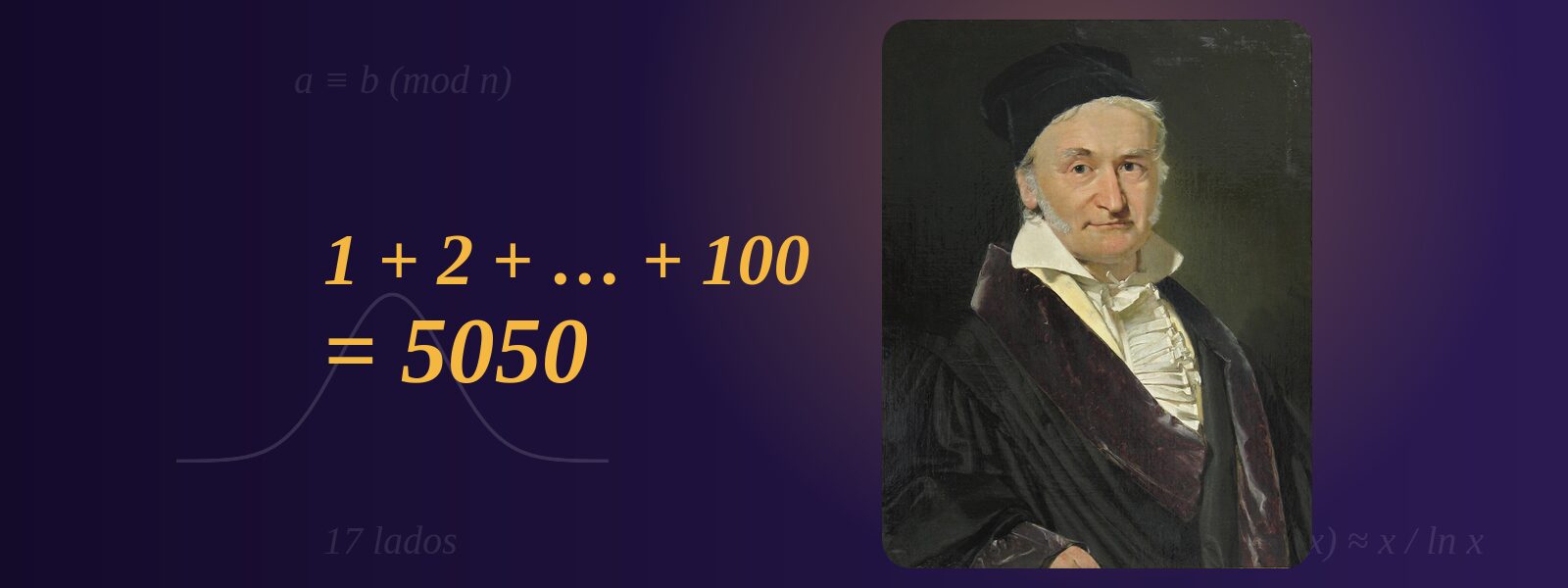
The normal curve, Gauss's bell

If measurement errors are random, how are they distributed? In Theoria motus, Gauss started from the idea that the mean is the best estimate and arrived at the shape of the error curve: $$f(x) = \frac{1}{\sigma\sqrt{2\pi}}\, e^{-\frac{(x - \mu)^2}{2\sigma^2}},$$ where $\mu$ is the mean and $\sigma$ is the standard deviation. It is the normal curve, or Gaussian bell: high in medium, symmetrical, and increasingly lower away from the mean. It appears everywhere, from the heights of the people to the errors of a machine.

October 10, 2026 Read
Hero Image
Descartes and the idea of ​​function

Descartes never used the word “function”. But it was he who made the idea possible: in Geometry, a curve stops being just a drawing and becomes a relationship between two numbers, $x$ and $y$. When one changes, the other changes along with it, following a rule. In this part, we tell you how this idea gained name, symbol and graphic. The following five topics develop this reading and the subsequent history of the idea of ​​function.

October 10, 2026 Read
Hero Image
$V - A + F = 2$ and the soccer ball

In 1750, in a letter to mathematician Christian Goldbach, Euler noted a relationship between the number of vertices ($V$), edges ($A$) and faces ($F$) of a convex polyhedron: $$V - A + F = 2.$$ Rotate the polyhedra with your finger or mouse and check the calculation: V, A and F are counted by the program from the drawing itself. In all cases it gives 2. Ative o JavaScript para ver esta figura interativa.

October 10, 2026 Read
Hero Image
Morphogenesis: the leopard's spots in equations

An embryo starts as a ball of almost identical cells. Even so, it ends up with five fingers on each hand, stripes on a zebra and spots on a leopard. Where does form come from, if at the start everything is uniform? In 1952, in the last major paper he published, “The chemical basis of morphogenesis”, Turing proposed a mathematical answer that biologists took decades to confirm. Two substances, two speeds The idea is to imagine two chemical substances, which Turing called morphogens, spreading through a tissue. Today they are usually described like this:

October 16, 2026 Read
Hero Image
Image credits

Historical images All come from Wikimedia Commons. We use the thumbnails provided by Commons, unedited. Portrait of Jakob Bernoulli, painted in 1687 by his brother Niklaus Bernoulli: source page · public domain. Title page of the Ars conjectandi, Basel, 1713: source page · public domain. Jakob Bernoulli’s tombstone in the cloister of Basel Minster, photo by Wladyslaw Sojka: source page · Free Art License. Cross-section of a nautilus shell, photo by Florian Elias Rieser: source page · CC BY-SA 4.0. Blog figures The cover, the drawing of the two spirals and the graph of the proportion of heads in simulated coin tosses are original illustrations, with versions in each of the site’s languages. The table of notations for the integral, in the post on the legacy, was redone from a table in this site’s old calculus course.

October 14, 2026 Read
Hero Image
Image credits

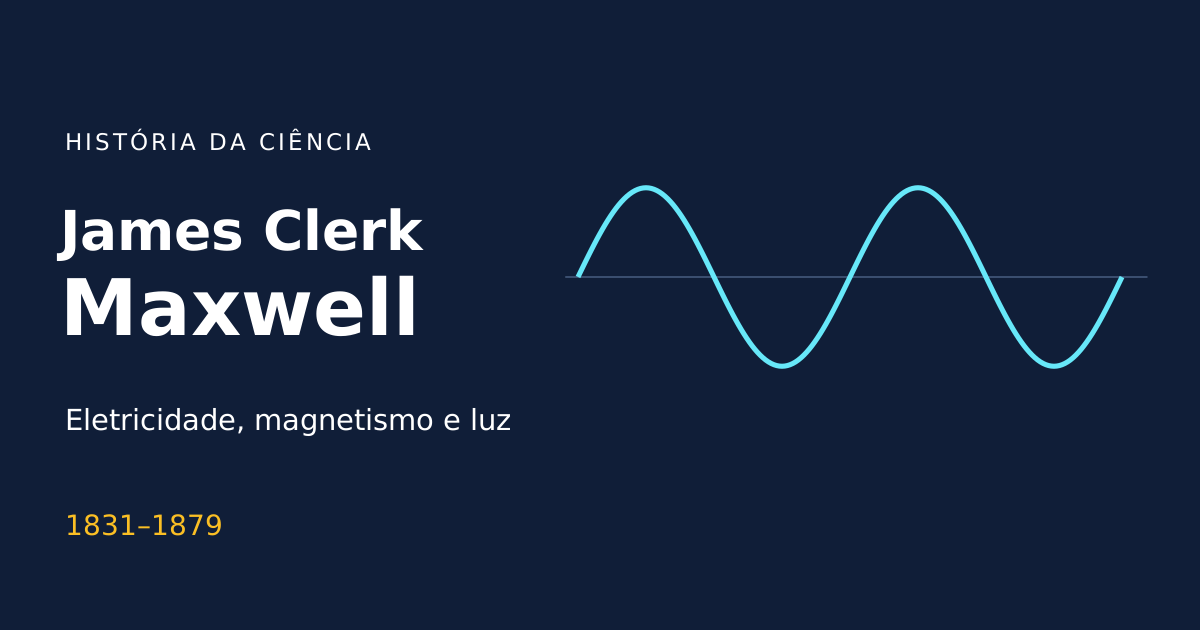
Historical images and photographs All come from Wikimedia Commons. We use the thumbnails provided by Commons, unedited. Portrait of Maxwell, engraving by G. J. Stodart, 1890: source page · public domain. The tartan ribbon, the first colour photograph, by Maxwell and Thomas Sutton, 1861: source page · public domain. Saturn seen from above, by the Cassini spacecraft, 2013: NASA/JPL-Caltech/Space Science Institute, source page · public domain. Michael Faraday, photograph from the 1850s, unknown author: source page · public domain. Title page of the Treatise on Electricity and Magnetism, Oxford, 1873: source page · public domain. The statue of Maxwell with his dog Toby, in Edinburgh, photo by Зеленый кабинет: source page · CC BY-SA 2.0. Blog figures The cover, the wave profile and the graph of the Maxwell distribution for nitrogen are original illustrations, with versions in each of the site’s languages. The graph was calculated with the exact formula of the distribution. The discussion of quaternions and vectors, in the post on the equations, draws on passages from this site’s old course on vectors.
October 14, 2026 Read
Hero Image
Image credits

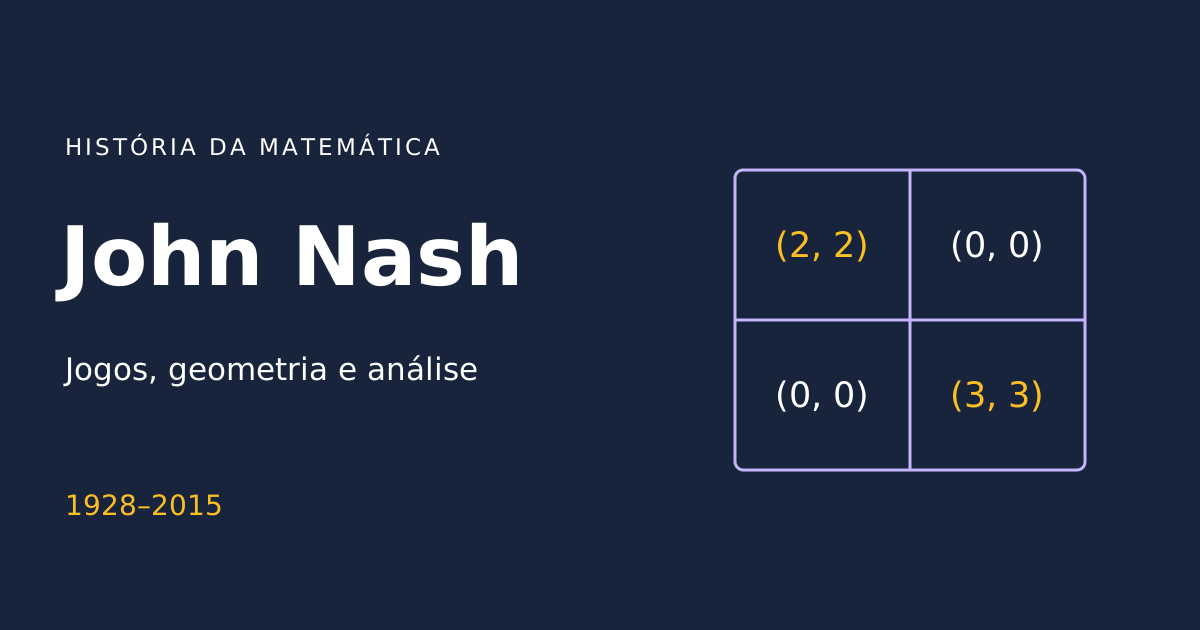
Photographs and images All come from Wikimedia Commons. We use the thumbnails provided by Commons, unedited. Portrait of John Nash, photo by Peter Badge: source page · CC BY-SA 3.0. John Nash in 2006, in Cologne, photo by Elke Wetzig: source page · CC BY-SA 3.0. Isometric embedding of the flat torus, Hevea project, uploaded by Romainbehar: source page · CC0. Blog figures The cover, the Hex board and the graph of the product of gains in bargaining are original illustrations, with versions in each language of the site. The board shows an invented game, in which red has completed its chain.

October 14, 2026 Read
  • ««
  • «
  • 11
  • 12
  • 13
  • 14
  • 15
  • »
  • »»
Navigation
  • Start here
  • Recent posts
  • About Euler
  • App
  • Privacy
Contact me:
  • hirowat2@gmail.com

Euler's Eyes
© 2021 Euler Eyes.
Powered by Hugo Logo