Logo Euler's Eyes
  • Dark Theme
    Light Theme Dark Theme System Theme
Logo Inverted Logo
  • Tags
  • 1 Phase
  • 1st Phase
  • 2 Phase
  • 2 Phase,
  • 2nd Phase
  • 2° Degree Equation
  • Alan Turing
  • Algebra
  • Algebraic Expressions
  • Analysis
  • Analytic Geometry
  • Analytical Geometry
  • Angle Bisector
  • Angle Measurements
  • Angles
  • Apothem
  • Arc Capable
  • Arc Properties
  • Archimedes
  • Area
  • Arithmetic Progression
  • Artificial Intelligence
  • Axioms and Postulates
  • Basic Concepts of Statistics
  • Bernoulli
  • Bhaskara
  • Binary Numbers
  • Binomial
  • Biography
  • Calculating Machine
  • Calculation
  • Calculus
  • Calculus of Variations
  • Cartesian Plane
  • Cartesian Product of Sets
  • Cauchy
  • Central Angle
  • Centroid
  • Children
  • Circle
  • Circle Area
  • Circumcenter
  • Circumference
  • Circumference Ratio
  • Circumferences
  • Circumscript Segments
  • Classification in Mathematics
  • Combinatorial Analysis
  • Combinatorics
  • Comparison of Angles
  • Complement
  • Complex Numbers
  • Compound Interest
  • Computing
  • Concave Region
  • Congruence
  • Congruence of Triangles
  • Convex Region
  • Correspondence Law
  • Cosine Theorem
  • Count
  • Cryptography
  • Decision Theory
  • Demo
  • Derivative
  • Descartes
  • Diagonals
  • Diamond
  • Differential Equations
  • Dispersion Measures
  • Distance
  • Division
  • Domain and Image
  • Einstein
  • Elasticity
  • Electromagnetism
  • Elementary Descriptive Statistics
  • Elementary School I
  • Elementary School II
  • ENEM 2021
  • ENEM 2022
  • ENEM 2023
  • ENEM 2024
  • ENEM 2025
  • Entrance Exam
  • Equality
  • Equations
  • Equiprobable Events
  • Equivalence Between Sets
  • Equivalence Relations
  • Euclid
  • Euclid's Postulate
  • Euler
  • Euler Project
  • Even Numbers
  • Exercises for Adding Natural Numbers
  • Exponential Function
  • External Angles
  • Fees
  • Fermat
  • Fermat's Last Theorem
  • Financial Mathematics
  • First Degree Equations
  • First Degree Functions
  • Flat
  • Flat Figures
  • Flat Geometry
  • Fractions
  • Function Concept
  • Function Discovery
  • Functions
  • FUVEST 2021
  • FUVEST 2022
  • FUVEST 2023
  • FUVEST 2024
  • FUVEST 2025
  • FUVEST 2026
  • Galois
  • Game Theory
  • Gauss
  • Geometric Constructions
  • Geometric Shapes
  • Geometry
  • Geometry With Natural Numbers
  • Geometry With Sequences of Numbers
  • Golden Segment
  • Graph Reading
  • Graphics
  • Graphs for Integers
  • Gravitation
  • Greatest Common Divisor
  • Group Theory
  • Groups
  • Hamilton
  • Height
  • History of Mathematics
  • Incenter
  • Increases and Discounts
  • Inequalities
  • Inscribable Quadrilateral
  • Inscribed Angle
  • Integral
  • Internal Angles
  • Interval Operations
  • Intervals
  • Introduction
  • Introduction to Angles
  • Introduction to Circumference
  • Introduction to Function Theory
  • Introduction to Geometry
  • Introduction to Integers
  • Introduction to Logarithm Table
  • Introduction to Polygons
  • Introduction to Probability
  • Introduction to Quadrilaterals
  • Introduction to Radiciation
  • Introduction to Rational Numbers
  • Introduction to Real Numbers
  • Introduction to Sets
  • Introduction to Statistics
  • Introduction to Triangles
  • Johann Bernoulli
  • John Napier
  • John Nash
  • Kids
  • Lagrange
  • Language
  • Law of Cosines
  • Law of Sines
  • Least Common Multiple
  • Leibniz
  • Level 1
  • Level 2
  • Level 3
  • Limit
  • Linear Systems
  • Logarithm
  • Logarithm Properties
  • Logarithms
  • Logic
  • Magnification
  • Math Elements
  • Mathematical Biology
  • Mathematical Logic
  • Mathematical Notation
  • Mathematical Programming
  • Mathematics Education
  • Mathematics Elements
  • Mathematics for Children
  • Mathematics for Kids
  • Matrices
  • Maxwell
  • Measure
  • Mechanics
  • Medium Base
  • Metric Relationships
  • Midpoint
  • Modular Function
  • Multiplication
  • Napier
  • Natural Number Subtraction Exercises
  • Newton
  • Niels Henrik Abel
  • Notable Points of the Triangle
  • Notation
  • Notion of Infinity
  • Notions of Probability
  • Nth Root
  • Number And
  • Number Theory
  • Number Π
  • Numbering Systems
  • Numerical Calculation
  • Numerical Methods
  • OBMEP
  • OBMEP 2023
  • Obmep,
  • Odd Numbers
  • Operations With Rational Numbers
  • Operations With Sets
  • Operations With Venn-Euler Diagrams
  • Optics
  • Optimization
  • Orthocenter
  • Parallelism
  • Parallelogram
  • Parallels
  • Partial Derivatives
  • Pascal
  • Pascal's Triangle
  • Peano Axioms
  • Peirce
  • Percentage
  • Percentage Basics
  • Perimeter
  • Perpendicular Bisector
  • Perpendicularity
  • Perpendiculars
  • Philosophy
  • Physical
  • Physics
  • Pi Number
  • Pi Numbers
  • Pitot
  • Plane Geometry
  • Point
  • Point Power
  • Polygons
  • Polynomials
  • Position Measurements
  • Position Relative to the Circumference
  • Postulates
  • Potentiation of Integers
  • Power With Negative Exponent
  • Prime Numbers
  • Primitive Notions
  • Principia
  • Probability
  • Progressions
  • Proof
  • Properties
  • Properties of Polygons
  • Proportion
  • Proportionality
  • Proportions
  • Proportions and Geometry
  • Pure Mathematics
  • Pythagoras Theorem
  • Pythagorean Suits
  • Quadratic Function
  • Quadrilateral
  • Quadrilaterals
  • Quantifier
  • Quantity Analysis
  • Quaternions
  • R Programming
  • Real Numbers
  • Rectangle
  • Rectangle Triangles
  • Reduction
  • Reflection
  • Regions in Planes
  • Regular Polygons
  • Relations
  • Relationship Properties
  • Relativity
  • Rhombus
  • Right Angle
  • Right Triangle
  • Right Triangle Relationships
  • Rule of 3
  • Rule of Three
  • Saussure
  • Segment Angle
  • Semi-Inscribed Angle
  • Semi-Straight
  • Semiotics
  • Sequences
  • Series
  • Set Family
  • Set Partition
  • Set Theory
  • Signal Rule
  • Similarity
  • Similarity of Triangles
  • Simple Interest
  • Sines Theorem
  • Sophie Germain
  • Spatial Geometry
  • Square
  • Square Root
  • Statistic
  • Stewart Ratio
  • Straight
  • Straight Lines
  • Straight Segment
  • Sum of Angles
  • Supplement
  • Symmetry
  • Tangent
  • Thales' Theorem
  • The Number Zero
  • Theorems
  • Trapezium
  • Trapezius
  • Triangle
  • Triangles
  • Triangular Inequality
  • Trigonometry
  • Truth Table
  • Understanding Relationships
  • Vectors
  • Venn-Euler Diagrams
  • Whole Numbers
  • Wiles
  • Women in Mathematics
  • Year 2018
  • Year 2019
  • Year 2021
  • Year 2022
  • Évariste Galois
Hero Image
Algebra done with squares and rectangles

If a straight line is cut at random, the square on the whole equals the squares on the segments plus twice the rectangle contained by the segments. — Euclid, Elements, Proposition II.4 The Greeks had no letters for unknowns, no plus or minus signs, no equals sign. When they wanted to speak of $a\cdot b$, they spoke of a rectangle with sides $a$ and $b$; when they wanted $a^2$, they spoke of a square with side $a$. The words “square” and “cube” that we use for powers come from this. Book II of the Elements is made entirely in this way: it consists of identities of algebra, stated and proved as facts about areas. Historians call it geometric algebra.

October 14, 2026 Read
Hero Image
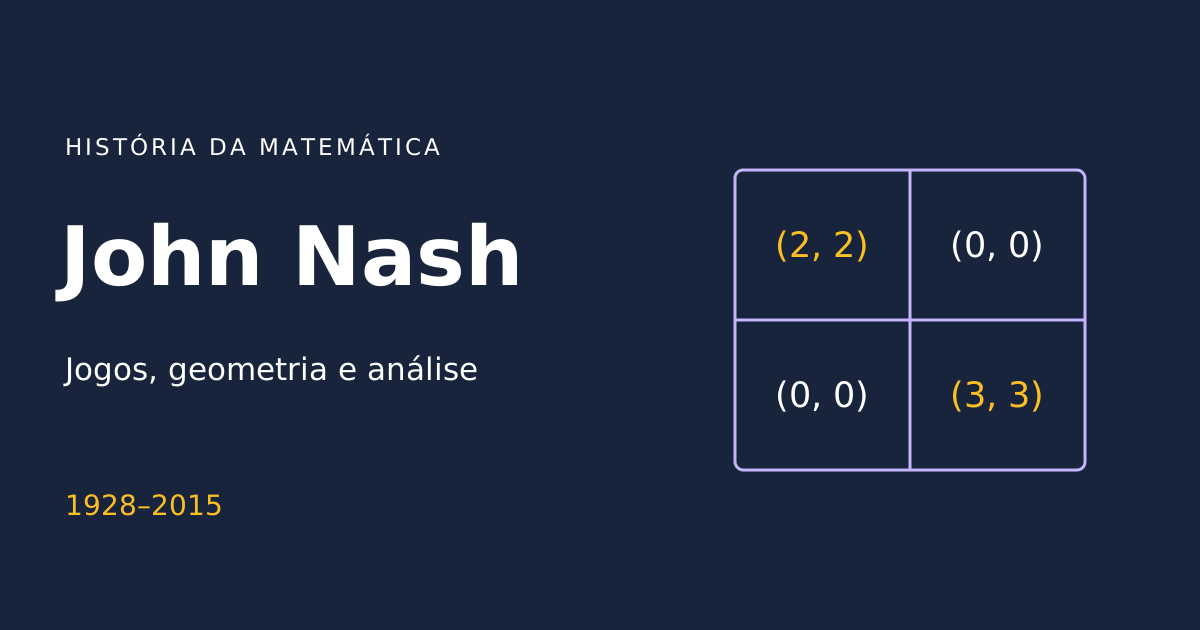
The Nash bargaining solution

A new treatment is presented of a classical economic problem, one which occurs in many forms, as bargaining, bilateral monopoly, etc. — John Nash, The Bargaining Problem (1950) In 1948, still an undergraduate at the Carnegie Institute of Technology, Nash took a course in international economics, the only economics course of his life. He came out of it with a question: when two people negotiate, how do they share the gains from a deal? Economists thought the answer depended on each side’s psychology, skill and bluffing, and that there was nothing to say in general. Nash showed that, if the deal must satisfy a few reasonable requirements, there is only one possible answer. The paper, written before he arrived at Princeton, was published in 1950 in the journal Econometrica.

October 14, 2026 Read
Hero Image
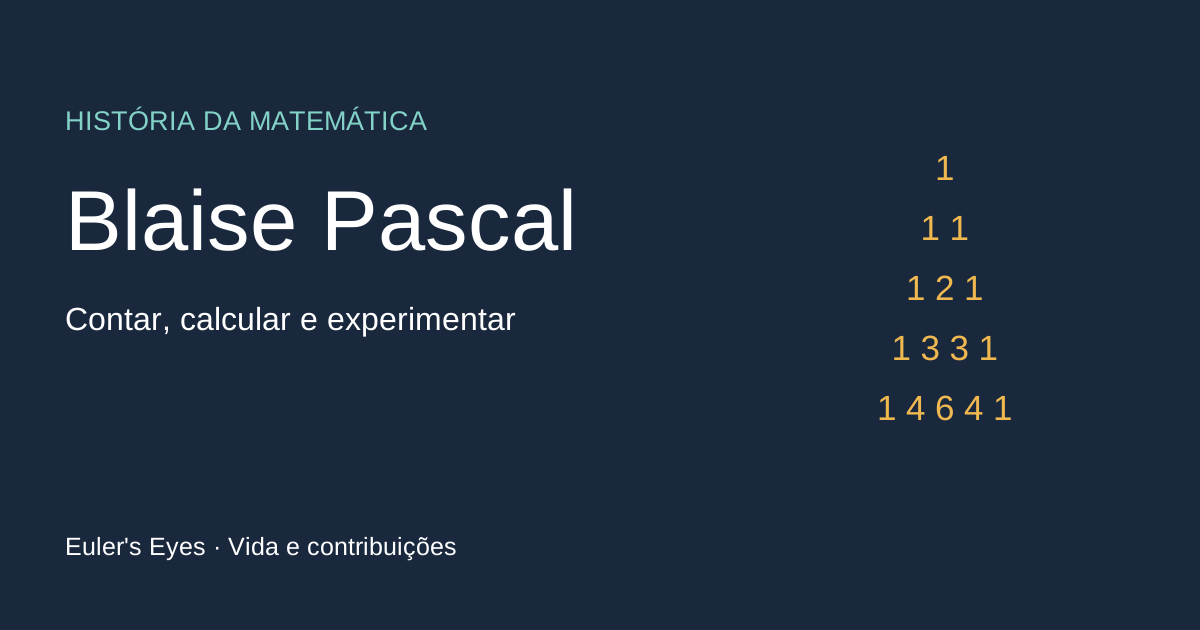
The Pascaline: a sum made of gears

In 1640 Étienne Pascal was appointed tax commissioner for Normandy. The job meant adding up column after column of figures late into the night, and his son Blaise, then 17, helped. To make matters worse, French money was not decimal: $$1\ \text{livre}=20\ \text{sols},\qquad 1\ \text{sol}=12\ \text{deniers}.$$Adding $3$ livres, $15$ sols and $8$ deniers to $2$ livres, $7$ sols and $9$ deniers needs three kinds of carry: deniers: $8+9=17$, which is $1$ sol and $5$ deniers; sols: $15+7+1=23$, which is $1$ livre and $3$ sols; livres: $3+2+1=6$. Result: $6$ livres, $3$ sols and $5$ deniers. Do that a thousand times a night and you will make mistakes. In 1642 Blaise began building a machine that would not.

October 11, 2026 Read
Hero Image
Crumpling without stretching: the embedding theorem

Take a sheet of paper. You can roll it into a cylinder without tearing or stretching it: distances measured on the sheet, with a flexible ruler, stay the same. But you cannot wrap a ball with it without making folds. The sheet and the sphere have different intrinsic geometries, and Gauss proved in 1827 that this difference, the curvature, does not change when the surface is bent without stretching. In the nineteenth century Bernhard Riemann had an even bolder idea: to describe a surface, or a space of any dimension, by its internal measurements alone, without drawing it anywhere. All it takes is a rule, the metric, that says how to measure the length of any curve. This is how general relativity describes spacetime: from inside, without a larger space around it.

October 14, 2026 Read
Hero Image
Euclid's algorithm: the greatest common divisor

The Euclidean algorithm is the granddaddy of all algorithms, because it is the oldest nontrivial algorithm that has survived to the present day. — Donald Knuth, The Art of Computer Programming, vol. 2 (1969) You have two rods, one 252 cm long and the other 105 cm, and you want the longest ruler that measures both exactly, a whole number of times. In today’s language you want the greatest common divisor, $\gcd(252,105)$. You could list all the divisors of each number and look for the largest common one, but with big numbers that is impractical. In Book VII of the Elements, Euclid teaches a much faster way.

October 14, 2026 Read
Hero Image
The mystic hexagram: six points on a conic

In February 1640 a sheet printed on one side only, like a poster, circulated in Paris under the title Essay on conics. It had no proofs, only definitions, three lemmas and a list of results. The author was 16 years old and his name was Blaise Pascal. When Father Mersenne showed the sheet to Descartes, the reaction was suspicion: Descartes thought the young man had taken everything from Girard Desargues, the architect and geometer Pascal admired. Desargues’s influence was real, and Pascal himself acknowledged it. But the central result on the sheet was new.

October 11, 2026 Read
Hero Image
The heat equation and the regularity of De Giorgi and Nash

In 1900, at the International Congress of Mathematicians in Paris, David Hilbert presented a list of 23 problems that, in his view, would guide twentieth-century mathematics. Problem 19 asked, in simple terms: are the solutions of the “well-behaved” problems of the calculus of variations always smooth functions? Half a century later, the question was still open for an important class of equations. In 1956 Nash heard about it from a colleague and decided to attack it.

October 14, 2026 Read
Hero Image
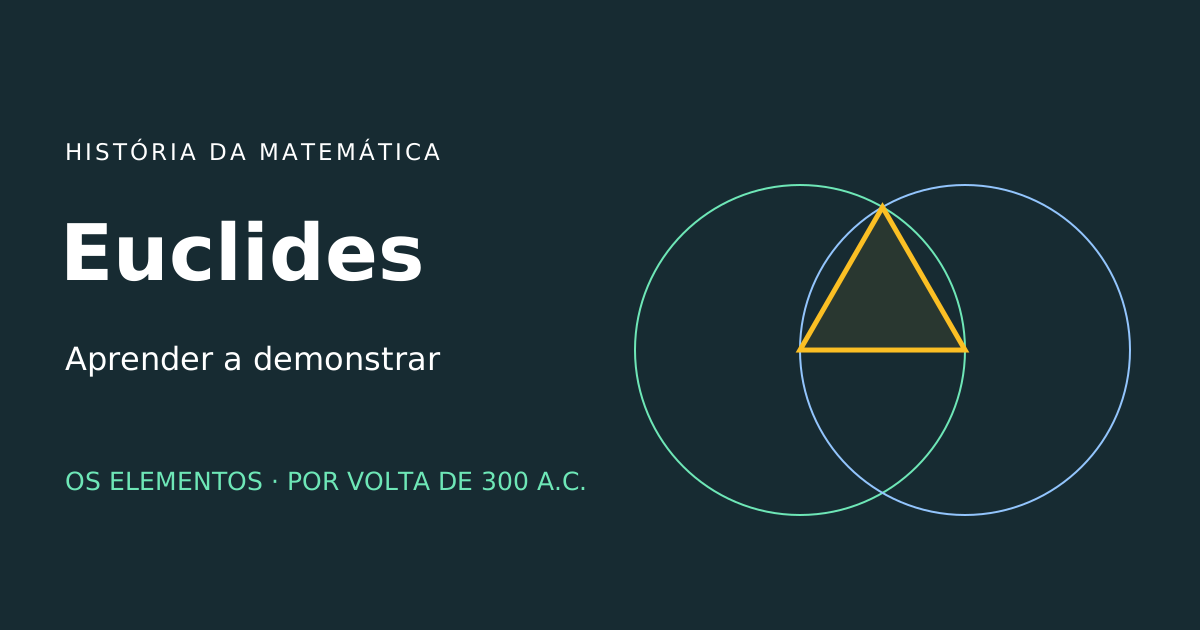
The primes never run out

Prime numbers are more than any assigned multitude of prime numbers. — Euclid, Elements, Proposition IX.20 A prime number is an integer greater than 1 that can only be divided by 1 and by itself: 2, 3, 5, 7, 11, 13, … All the others, such as $12=2\cdot2\cdot3$, are products of primes. The primes are the atoms of arithmetic. The further you go, the rarer they become. Between 1 and 100 there are 25 primes; between 1,000,001 and 1,000,100, only 6. Do they run out at some point? Euclid showed that they do not, with a four-line argument that the English mathematician G. H. Hardy considered one of the most beautiful in all of mathematics.
October 14, 2026 Read
Hero Image
The cycloid: the toothache curve

Paint a dot on a bicycle tyre and push the bike in a straight line. The dot rises, makes an arch and comes back down to touch the ground, once for every turn of the wheel. The curve it traces is called the cycloid. In the 17th century it was the fashionable curve. The French called it the roulette. So many mathematicians quarrelled over discoveries about it that it earned a nickname: the Helen of geometers, after Helen of Troy, who started a war.

October 11, 2026 Read
Hero Image
The fifth postulate and the other geometries

Out of nothing I have created a strange new universe. — János Bolyai, letter to his father (3 November 1823) Euclid’s first four postulates are short and obvious: draw a line, extend it, draw a circle, all right angles are equal. The fifth is different: If a straight line falling on two straight lines makes the interior angles on the same side less than two right angles, the two straight lines, if extended indefinitely, meet on that side.

October 14, 2026 Read
Hero Image
The legacy of John Nash

Statistically, it would seem improbable that any mathematician or scientist, at the age of 66, would be able through continued research efforts, to add much to his or her previous achievements. However I am still making the effort. — John Nash, autobiographical note for the Nobel Foundation (1994) John Nash is the only person to have received both the Nobel Prize and the Abel Prize, the two highest honours in economics and in mathematics. The two halves of his work seem to have nothing in common: one is about human decisions, the other about surfaces and equations. What unites them is the style: attacking problems everyone thought impossible with ideas nobody had had.

October 14, 2026 Read
Hero Image
Pascal's principle: multiplying forces with water

An elephant and a woman in high heels: who sinks deeper into soft ground? It may be the woman. The elephant weighs fifty times more, but its weight spreads over four broad feet. Hers is concentrated on the thin tip of a heel. What sinks into the ground is not force but pressure: the force divided by the area it rests on. $$p=\frac FA.$$The unit of pressure is the pascal: $1\ \text{Pa}=1\ \text{N/m}^2$, a force of one newton spread over one square metre. It is a tiny pressure; at sea level the atmosphere exerts about $100{,}000$ Pa.

October 11, 2026 Read
  • ««
  • «
  • 1
  • 2
  • 3
  • 4
  • »
  • »»
Navigation
  • Start here
  • Recent posts
  • About Euler
  • App
  • Privacy
Contact me:
  • hirowat2@gmail.com

Euler's Eyes
© 2021 Euler Eyes.
Powered by Hugo Logo