Hero Image
Other contributions and legacy

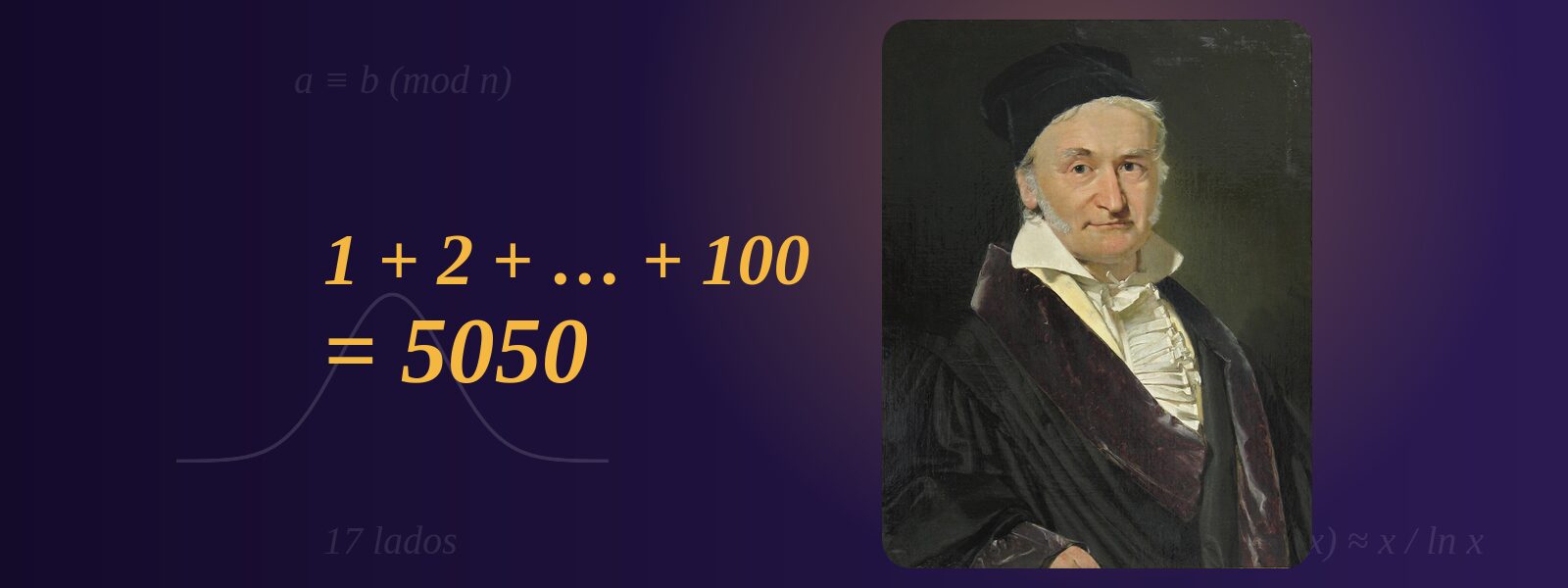
Other contributions Physics: Gauss’s law of electromagnetism, the study of Earth’s magnetism and the Gauss unit. Complex numbers: Gaussian integers, numbers $a + bi$ with $a$ and $b$ integers. Astronomy and geodesy: orbits of planets and comets, the heliotrope and the Hannover measurement. Algorithms: a method for calculating the date of Easter and, in a manuscript by 1805, a version of the fast Fourier transform, rediscovered in 1965 and used today in every cell phone. To remember Gauss was born poor in Braunschweig, studied under a duke and spent his life in Göttingen. Added from 1 to 100 by joining pairs: $1 + 2 + \cdots + n = \frac{n(n+1)}{2}$. At 18 years he showed how to construct a polygon with 17 sides, using only square roots. He created the congruence notation, $a \equiv b \pmod n$, the mathematics of the clock and nines-out. He proved that every polynomial of degree $n$ has $n$ complex roots. Estimated the number of primes: $\pi(x) \approx x / \ln x$. He rediscovered Ceres with the least squares method, which shows why the average is the best estimate. He gave the name to the normal curve, the Gaussian bell. He showed that curvature can be measured from within the surface: this is why there is no perfect flat map. He named the determinant and organized the elimination that solves systems of equations. With two well-chosen points, $\pm 1/\sqrt{3}$, he calculated exact integrals for polynomials up to degree 3. All topics by Carl Friedrich Gauss · ← Gaussian quadrature: integrate with two points · Image credits →

Hero Image
Other contributions and legacy

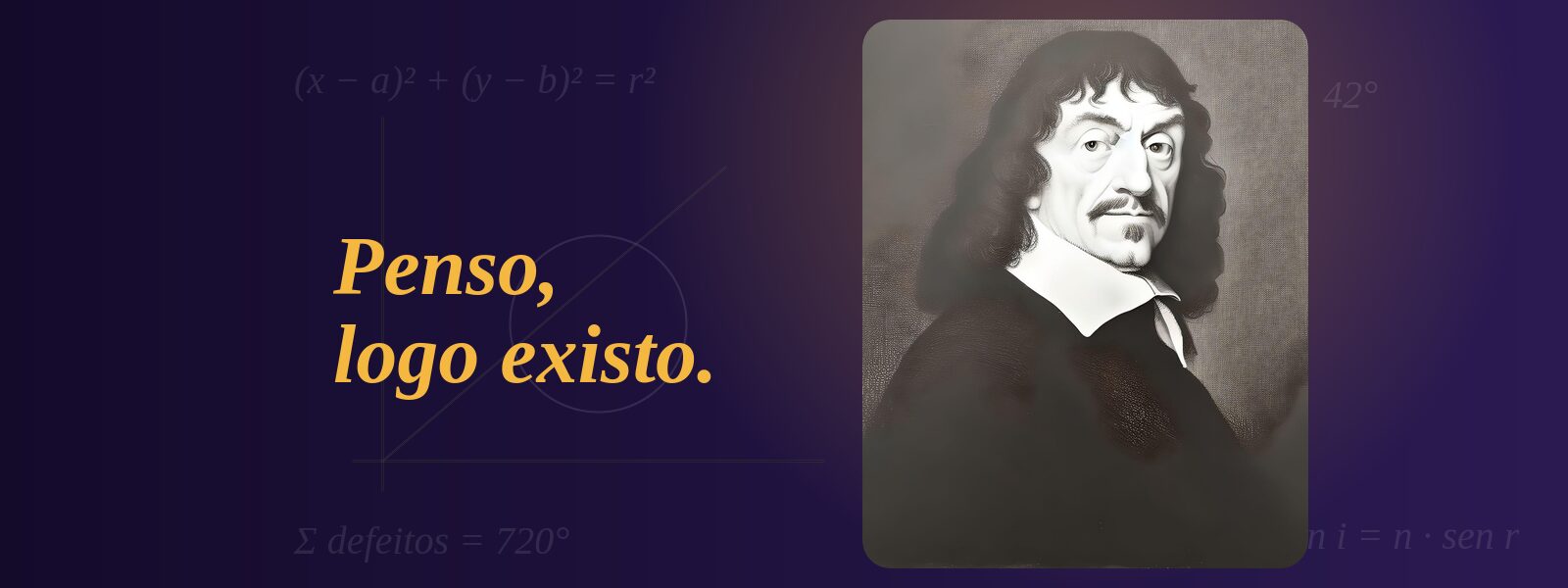
Other contributions Descartes’ vortices: for him, the planets were dragged by whirlpools of matter around each star.René Descartes, Principles of Philosophy · public domain Optics: in addition to the law of refraction, he studied the ideal shape of lenses, which should have a profile of ellipse or hyperbola to focus light on a point. Descartes’ Folio: the curve $x^3 + y^3 = 3axy$, which he proposed as a challenge to Fermat to find tangent lines. Physics: formulated a version of the principle of inertia, that a body in motion continues in straight line if nothing gets in your way. Philosophy: the Meditations and the Principles of Philosophy made it the starting point of modern philosophy. To remember Descartes lived between France, Holland and Sweden, and wrote the Discourse on the Method in French to be read by everyone. He created analytical geometry: points became pairs $(x, y)$ and figures became equations. He showed how to construct $\sqrt{a}$ with a ruler and compass and fixed the notation $x$, $y$, $z$ and $x^3$. The rule of signs tells how many positive roots a polynomial can have. The sum of the vertex defects of a polyhedron is 720°, which leads to the formula $V - A + F = 2$. He explained the rainbow: the rays accumulate at 42° from the point opposite the Sun. With it comes the idea of ​​function: a rule that “listens” to one number and “speaks” another. The word comes from Latin functus, and the symbol $f(x)$ is Euler (1734). There is no $1 \div 0$: close to zero, $\frac{1}{x}$ runs away to $+\infty$ on one side and to $-\infty$ on the other. All topics by René Descartes · ← Infinity and division by zero · Image credits →

Hero Image
Chapter 1: references and credits

Further reading Cajori, Florian. A History of Mathematical Notations. 2 vols. Chicago: Open Court, 1928–1929. The reference work on the origin of each symbol; almost every date in this chapter can be checked in it. Mazur, Joseph. Enlightening Symbols: A Short History of Mathematical Notation and Its Hidden Powers. Princeton: Princeton University Press, 2014. An accessible history on the same theme as this book. Ifrah, Georges. The Universal History of Numbers. London: Harvill Press, 1998. On number systems and zero. Klein, Jacob. Greek Mathematical Thought and the Origin of Algebra. Cambridge, MA: MIT Press, 1968. On the passage from Diophantus to Viète. Boyer, Carl B.; Merzbach, Uta C. A History of Mathematics. 3rd ed. Hoboken: Wiley, 2011. Crowe, Michael J. A History of Vector Analysis. Notre Dame: University of Notre Dame Press, 1967. On the dispute between quaternions and vectors. Maor, Eli. Trigonometric Delights. Princeton: Princeton University Press, 1998. On the history of the sine and the names of trigonometry. Grabiner, Judith V. The Origins of Cauchy’s Rigorous Calculus. Cambridge, MA: MIT Press, 1981. On Berkeley, Cauchy and the limit. Miller, Jeff. Earliest Uses of Various Mathematical Symbols. A page maintained since the 1990s, with the earliest known occurrences of each sign. MacTutor History of Mathematics, University of St Andrews: biographies of al-Khwarizmi, Fibonacci, Recorde, Viète, Harriot, Oughtred, Cayley, Boole, Frege and Peano. The old texts on this site about geometry, trigonometry, the square root, quadratic equations, logarithms, derivatives, the chain rule, integrals, limits, functions, differential equations, groups, matrices, vectors and quaternions were the basis for rewriting this chapter. From them come the story of radix quadrati, the completing-the-square figure, Pythagoras’ theorem in Latin, the etymology of cathetus, hypotenuse, minute and second, the passage from $\Sigma$ to $\int$, the proof that $1=2$, Hooke’s law, the “canon of heat” and the propagation of errors, the abbreviation of logarithmus to $\log$, the etymology of derivative and function, reading a function as a sentence with a hole, the group table of the triangle’s moves, the dispute between quaternions and vectors, and the ideas of active and sterile notation.