Logo Euler's Eyes
  • Dark Theme
    Light Theme Dark Theme System Theme
Logo Inverted Logo
  • Tags
  • 1 Phase
  • 1st Phase
  • 2 Phase
  • 2 Phase,
  • 2nd Phase
  • 2° Degree Equation
  • Alan Turing
  • Algebra
  • Algebraic Expressions
  • Analysis
  • Analytic Geometry
  • Analytical Geometry
  • Angle Bisector
  • Angle Measurements
  • Angles
  • Apothem
  • Arc Capable
  • Arc Properties
  • Archimedes
  • Area
  • Arithmetic Progression
  • Artificial Intelligence
  • Axioms and Postulates
  • Basic Concepts of Statistics
  • Bernoulli
  • Bhaskara
  • Binary Numbers
  • Binomial
  • Biography
  • Calculating Machine
  • Calculation
  • Calculus
  • Calculus of Variations
  • Cartesian Plane
  • Cartesian Product of Sets
  • Cauchy
  • Central Angle
  • Centroid
  • Children
  • Circle
  • Circle Area
  • Circumcenter
  • Circumference
  • Circumference Ratio
  • Circumferences
  • Circumscript Segments
  • Classification in Mathematics
  • Combinatorial Analysis
  • Combinatorics
  • Comparison of Angles
  • Complement
  • Complex Numbers
  • Compound Interest
  • Computing
  • Concave Region
  • Congruence
  • Congruence of Triangles
  • Convex Region
  • Correspondence Law
  • Cosine Theorem
  • Count
  • Cryptography
  • Decision Theory
  • Demo
  • Derivative
  • Descartes
  • Diagonals
  • Diamond
  • Differential Equations
  • Dispersion Measures
  • Distance
  • Division
  • Domain and Image
  • Einstein
  • Elasticity
  • Electromagnetism
  • Elementary Descriptive Statistics
  • Elementary School I
  • Elementary School II
  • ENEM 2021
  • ENEM 2022
  • ENEM 2023
  • ENEM 2024
  • ENEM 2025
  • Entrance Exam
  • Equality
  • Equations
  • Equiprobable Events
  • Equivalence Between Sets
  • Equivalence Relations
  • Euclid
  • Euclid's Postulate
  • Euler
  • Euler Project
  • Even Numbers
  • Exercises for Adding Natural Numbers
  • Exponential Function
  • External Angles
  • Fees
  • Fermat
  • Fermat's Last Theorem
  • Financial Mathematics
  • First Degree Equations
  • First Degree Functions
  • Flat
  • Flat Figures
  • Flat Geometry
  • Fractions
  • Function Concept
  • Function Discovery
  • Functions
  • FUVEST 2021
  • FUVEST 2022
  • FUVEST 2023
  • FUVEST 2024
  • FUVEST 2025
  • FUVEST 2026
  • Galois
  • Game Theory
  • Gauss
  • Geometric Constructions
  • Geometric Shapes
  • Geometry
  • Geometry With Natural Numbers
  • Geometry With Sequences of Numbers
  • Golden Segment
  • Graph Reading
  • Graphics
  • Graphs for Integers
  • Gravitation
  • Greatest Common Divisor
  • Group Theory
  • Groups
  • Hamilton
  • Height
  • History of Mathematics
  • Incenter
  • Increases and Discounts
  • Inequalities
  • Inscribable Quadrilateral
  • Inscribed Angle
  • Integral
  • Internal Angles
  • Interval Operations
  • Intervals
  • Introduction
  • Introduction to Angles
  • Introduction to Circumference
  • Introduction to Function Theory
  • Introduction to Geometry
  • Introduction to Integers
  • Introduction to Logarithm Table
  • Introduction to Polygons
  • Introduction to Probability
  • Introduction to Quadrilaterals
  • Introduction to Radiciation
  • Introduction to Rational Numbers
  • Introduction to Real Numbers
  • Introduction to Sets
  • Introduction to Statistics
  • Introduction to Triangles
  • Johann Bernoulli
  • John Napier
  • John Nash
  • Kids
  • Lagrange
  • Language
  • Law of Cosines
  • Law of Sines
  • Least Common Multiple
  • Leibniz
  • Level 1
  • Level 2
  • Level 3
  • Limit
  • Linear Systems
  • Logarithm
  • Logarithm Properties
  • Logarithms
  • Logic
  • Magnification
  • Math Elements
  • Mathematical Biology
  • Mathematical Logic
  • Mathematical Notation
  • Mathematical Programming
  • Mathematics Education
  • Mathematics Elements
  • Mathematics for Children
  • Mathematics for Kids
  • Matrices
  • Maxwell
  • Measure
  • Mechanics
  • Medium Base
  • Metric Relationships
  • Midpoint
  • Modular Function
  • Multiplication
  • Napier
  • Natural Number Subtraction Exercises
  • Newton
  • Niels Henrik Abel
  • Notable Points of the Triangle
  • Notation
  • Notion of Infinity
  • Notions of Probability
  • Nth Root
  • Number And
  • Number Theory
  • Number Π
  • Numbering Systems
  • Numerical Calculation
  • Numerical Methods
  • OBMEP
  • OBMEP 2023
  • Obmep,
  • Odd Numbers
  • Operations With Rational Numbers
  • Operations With Sets
  • Operations With Venn-Euler Diagrams
  • Optics
  • Optimization
  • Orthocenter
  • Parallelism
  • Parallelogram
  • Parallels
  • Partial Derivatives
  • Pascal
  • Pascal's Triangle
  • Peano Axioms
  • Peirce
  • Percentage
  • Percentage Basics
  • Perimeter
  • Perpendicular Bisector
  • Perpendicularity
  • Perpendiculars
  • Philosophy
  • Physical
  • Physics
  • Pi Number
  • Pi Numbers
  • Pitot
  • Plane Geometry
  • Point
  • Point Power
  • Polygons
  • Polynomials
  • Position Measurements
  • Position Relative to the Circumference
  • Postulates
  • Potentiation of Integers
  • Power With Negative Exponent
  • Prime Numbers
  • Primitive Notions
  • Principia
  • Probability
  • Progressions
  • Proof
  • Properties
  • Properties of Polygons
  • Proportion
  • Proportionality
  • Proportions
  • Proportions and Geometry
  • Pure Mathematics
  • Pythagoras Theorem
  • Pythagorean Suits
  • Quadratic Function
  • Quadrilateral
  • Quadrilaterals
  • Quantifier
  • Quantity Analysis
  • Quaternions
  • R Programming
  • Real Numbers
  • Rectangle
  • Rectangle Triangles
  • Reduction
  • Reflection
  • Regions in Planes
  • Regular Polygons
  • Relations
  • Relationship Properties
  • Relativity
  • Rhombus
  • Right Angle
  • Right Triangle
  • Right Triangle Relationships
  • Rule of 3
  • Rule of Three
  • Saussure
  • Segment Angle
  • Semi-Inscribed Angle
  • Semi-Straight
  • Semiotics
  • Sequences
  • Series
  • Set Family
  • Set Partition
  • Set Theory
  • Signal Rule
  • Similarity
  • Similarity of Triangles
  • Simple Interest
  • Sines Theorem
  • Sophie Germain
  • Spatial Geometry
  • Square
  • Square Root
  • Statistic
  • Stewart Ratio
  • Straight
  • Straight Lines
  • Straight Segment
  • Sum of Angles
  • Supplement
  • Symmetry
  • Tangent
  • Thales' Theorem
  • The Number Zero
  • Theorems
  • Trapezium
  • Trapezius
  • Triangle
  • Triangles
  • Triangular Inequality
  • Trigonometry
  • Truth Table
  • Understanding Relationships
  • Vectors
  • Venn-Euler Diagrams
  • Whole Numbers
  • Wiles
  • Women in Mathematics
  • Year 2018
  • Year 2019
  • Year 2021
  • Year 2022
  • Évariste Galois
Hero Image
Dividing the lemniscate with ruler and compass

In 1694 Jakob Bernoulli studied a curve shaped like a figure eight lying on its side, which he called lemniscus, a ribbon bow. With its foci at the points $(\pm\frac1{\sqrt2},0)$, it is the set of points whose distances to the two foci have product $\frac12$. Its equation is $$(x^2+y^2)^2=x^2-y^2,$$or, in polar coordinates, $r^2=\cos2\theta$. A century and a half later Abel proved about it a theorem that seems to have come out of Euclid’s book: for which numbers $n$ can the lemniscate be divided into $n$ arcs of equal length using only ruler and compass?

October 15, 2026 Read
Hero Image
Galois imaginaries: finite fields

In June 1830, aged 18, Galois published a short paper, On the theory of numbers, in a Paris scientific bulletin. In it he invented new numbers, which he called imaginaries, for a world in which only finitely many numbers exist. For more than a century the paper looked like a curiosity. Today it is inside every mobile phone. Counting with remainders In clock arithmetic we count only with the remainders of division by a fixed number. With the number 5 there are only $0, 1, 2, 3, 4$, and the sums “wrap around”:

October 15, 2026 Read
Hero Image
Four squares are enough

Take any positive whole number and try to write it as a sum of perfect squares, $0, 1, 4, 9, 16, 25, \ldots$, using as few terms as possible: $$\begin{aligned} 5&=4+1,\\ 6&=4+1+1,\\ 7&=4+1+1+1,\\ 30&=25+4+1,\\ 2026&=2025+1=45^2+1^2. \end{aligned}$$Some numbers are squares, others need two, others three. The number 7 needs four: there is no other way. Could some number need five? In 1770 Lagrange proved that no number does: Every positive whole number is a sum of four squares of integers.
October 14, 2026 Read
Hero Image
Abelian groups: when order does not matter

Putting on your sock and then your shoe does not give the same result as putting on your shoe and then your sock. Adding 3 and then 5 gives the same as adding 5 and then 3. When the order of two operations does not change the result, we say they commute. The word mathematicians use for structures in which everything commutes is a tribute to Abel: abelian. The last memoir After proving that the general equation of the fifth degree has no formula, Abel wanted to know which equations do have one. In 1829, in one of the last papers he published in Crelle’s Journal, he studied a special family: equations in which all the roots can be obtained from one of them, $x$, by rational functions $\theta_1(x), \theta_2(x),\dots$ that commute with each other:

October 15, 2026 Read
Hero Image
Doubling the cube and trisecting the angle: the impossible constructions

The Greeks left three construction problems that nobody managed to solve with ruler and compass, the tools of Euclid’s Elements: Doubling the cube: constructing the edge of a cube with twice the volume of a given cube. Trisecting the angle: dividing any angle into three equal parts. Squaring the circle: constructing a square with the same area as a given circle. Legend has it that, during a plague, the oracle of Delos told the Athenians to double the altar of Apollo, which had the shape of a cube. They doubled the edge, the volume became eight times larger, and the plague went on. For two thousand years mathematicians tried. The answer only came in the nineteenth century, with the ideas of Gauss and Galois: it is impossible.

October 15, 2026 Read
Hero Image
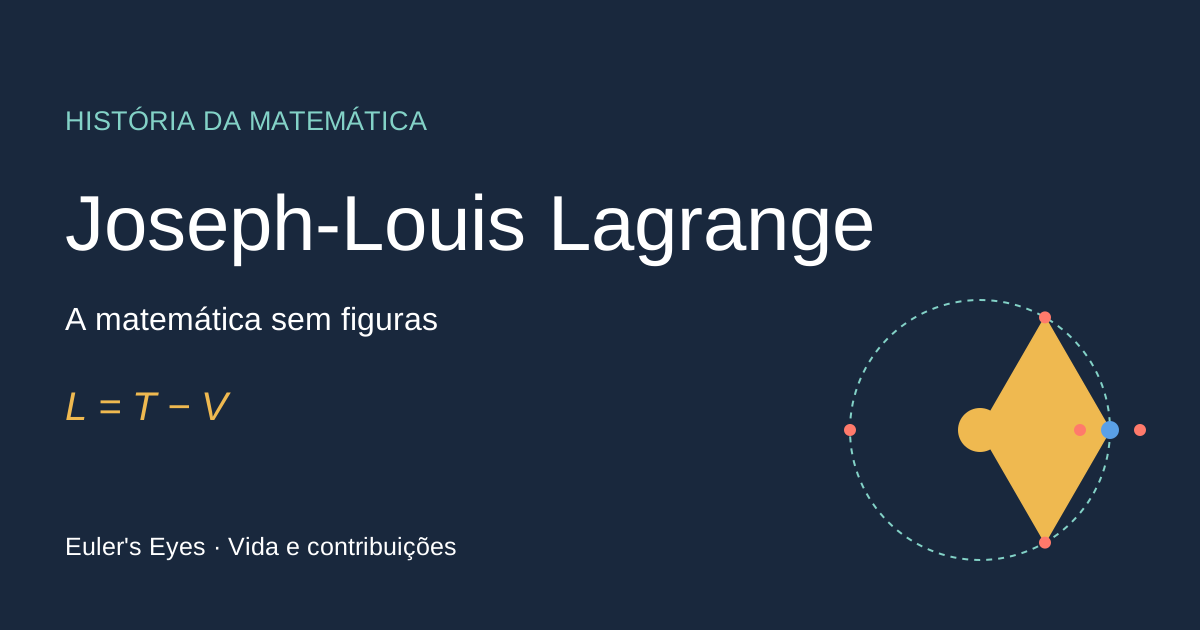
Shuffling the roots: Lagrange's theorem

In 1770 algebra had a problem that had been stuck for more than two centuries. There were formulas for solving equations of degree 2, the quadratic formula, and also of degrees 3 and 4, published by Cardano in 1545. For degree 5, nobody could find anything. The best mathematicians had tried, and every method that worked up to degree 4 jammed at 5. Lagrange did not try yet another method. He asked a different question: why do the old methods work?

October 14, 2026 Read
Hero Image
The legacy of Évariste Galois

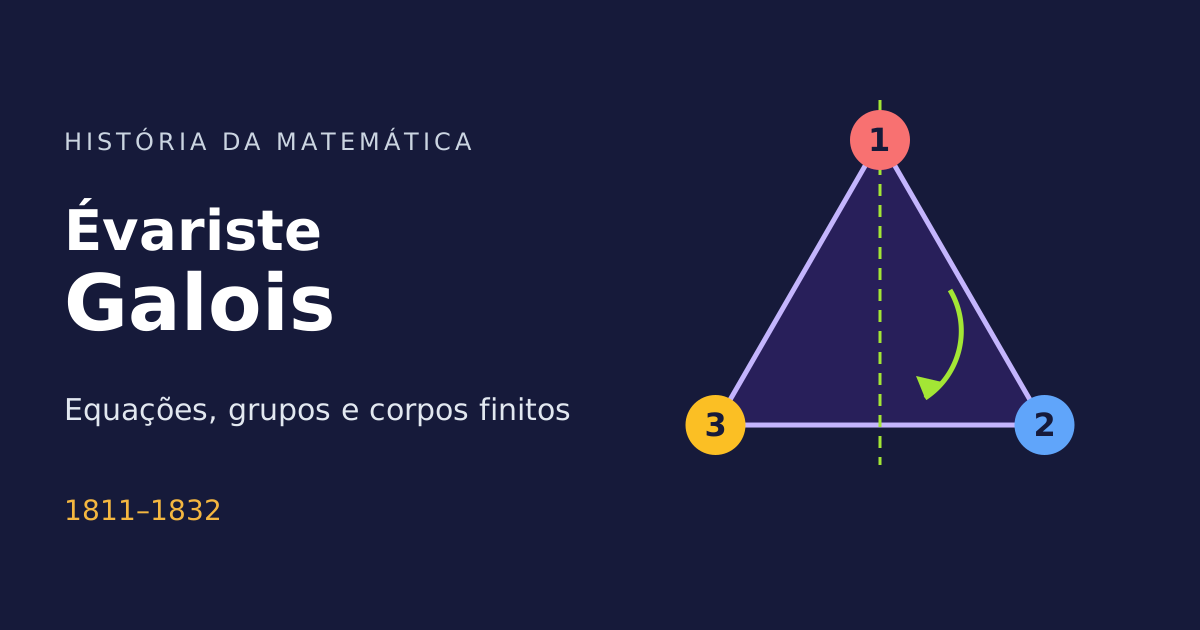
This letter, if judged by the novelty and profundity of ideas it contains, is perhaps the most substantial piece of writing in the whole literature of mankind. — Hermann Weyl, Symmetry (1952) Galois left some sixty pages of mathematics, much of it written in haste. It took half a century for them to be understood. When they were, they changed the very idea of what mathematics is: instead of studying numbers and figures, studying the transformations that leave them unchanged.

October 15, 2026 Read
Hero Image
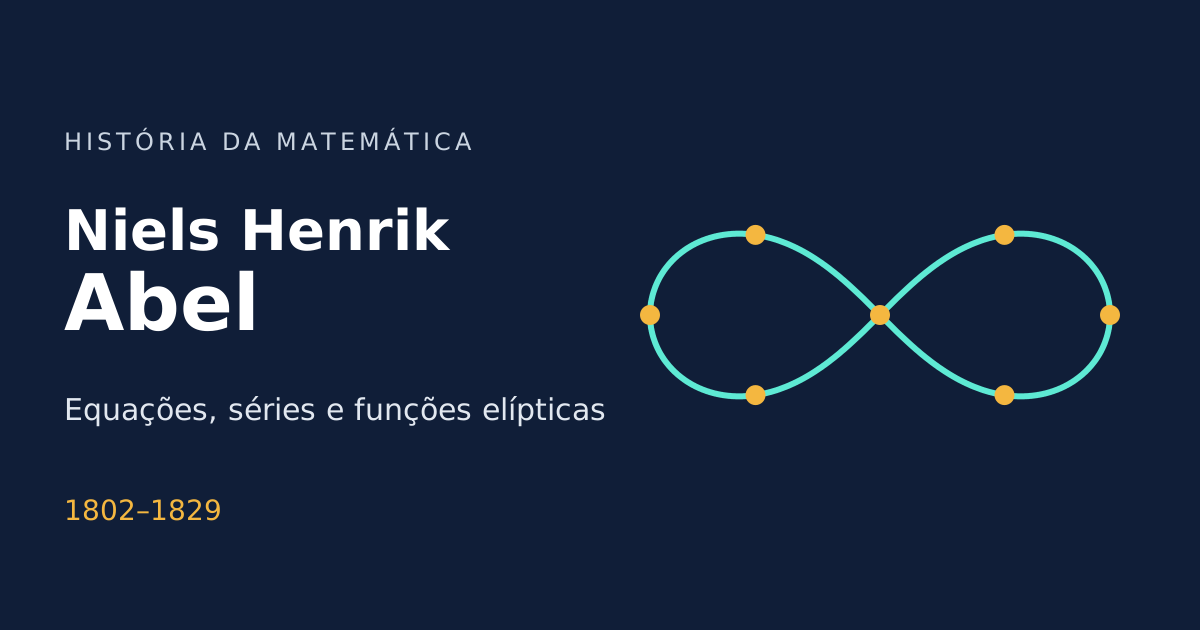
The legacy of Niels Henrik Abel

Abel has left mathematicians enough work for a hundred and fifty years. — Saying attributed to Charles Hermite Abel worked as a mathematician for less than eight years. In that time he settled the oldest question in algebra, brought rigour to series, created elliptic functions and wrote a memoir that was only fully understood decades after his death. His name is now found in more places in mathematics than that of almost anyone else: abelian groups, abelian integrals, abelian functions, abelian varieties, Abel’s theorem, Abel summation, Abel’s test.

October 15, 2026 Read
Hero Image
The derivative without infinitesimals and the mean value theorem

At the end of the eighteenth century, calculus worked very well and nobody could properly explain why. Leibniz’s $dx$ were “infinitely small” quantities: sometimes they were treated as if they were different from zero, so that one could divide by them, and right afterwards as if they were zero, so that one could discard them. Bishop Berkeley had mocked this in 1734, calling them “ghosts of departed quantities”. Lagrange was bothered by it. In 1797 he published a book whose subtitle is a whole programme:

October 14, 2026 Read
Hero Image
Image credits

Historical images and photographs All come from Wikimedia Commons. We use the thumbnails provided by Commons, unedited. Portrait of Abel, drawing by Johan Gørbitz, Paris, 1826: source page · public domain. First volume of Crelle’s Journal, Berlin, 1826: source page · public domain. Abel’s grave at Froland, photo by Karl Ragnar Gjertsen: source page · CC BY 4.0. Abel monument in Oslo, sculpture by Gustav Vigeland, photo by Wolfmann: source page · CC BY-SA 4.0. Blog figures The figure of the lemniscate divided into eight equal arcs is an original illustration. The points were computed with the formula $r=\sqrt{\sqrt2-1}$ derived in the post. The figure has no text and serves every language of the site.

October 15, 2026 Read
Hero Image
Image credits

Historical images and photographs All come from Wikimedia Commons. We use the thumbnails provided by Commons, unedited. Galois at 15, drawing by an unknown artist: source page · public domain. Galois drawn by his brother Alfred, published in 1848: source page · public domain. The letter to Auguste Chevalier, 29 May 1832: source page · public domain. The Louis-le-Grand college, Paris, photo by Celette: source page · CC BY-SA 4.0. Blog figures The figure of the six symmetries of the triangle is an original illustration. The table in the post was checked by a program that composes the permutations of the corners. The figure has no text and serves every language of the site.

October 15, 2026 Read
Hero Image
Lagrange multipliers: optimising under a constraint

Almost every real decision is a maximum or minimum problem with a constraint. A factory wants the greatest profit but has a limited amount of raw material. A can must hold 350 ml using as little aluminium as possible. A pendulum moves however it likes, as long as the bob stays attached to the string. Lagrange found a single method for all these problems. It appears in the Analytical Mechanics of 1788, to deal with the ties of mechanical systems, and in the Theory of Analytic Functions of 1797, as a general rule of calculation.

October 14, 2026 Read
  • ««
  • «
  • 1
  • 2
  • 3
  • 4
  • »
  • »»
Navigation
  • Start here
  • Recent posts
  • About Euler
  • App
  • Privacy
Contact me:
  • hirowat2@gmail.com

Euler's Eyes
© 2021 Euler Eyes.
Powered by Hugo Logo