Logo Euler's Eyes
  • Dark Theme
    Light Theme Dark Theme System Theme
Logo Inverted Logo
  • Tags
  • 1 Phase
  • 1st Phase
  • 2 Phase
  • 2 Phase,
  • 2nd Phase
  • 2° Degree Equation
  • Alan Turing
  • Algebra
  • Algebraic Expressions
  • Analysis
  • Analytic Geometry
  • Analytical Geometry
  • Angle Bisector
  • Angle Measurements
  • Angles
  • Apothem
  • Arc Capable
  • Arc Properties
  • Archimedes
  • Area
  • Arithmetic Progression
  • Artificial Intelligence
  • Axioms and Postulates
  • Basic Concepts of Statistics
  • Bernoulli
  • Bhaskara
  • Binary Numbers
  • Binomial
  • Biography
  • Calculating Machine
  • Calculation
  • Calculus
  • Calculus of Variations
  • Cartesian Plane
  • Cartesian Product of Sets
  • Cauchy
  • Central Angle
  • Centroid
  • Children
  • Circle
  • Circle Area
  • Circumcenter
  • Circumference
  • Circumference Ratio
  • Circumferences
  • Circumscript Segments
  • Classification in Mathematics
  • Combinatorial Analysis
  • Combinatorics
  • Comparison of Angles
  • Complement
  • Complex Numbers
  • Compound Interest
  • Computing
  • Concave Region
  • Congruence
  • Congruence of Triangles
  • Convex Region
  • Correspondence Law
  • Cosine Theorem
  • Count
  • Cryptography
  • Decision Theory
  • Demo
  • Derivative
  • Descartes
  • Diagonals
  • Diamond
  • Differential Equations
  • Dispersion Measures
  • Distance
  • Division
  • Domain and Image
  • Einstein
  • Elasticity
  • Electromagnetism
  • Elementary Descriptive Statistics
  • Elementary School I
  • Elementary School II
  • ENEM 2021
  • ENEM 2022
  • ENEM 2023
  • ENEM 2024
  • ENEM 2025
  • Entrance Exam
  • Equality
  • Equations
  • Equiprobable Events
  • Equivalence Between Sets
  • Equivalence Relations
  • Euclid
  • Euclid's Postulate
  • Euler
  • Euler Project
  • Even Numbers
  • Exercises for Adding Natural Numbers
  • Exponential Function
  • External Angles
  • Fees
  • Fermat
  • Fermat's Last Theorem
  • Financial Mathematics
  • First Degree Equations
  • First Degree Functions
  • Flat
  • Flat Figures
  • Flat Geometry
  • Fractions
  • Function Concept
  • Function Discovery
  • Functions
  • FUVEST 2021
  • FUVEST 2022
  • FUVEST 2023
  • FUVEST 2024
  • FUVEST 2025
  • FUVEST 2026
  • Galois
  • Game Theory
  • Gauss
  • Geometric Constructions
  • Geometric Shapes
  • Geometry
  • Geometry With Natural Numbers
  • Geometry With Sequences of Numbers
  • Golden Segment
  • Graph Reading
  • Graphics
  • Graphs for Integers
  • Gravitation
  • Greatest Common Divisor
  • Group Theory
  • Groups
  • Hamilton
  • Height
  • History of Mathematics
  • Incenter
  • Increases and Discounts
  • Inequalities
  • Inscribable Quadrilateral
  • Inscribed Angle
  • Integral
  • Internal Angles
  • Interval Operations
  • Intervals
  • Introduction
  • Introduction to Angles
  • Introduction to Circumference
  • Introduction to Function Theory
  • Introduction to Geometry
  • Introduction to Integers
  • Introduction to Logarithm Table
  • Introduction to Polygons
  • Introduction to Probability
  • Introduction to Quadrilaterals
  • Introduction to Radiciation
  • Introduction to Rational Numbers
  • Introduction to Real Numbers
  • Introduction to Sets
  • Introduction to Statistics
  • Introduction to Triangles
  • Johann Bernoulli
  • John Napier
  • John Nash
  • Kids
  • Lagrange
  • Language
  • Law of Cosines
  • Law of Sines
  • Least Common Multiple
  • Leibniz
  • Level 1
  • Level 2
  • Level 3
  • Limit
  • Linear Systems
  • Logarithm
  • Logarithm Properties
  • Logarithms
  • Logic
  • Magnification
  • Math Elements
  • Mathematical Biology
  • Mathematical Logic
  • Mathematical Notation
  • Mathematical Programming
  • Mathematics Education
  • Mathematics Elements
  • Mathematics for Children
  • Mathematics for Kids
  • Matrices
  • Maxwell
  • Measure
  • Mechanics
  • Medium Base
  • Metric Relationships
  • Midpoint
  • Modular Function
  • Multiplication
  • Napier
  • Natural Number Subtraction Exercises
  • Newton
  • Niels Henrik Abel
  • Notable Points of the Triangle
  • Notation
  • Notion of Infinity
  • Notions of Probability
  • Nth Root
  • Number And
  • Number Theory
  • Number Π
  • Numbering Systems
  • Numerical Calculation
  • Numerical Methods
  • OBMEP
  • OBMEP 2023
  • Obmep,
  • Odd Numbers
  • Operations With Rational Numbers
  • Operations With Sets
  • Operations With Venn-Euler Diagrams
  • Optics
  • Optimization
  • Orthocenter
  • Parallelism
  • Parallelogram
  • Parallels
  • Partial Derivatives
  • Pascal
  • Pascal's Triangle
  • Peano Axioms
  • Peirce
  • Percentage
  • Percentage Basics
  • Perimeter
  • Perpendicular Bisector
  • Perpendicularity
  • Perpendiculars
  • Philosophy
  • Physical
  • Physics
  • Pi Number
  • Pi Numbers
  • Pitot
  • Plane Geometry
  • Point
  • Point Power
  • Polygons
  • Polynomials
  • Position Measurements
  • Position Relative to the Circumference
  • Postulates
  • Potentiation of Integers
  • Power With Negative Exponent
  • Prime Numbers
  • Primitive Notions
  • Principia
  • Probability
  • Progressions
  • Proof
  • Properties
  • Properties of Polygons
  • Proportion
  • Proportionality
  • Proportions
  • Proportions and Geometry
  • Pure Mathematics
  • Pythagoras Theorem
  • Pythagorean Suits
  • Quadratic Function
  • Quadrilateral
  • Quadrilaterals
  • Quantifier
  • Quantity Analysis
  • Quaternions
  • R Programming
  • Real Numbers
  • Rectangle
  • Rectangle Triangles
  • Reduction
  • Reflection
  • Regions in Planes
  • Regular Polygons
  • Relations
  • Relationship Properties
  • Relativity
  • Rhombus
  • Right Angle
  • Right Triangle
  • Right Triangle Relationships
  • Rule of 3
  • Rule of Three
  • Saussure
  • Segment Angle
  • Semi-Inscribed Angle
  • Semi-Straight
  • Semiotics
  • Sequences
  • Series
  • Set Family
  • Set Partition
  • Set Theory
  • Signal Rule
  • Similarity
  • Similarity of Triangles
  • Simple Interest
  • Sines Theorem
  • Sophie Germain
  • Spatial Geometry
  • Square
  • Square Root
  • Statistic
  • Stewart Ratio
  • Straight
  • Straight Lines
  • Straight Segment
  • Sum of Angles
  • Supplement
  • Symmetry
  • Tangent
  • Thales' Theorem
  • The Number Zero
  • Theorems
  • Trapezium
  • Trapezius
  • Triangle
  • Triangles
  • Triangular Inequality
  • Trigonometry
  • Truth Table
  • Understanding Relationships
  • Vectors
  • Venn-Euler Diagrams
  • Whole Numbers
  • Wiles
  • Women in Mathematics
  • Year 2018
  • Year 2019
  • Year 2021
  • Year 2022
  • Évariste Galois
Hero Image
The derivative without infinitesimals and the mean value theorem

At the end of the eighteenth century, calculus worked very well and nobody could properly explain why. Leibniz’s $dx$ were “infinitely small” quantities: sometimes they were treated as if they were different from zero, so that one could divide by them, and right afterwards as if they were zero, so that one could discard them. Bishop Berkeley had mocked this in 1734, calling them “ghosts of departed quantities”. Lagrange was bothered by it. In 1797 he published a book whose subtitle is a whole programme:

October 14, 2026 Read
Hero Image
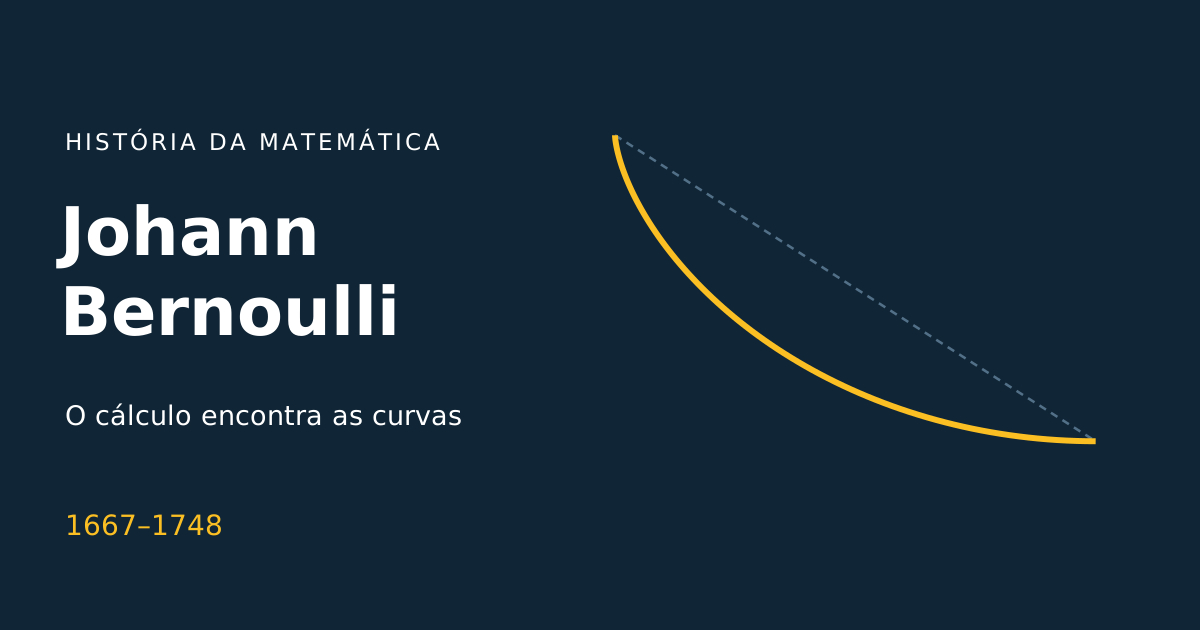
The legacy of Johann Bernoulli

Johann Bernoulli did not write a great book, as his brother wrote the Ars conjectandi or Newton the Principia. His most famous book came out under someone else’s name. What he left was a way of working: turning every problem of physics or geometry into an equation and solving it with Leibniz’s calculus. And he left pupils. Leibniz’s champion In the dispute over who had invented the calculus, Newton or Leibniz, Johann was the most combative soldier on Leibniz’s side. When the Royal Society, presided over by Newton, published at the beginning of 1713 a report giving priority to Newton, Leibniz replied with an anonymous broadsheet, the Charta volans, which quoted the judgement of “an eminent mathematician”: it was Johann. In the years that followed, Johann challenged the English mathematicians with hard problems, which he thought impossible with Newton’s method. Leibniz died in 1716, and Johann carried on the fight alone for years. The dispute cut English mathematics off from that of the Continent for almost a century.
October 14, 2026 Read
Hero Image
Image credits

Historical images All come from Wikimedia Commons. We use the thumbnails provided by Commons, unedited. Portrait of Johann Bernoulli, engraving in the Rijksmuseum collection: source page · CC0. Portrait of Guillaume de l’Hôpital: source page · public domain. Title page of the Analyse des infiniment petits, Paris, 1696: source page · public domain. Portrait of Daniel Bernoulli, engraving by Johann Jakob Haid after Johann Rudolf Huber: source page · public domain. The chain and the arch, drawings by Giovanni Poleni, Memorie istoriche della gran cupola del Tempio Vaticano, 1748: source page · public domain. Blog figures The cover and the diagram of the cycloid and the straight line between the same points are original illustrations, with versions in each of the site’s languages. The diagram is to scale: both axes use the same unit. The table of function notations, in the post on the legacy, was redone from a table in this site’s old course on functions.

October 14, 2026 Read
Hero Image
Lagrange multipliers: optimising under a constraint

Almost every real decision is a maximum or minimum problem with a constraint. A factory wants the greatest profit but has a limited amount of raw material. A can must hold 350 ml using as little aluminium as possible. A pendulum moves however it likes, as long as the bob stays attached to the string. Lagrange found a single method for all these problems. It appears in the Analytical Mechanics of 1788, to deal with the ties of mechanical systems, and in the Theory of Analytic Functions of 1797, as a general rule of calculation.

October 14, 2026 Read
Hero Image
Lagrange's legacy

Lagrange is the lofty pyramid of the mathematical sciences. — Napoleon Bonaparte, according to his contemporaries Lagrange left no anecdotes of precocious genius like Pascal, nor a body of work the size of Euler’s. He left something else: a way of doing mathematics. Where others drew, he calculated; where others found a trick for each problem, he looked for the rule that explained all the tricks. Almost everything he did is still in the textbooks under his name: the Euler–Lagrange equation, the Lagrangian, the Lagrange points, Lagrange’s theorem, the Lagrange remainder, Lagrange multipliers.

October 14, 2026 Read
Hero Image
Image credits for Lagrange

Historical images All come from Wikimedia Commons. We use the thumbnails provided by Commons, unedited. Portrait of Joseph-Louis Lagrange, engraving by an unknown artist: source page · public domain. Medallion with Lagrange’s profile, bronze by Pierre-Jean David d’Angers, Musées d’Angers: source page · CC0. Title page of the Méchanique analitique, Paris, 1788: source page · public domain. Statue of Lagrange in Turin, photo by Twice25, 2009: source page · CC BY-SA 3.0. Blog figures The cover, the diagram of the five Lagrange points and the graph of curves of equal area with the constraint line are original illustrations, with versions in each of the site’s languages. The diagram of the points is not to scale: L1 and L2 are in reality a hundred times closer to the Earth than the Sun is.

October 14, 2026 Read
  • ««
  • «
  • 1
  • 2
  • »
  • »»
Navigation
  • Start here
  • Recent posts
  • About Euler
  • App
  • Privacy
Contact me:
  • hirowat2@gmail.com

Euler's Eyes
© 2021 Euler Eyes.
Powered by Hugo Logo