Logo Euler's Eyes
  • Dark Theme
    Light Theme Dark Theme System Theme
Logo Inverted Logo
  • Tags
  • 1 Phase
  • 1st Phase
  • 2 Phase
  • 2 Phase,
  • 2nd Phase
  • 2° Degree Equation
  • Alan Turing
  • Algebra
  • Algebraic Expressions
  • Analysis
  • Analytic Geometry
  • Analytical Geometry
  • Angle Bisector
  • Angle Measurements
  • Angles
  • Apothem
  • Arc Capable
  • Arc Properties
  • Archimedes
  • Area
  • Arithmetic Progression
  • Artificial Intelligence
  • Axioms and Postulates
  • Basic Concepts of Statistics
  • Bernoulli
  • Bhaskara
  • Binary Numbers
  • Binomial
  • Biography
  • Calculating Machine
  • Calculation
  • Calculus
  • Calculus of Variations
  • Cartesian Plane
  • Cartesian Product of Sets
  • Cauchy
  • Central Angle
  • Centroid
  • Children
  • Circle
  • Circle Area
  • Circumcenter
  • Circumference
  • Circumference Ratio
  • Circumferences
  • Circumscript Segments
  • Classification in Mathematics
  • Combinatorial Analysis
  • Combinatorics
  • Comparison of Angles
  • Complement
  • Complex Numbers
  • Compound Interest
  • Computing
  • Concave Region
  • Congruence
  • Congruence of Triangles
  • Convex Region
  • Correspondence Law
  • Cosine Theorem
  • Count
  • Cryptography
  • Decision Theory
  • Demo
  • Derivative
  • Descartes
  • Diagonals
  • Diamond
  • Differential Equations
  • Dispersion Measures
  • Distance
  • Division
  • Domain and Image
  • Einstein
  • Elasticity
  • Electromagnetism
  • Elementary Descriptive Statistics
  • Elementary School I
  • Elementary School II
  • ENEM 2021
  • ENEM 2022
  • ENEM 2023
  • ENEM 2024
  • ENEM 2025
  • Entrance Exam
  • Equality
  • Equations
  • Equiprobable Events
  • Equivalence Between Sets
  • Equivalence Relations
  • Euclid
  • Euclid's Postulate
  • Euler
  • Euler Project
  • Even Numbers
  • Exercises for Adding Natural Numbers
  • Exponential Function
  • External Angles
  • Fees
  • Fermat
  • Fermat's Last Theorem
  • Financial Mathematics
  • First Degree Equations
  • First Degree Functions
  • Flat
  • Flat Figures
  • Flat Geometry
  • Fractions
  • Function Concept
  • Function Discovery
  • Functions
  • FUVEST 2021
  • FUVEST 2022
  • FUVEST 2023
  • FUVEST 2024
  • FUVEST 2025
  • FUVEST 2026
  • Galois
  • Game Theory
  • Gauss
  • Geometric Constructions
  • Geometric Shapes
  • Geometry
  • Geometry With Natural Numbers
  • Geometry With Sequences of Numbers
  • Golden Segment
  • Graph Reading
  • Graphics
  • Graphs for Integers
  • Gravitation
  • Greatest Common Divisor
  • Group Theory
  • Groups
  • Hamilton
  • Height
  • History of Mathematics
  • Incenter
  • Increases and Discounts
  • Inequalities
  • Inscribable Quadrilateral
  • Inscribed Angle
  • Integral
  • Internal Angles
  • Interval Operations
  • Intervals
  • Introduction
  • Introduction to Angles
  • Introduction to Circumference
  • Introduction to Function Theory
  • Introduction to Geometry
  • Introduction to Integers
  • Introduction to Logarithm Table
  • Introduction to Polygons
  • Introduction to Probability
  • Introduction to Quadrilaterals
  • Introduction to Radiciation
  • Introduction to Rational Numbers
  • Introduction to Real Numbers
  • Introduction to Sets
  • Introduction to Statistics
  • Introduction to Triangles
  • Johann Bernoulli
  • John Napier
  • John Nash
  • Kids
  • Lagrange
  • Language
  • Law of Cosines
  • Law of Sines
  • Least Common Multiple
  • Leibniz
  • Level 1
  • Level 2
  • Level 3
  • Limit
  • Linear Systems
  • Logarithm
  • Logarithm Properties
  • Logarithms
  • Logic
  • Magnification
  • Math Elements
  • Mathematical Biology
  • Mathematical Logic
  • Mathematical Notation
  • Mathematical Programming
  • Mathematics Education
  • Mathematics Elements
  • Mathematics for Children
  • Mathematics for Kids
  • Matrices
  • Maxwell
  • Measure
  • Mechanics
  • Medium Base
  • Metric Relationships
  • Midpoint
  • Modular Function
  • Multiplication
  • Napier
  • Natural Number Subtraction Exercises
  • Newton
  • Niels Henrik Abel
  • Notable Points of the Triangle
  • Notation
  • Notion of Infinity
  • Notions of Probability
  • Nth Root
  • Number And
  • Number Theory
  • Number Π
  • Numbering Systems
  • Numerical Calculation
  • Numerical Methods
  • OBMEP
  • OBMEP 2023
  • Obmep,
  • Odd Numbers
  • Operations With Rational Numbers
  • Operations With Sets
  • Operations With Venn-Euler Diagrams
  • Optics
  • Optimization
  • Orthocenter
  • Parallelism
  • Parallelogram
  • Parallels
  • Partial Derivatives
  • Pascal
  • Pascal's Triangle
  • Peano Axioms
  • Peirce
  • Percentage
  • Percentage Basics
  • Perimeter
  • Perpendicular Bisector
  • Perpendicularity
  • Perpendiculars
  • Philosophy
  • Physical
  • Physics
  • Pi Number
  • Pi Numbers
  • Pitot
  • Plane Geometry
  • Point
  • Point Power
  • Polygons
  • Polynomials
  • Position Measurements
  • Position Relative to the Circumference
  • Postulates
  • Potentiation of Integers
  • Power With Negative Exponent
  • Prime Numbers
  • Primitive Notions
  • Principia
  • Probability
  • Progressions
  • Proof
  • Properties
  • Properties of Polygons
  • Proportion
  • Proportionality
  • Proportions
  • Proportions and Geometry
  • Pure Mathematics
  • Pythagoras Theorem
  • Pythagorean Suits
  • Quadratic Function
  • Quadrilateral
  • Quadrilaterals
  • Quantifier
  • Quantity Analysis
  • Quaternions
  • R Programming
  • Real Numbers
  • Rectangle
  • Rectangle Triangles
  • Reduction
  • Reflection
  • Regions in Planes
  • Regular Polygons
  • Relations
  • Relationship Properties
  • Relativity
  • Rhombus
  • Right Angle
  • Right Triangle
  • Right Triangle Relationships
  • Rule of 3
  • Rule of Three
  • Saussure
  • Segment Angle
  • Semi-Inscribed Angle
  • Semi-Straight
  • Semiotics
  • Sequences
  • Series
  • Set Family
  • Set Partition
  • Set Theory
  • Signal Rule
  • Similarity
  • Similarity of Triangles
  • Simple Interest
  • Sines Theorem
  • Sophie Germain
  • Spatial Geometry
  • Square
  • Square Root
  • Statistic
  • Stewart Ratio
  • Straight
  • Straight Lines
  • Straight Segment
  • Sum of Angles
  • Supplement
  • Symmetry
  • Tangent
  • Thales' Theorem
  • The Number Zero
  • Theorems
  • Trapezium
  • Trapezius
  • Triangle
  • Triangles
  • Triangular Inequality
  • Trigonometry
  • Truth Table
  • Understanding Relationships
  • Vectors
  • Venn-Euler Diagrams
  • Whole Numbers
  • Wiles
  • Women in Mathematics
  • Year 2018
  • Year 2019
  • Year 2021
  • Year 2022
  • Évariste Galois
Hero Image
The legacy of Niels Henrik Abel

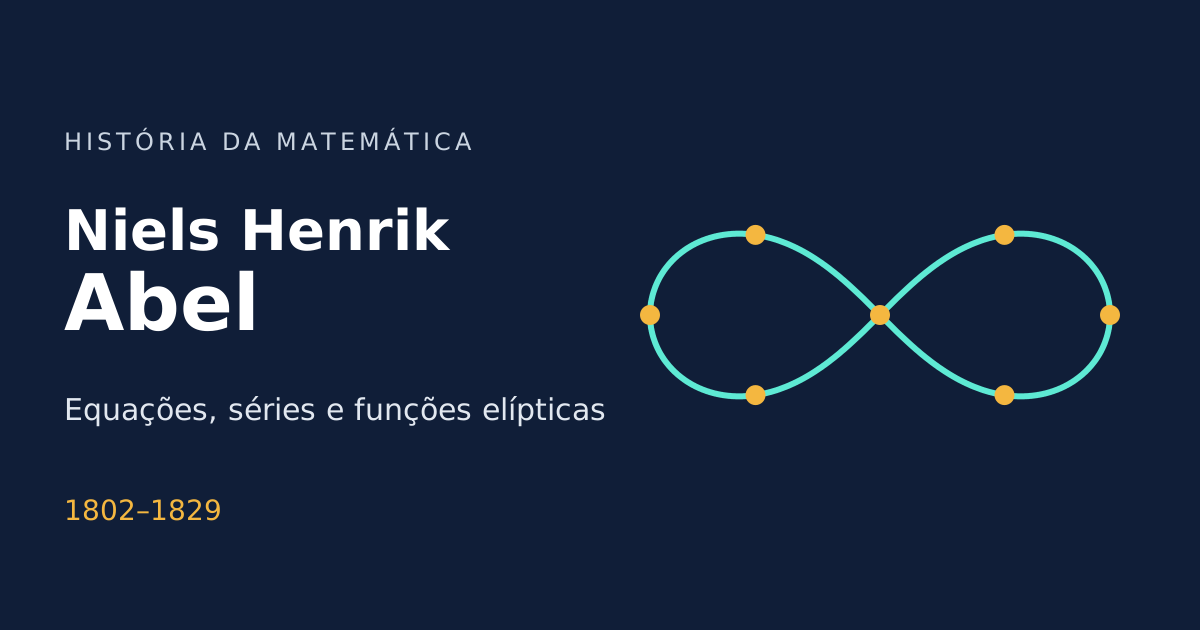
Abel has left mathematicians enough work for a hundred and fifty years. — Saying attributed to Charles Hermite Abel worked as a mathematician for less than eight years. In that time he settled the oldest question in algebra, brought rigour to series, created elliptic functions and wrote a memoir that was only fully understood decades after his death. His name is now found in more places in mathematics than that of almost anyone else: abelian groups, abelian integrals, abelian functions, abelian varieties, Abel’s theorem, Abel summation, Abel’s test.

October 15, 2026 Read
Hero Image
The heat equation and the regularity of De Giorgi and Nash

In 1900, at the International Congress of Mathematicians in Paris, David Hilbert presented a list of 23 problems that, in his view, would guide twentieth-century mathematics. Problem 19 asked, in simple terms: are the solutions of the “well-behaved” problems of the calculus of variations always smooth functions? Half a century later, the question was still open for an important class of equations. In 1956 Nash heard about it from a colleague and decided to attack it.

October 14, 2026 Read
Hero Image
Image credits

Historical images and photographs All come from Wikimedia Commons. We use the thumbnails provided by Commons, unedited. Portrait of Abel, drawing by Johan Gørbitz, Paris, 1826: source page · public domain. First volume of Crelle’s Journal, Berlin, 1826: source page · public domain. Abel’s grave at Froland, photo by Karl Ragnar Gjertsen: source page · CC BY 4.0. Abel monument in Oslo, sculpture by Gustav Vigeland, photo by Wolfmann: source page · CC BY-SA 4.0. Blog figures The figure of the lemniscate divided into eight equal arcs is an original illustration. The points were computed with the formula $r=\sqrt{\sqrt2-1}$ derived in the post. The figure has no text and serves every language of the site.
October 15, 2026 Read
Hero Image
The legacy of John Nash

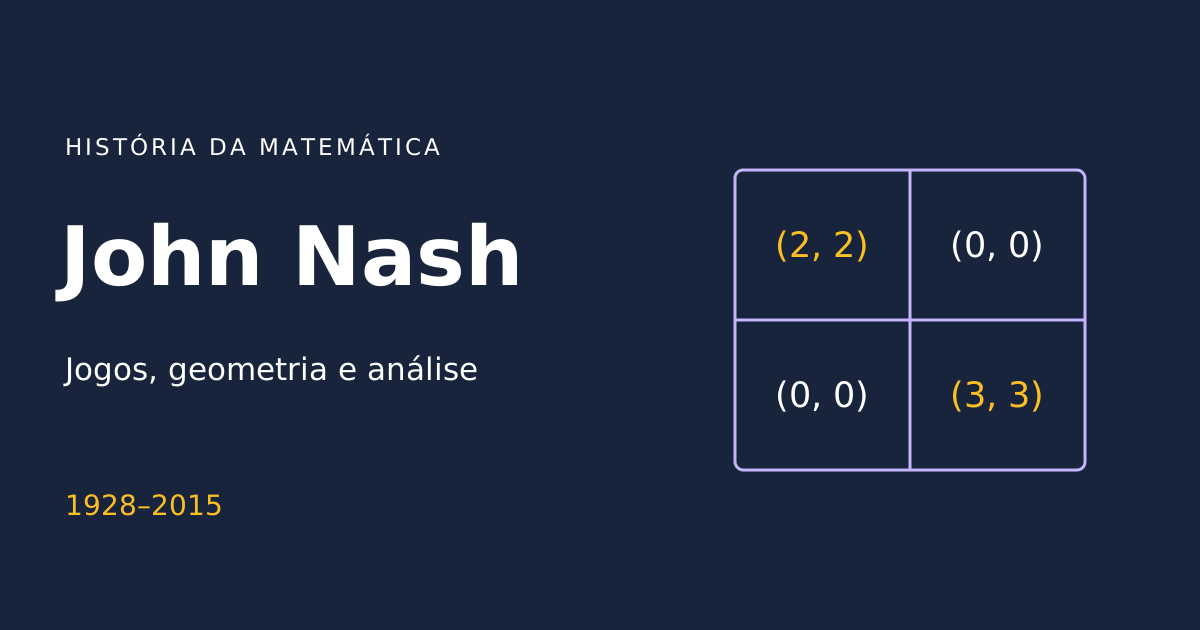
Statistically, it would seem improbable that any mathematician or scientist, at the age of 66, would be able through continued research efforts, to add much to his or her previous achievements. However I am still making the effort. — John Nash, autobiographical note for the Nobel Foundation (1994) John Nash is the only person to have received both the Nobel Prize and the Abel Prize, the two highest honours in economics and in mathematics. The two halves of his work seem to have nothing in common: one is about human decisions, the other about surfaces and equations. What unites them is the style: attacking problems everyone thought impossible with ideas nobody had had.

October 14, 2026 Read
Hero Image
Image credits

Photographs and images All come from Wikimedia Commons. We use the thumbnails provided by Commons, unedited. Portrait of John Nash, photo by Peter Badge: source page · CC BY-SA 3.0. John Nash in 2006, in Cologne, photo by Elke Wetzig: source page · CC BY-SA 3.0. Isometric embedding of the flat torus, Hevea project, uploaded by Romainbehar: source page · CC0. Blog figures The cover, the Hex board and the graph of the product of gains in bargaining are original illustrations, with versions in each language of the site. The board shows an invented game, in which red has completed its chain.

October 14, 2026 Read
  • ««
  • «
  • 1
  • 2
  • »
  • »»
Navigation
  • Start here
  • Recent posts
  • About Euler
  • App
  • Privacy
Contact me:
  • hirowat2@gmail.com

Euler's Eyes
© 2021 Euler Eyes.
Powered by Hugo Logo